Albumin Blood Test: Normal Range, Low Levels and Significance
Reviewed by the LabReadAI medical team
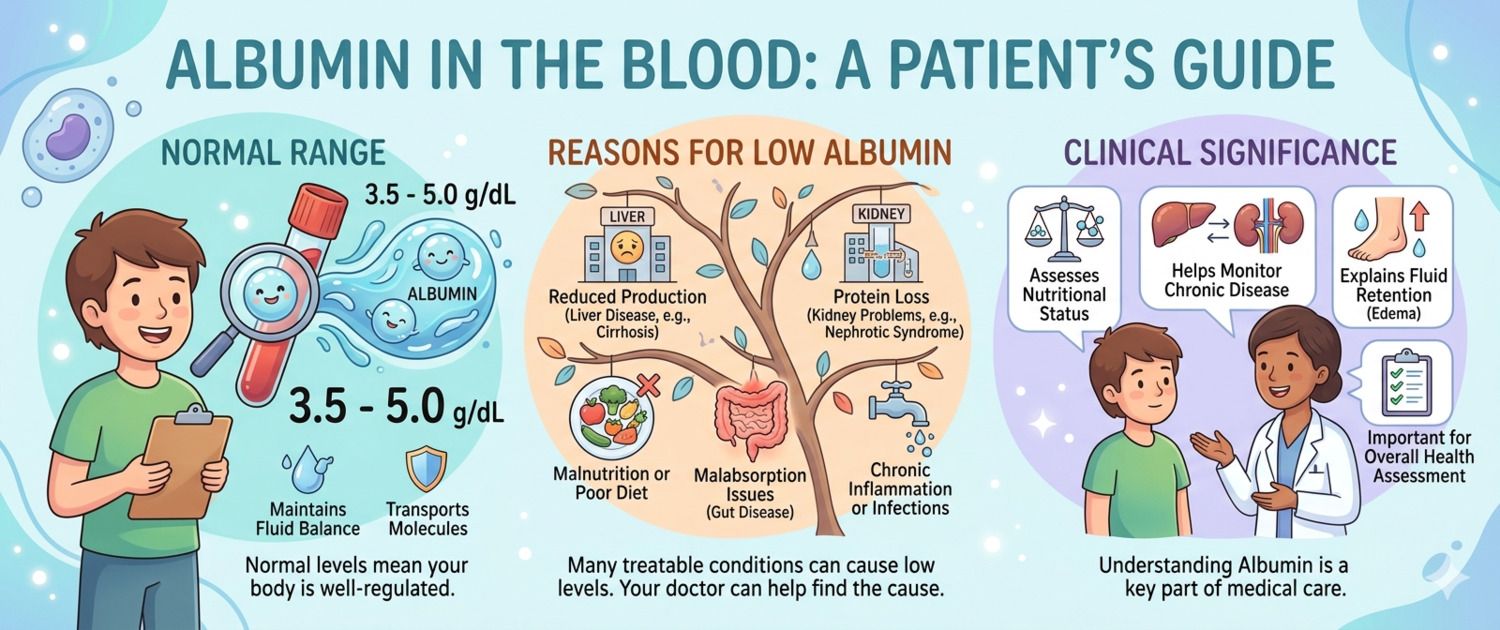
Albumin is the most abundant protein in blood plasma — and its reduction is seen in biochemistry panels far more often than its elevation. This is because albumin is a negative acute-phase protein: during any inflammation, physiological stress, or liver disease, the liver reduces albumin synthesis. This is exactly why low albumin has become one of the most important prognostic markers in clinical medicine: it simultaneously reflects nutritional status, liver function, and the intensity of the inflammatory response.
What Is Albumin and What Does It Do
Albumin is synthesised exclusively in the liver — approximately 10–15 g per day in a healthy adult. It makes up around 55–65% of all plasma protein. The albumin molecule is small, crosses capillaries freely, but under normal conditions is retained by the negative charge of glomerular capillary walls.
Albumin performs three fundamentally different roles simultaneously:
1. Oncotic pressure. Albumin is the primary creator of colloid osmotic (oncotic) pressure in plasma. It is what "holds" water inside blood vessels, preventing it from leaking into the tissues. When albumin falls, oncotic pressure drops — fluid escapes into the interstitial space and oedema develops. Classic locations: legs, abdomen (ascites), pleural cavity. This explains why oedema in liver cirrhosis or nephrotic syndrome is so difficult to treat.
2. Transport function. Albumin is a universal carrier in the bloodstream. It transports fatty acids, bilirubin (in its unconjugated form), calcium, magnesium, zinc, copper, thyroid hormones, and drugs — particularly warfarin, digoxin, NSAIDs, and statins. When albumin is low, the free (unbound) fractions of drugs increase, altering both their efficacy and toxicity.
3. Nutritional status. Albumin level has traditionally been used as a marker of protein-energy malnutrition. It falls with prolonged fasting, malabsorption, and malignancy. However, there is a limitation: albumin has a long half-life (~21 days), making it a poor marker of acute nutritional changes — but a reliable indicator of chronic depletion.
Normal Albumin Values
| Group | Normal Range (g/L) |
|---|---|
| Adults | 35–52 |
| Children under 3 | 25–55 |
| Children 3–14 | 38–54 |
| Pregnant — 1st trimester | 31–51 |
| Pregnant — 2nd–3rd trimester | 26–45 |
In pregnancy, albumin physiologically falls due to increased plasma volume (haemodilution) and higher foetal demand. Values of 28–32 g/L in the second and third trimester may be normal.
Reference ranges differ slightly between laboratories. Always use the values on your specific report.
Why Is Albumin Low? Hypoalbuminaemia
Albumin below 35 g/L is hypoalbuminaemia. Causes fall into four groups.
Reduced synthesis (liver disease): The liver is the only organ that synthesises albumin. Cirrhosis, severe chronic hepatitis, acute liver failure — albumin falls predictably alongside other synthetic markers: prothrombin time (coagulation panel), cholinesterase. In severe cirrhosis, albumin below 25 g/L is a sign of marked decompensation. Together with ALT, AST, GGT, and bilirubin, albumin is part of the full liver function assessment in the liver function panel.
Protein loss (nephrotic syndrome): In nephrotic syndrome, the glomerular filtration barrier fails — protein leaks into urine. Urinary albumin (proteinuria) in severe nephrotic syndrome can exceed 3–5 g per day. Blood albumin falls, oncotic pressure drops — massive oedema, ascites, pleural effusion develop. Simultaneously, creatinine rises and eGFR falls on kidney function testing.
Reduced synthesis as acute-phase response: This is the most common cause of moderate albumin reduction in clinical practice. During any inflammation, infection, or malignancy, cytokines (IL-6) reduce albumin synthesis in favour of acute-phase proteins (CRP, fibrinogen). This is not depletion — it is a reallocation of hepatic synthetic priorities. This is why albumin and CRP are "mirror" markers: as CRP rises, albumin falls.
Reduced protein intake: Prolonged fasting, malabsorption (coeliac disease, Crohn's disease), oncological cachexia — insufficient substrate for albumin synthesis. Here albumin falls slowly (due to its long half-life) but reliably reflects chronic depletion.
Why Is Albumin High?
True hyperalbuminaemia (albumin above 52 g/L) is essentially not seen in practice. The only real cause is haemoconcentration from severe dehydration: plasma volume falls and albumin concentration rises. Once fluid is replaced, albumin normalises. In this situation, haematocrit and creatinine rise in parallel.
Clinical Significance of Albumin Levels
| Albumin Level | Interpretation |
|---|---|
| 35–52 g/L | Normal |
| 28–34 g/L | Mild hypoalbuminaemia |
| 21–27 g/L | Significant hypoalbuminaemia, high complication risk |
| < 21 g/L | Severe hypoalbuminaemia, critical state |
Albumin below 25 g/L is an independent predictor of in-hospital mortality, prolonged length of stay, and post-surgical complications. This is why it features in most clinical severity scores (APACHE, SOFA, NRS-2002 for nutritional risk).
How to Prepare for the Test
Albumin is measured in a biochemistry blood panel. Blood is drawn fasting after 8 hours.
Important factors affecting interpretation: body position (lying down lowers albumin by 3–8% versus standing, due to fluid redistribution), tourniquet time (a prolonged tourniquet causes haemoconcentration that artificially elevates albumin), acute illness (lowers albumin through the acute-phase response).
For complete liver function assessment, albumin is read alongside ALT, AST, GGT, bilirubin, and prothrombin time — within the liver function panel. When nephrotic syndrome is suspected — simultaneously with creatinine and urine protein testing.
When to See a Doctor
Schedule a routine appointment with a GP or gastroenterologist if:
- Albumin is below 35 g/L on repeat testing without pregnancy or acute illness.
- Low albumin is accompanied by oedema, ascites, or pleural effusion.
- Albumin is declining on serial testing during treatment.
Seek immediate attention for rapidly developing oedema — particularly ascites — which may indicate acute decompensation of cirrhosis or nephrotic syndrome.
Conclusion
Albumin is a unique marker reflecting three aspects of the body's condition simultaneously: hepatic synthetic function, renal protein losses, and nutritional status. Its reduction is almost always clinically meaningful — whether from an acute-phase response, liver disease, renal loss, or chronic depletion. As a "mirror" of CRP, it helps the clinician understand the nature of hypoalbuminaemia: when CRP is high and albumin is low — this is inflammation, not starvation.
This article is for informational purposes only. Interpreting test results and prescribing treatment is exclusively the responsibility of a physician.
For informational purposes only
This article is for informational purposes only and does not constitute medical advice, diagnosis, or treatment. Please consult a healthcare professional for medical guidance.