High AST Levels: Normal Range, Causes and Key Differences from ALT
Reviewed by the LabReadAI medical team
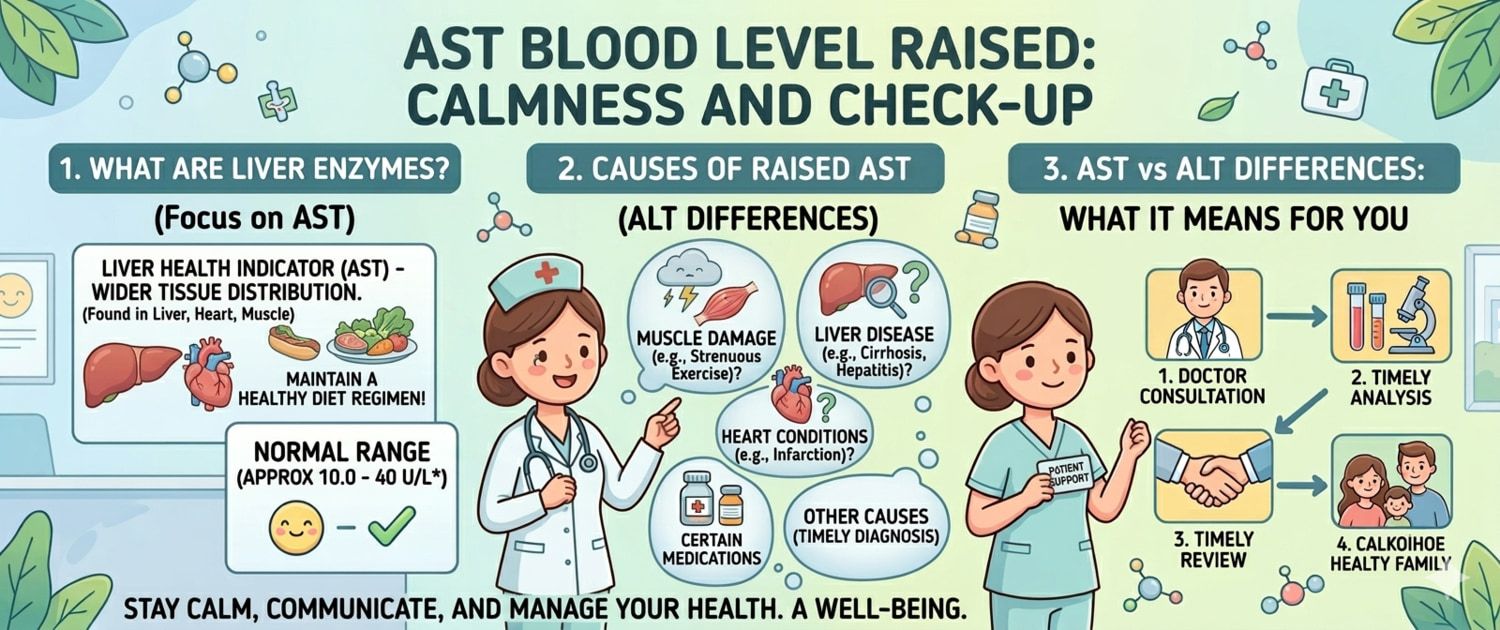
In a biochemical blood panel, AST and ALT almost always appear side by side — and many people treat them as interchangeable. They're not. While ALT points mainly at the liver, AST watches over the heart and muscles as well, which makes it a broader and in some ways more complex marker to interpret. Here's what aspartate aminotransferase is, what counts as a normal result, why the enzyme rises or falls, and when an elevated AST means you should call emergency services rather than book a routine appointment.
What Is AST and How Does It Differ from ALT
AST, or aspartate aminotransferase, is an enzyme involved in amino acid metabolism. Unlike ALT, which is concentrated mainly in the liver, AST is present in meaningful quantities across several tissues simultaneously: the heart muscle, skeletal muscle, liver, kidneys, and brain.
This breadth is what defines its diagnostic character. An isolated rise in ALT almost certainly points to the liver. A rise in AST is a wider signal — it tells you cells are being damaged somewhere, but it doesn't say which organ. To find out, you need to look at both enzymes together and calculate their ratio.
Under normal conditions, AST stays inside cells and barely enters the bloodstream. When any of these tissues are damaged — by inflammation, toxins, loss of blood supply, or physical trauma — the enzyme leaks out and circulates at elevated levels. On lab reports it appears as AST or ASAT.
Normal AST Levels by Sex and Age
AST reference ranges depend on sex and age. Men have a slightly higher upper limit due to greater muscle mass. Infants under one year show considerably higher values than adults — this is physiological and reflects rapid growth and organ development.
| Group | Normal Range (U/L) |
|---|---|
| Men | up to 40 |
| Women | up to 32 |
| Pregnant women | up to 32 |
| Children under 1 year | up to 58 |
| Children 1–14 years | up to 44 |
Reference ranges can differ slightly between laboratories depending on the measurement method. Always use the ranges printed on your specific lab report.
Why Is AST High? Heart, Liver or Muscles
The defining feature of AST is that it responds to several organs at once, and the degree of elevation helps orient the search for a cause.
Myocardial infarction was historically one of the first laboratory markers of acute cardiac damage. When heart muscle cells die, AST begins rising within six to twelve hours of the event, peaks around the end of the first day, and normalises over three to five days. Modern cardiology relies on more sensitive markers — troponin and CK-MB — but AST remains part of the standard cardiac workup. A high AST alongside chest pain is a reason to call emergency services, not schedule a clinic appointment. More on the clinical picture in the article on myocardial infarction.
Liver disease raises AST alongside ALT, but usually to a lesser degree. The exception is alcoholic liver disease, where AST frequently exceeds ALT — and this asymmetry is precisely what the de Ritis ratio captures. Viral hepatitis, cirrhosis, fatty liver disease, and toxic or drug-induced liver injury all elevate both enzymes simultaneously.
Skeletal muscle damage — rhabdomyolysis from severe trauma, crush injury, prolonged immobilisation, or intense exercise, and inflammatory myositis — produces a moderate AST rise with a normal or only mildly elevated ALT. This is why strenuous activity should be avoided for twenty-four hours before testing: an ordinary gym session is enough to distort the result in an otherwise healthy person.
Other causes include chronic heart failure with circulatory congestion, pulmonary embolism, and medications — statins, antibiotics, antifungal drugs — which can raise AST without underlying disease.
Why Is AST Low? When It Actually Matters
Low AST is an uncommon finding and in most cases needs no treatment on its own.
The most frequent explanation is vitamin B6 (pyridoxine) deficiency. B6 is a coenzyme that aspartate aminotransferase cannot function without — when B6 is depleted through poor nutrition, chronic alcohol use, or certain medications (isoniazid, penicillamine), AST production falls.
End-stage liver cirrhosis creates a counterintuitive picture: when almost no hepatocytes remain, there is nothing left to produce the enzyme. A normal or low AST in the setting of clinical liver failure is a warning sign, not reassurance. Severe kidney failure disrupts overall metabolism and can suppress the activity of multiple enzymes, including AST.
The De Ritis Ratio: How to Read AST and ALT Together
Interpreting AST without ALT is like reading only half of a sentence. Their ratio — the de Ritis ratio (AST/ALT) — is what narrows the differential.
| De Ritis Ratio | Most Likely Cause |
|---|---|
| Below 1 | Liver disease: viral hepatitis, fatty liver |
| 1–2 | Non-specific; further testing needed |
| Above 2 | Alcoholic liver disease or cardiac/muscle damage |
The calculation is straightforward: divide your AST value by your ALT value from the same report. For example, AST = 80, ALT = 35 gives a ratio of 2.3 — pointing toward alcohol or the heart rather than a primary liver condition.
For a complete assessment, AST and ALT are supplemented with alkaline phosphatase, GGT, and bilirubin when liver disease is suspected, or with troponin and CK-MB when cardiac involvement is on the table. A complete blood count helps establish the inflammatory background and rule out systemic causes that might be driving the enzyme changes. For a comprehensive liver assessment, the full liver function panel is the most practical approach.
How to Prepare for an AST Blood Test
Preparation is straightforward but matters: failing to follow the rules is one of the most common reasons for a falsely elevated result.
Blood is drawn fasting — after eight to twelve hours without food. Alcohol and intense physical activity should be avoided for twenty-four hours beforehand: muscle exertion breaks down myofibrils and raises AST even in a perfectly healthy person. No smoking for thirty minutes before the draw.
Tell your doctor about all medications you're taking. Statins, antibiotics, antifungals, and pain relievers can all elevate AST independently of any disease. The doctor will either factor this in during interpretation or recommend temporarily pausing the medication before the test.
When to Seek Urgent Medical Attention
Call emergency services immediately if high AST is accompanied by:
- Chest pain or pressure, especially radiating to the arm, jaw, or back.
- Shortness of breath, sudden severe weakness, or cold sweating.
- Rapid heartbeat or palpitations.
These may be signs of an acute coronary event. Every minute matters.
Schedule a routine appointment with a GP if:
- AST exceeds the upper limit of normal by more than twice, even without symptoms.
- AST is elevated alongside ALT and you have signs of liver involvement: jaundice, right upper abdominal discomfort, dark urine.
- Elevation is confirmed on a repeat test one to two weeks later.
Conclusion
AST is a versatile marker of cellular damage that keeps watch over the heart, muscles, and liver simultaneously. Its real diagnostic power emerges only when read alongside ALT: their ratio steers the clinical search in the right direction before any additional tests are ordered. Interpreting AST in isolation risks missing an important signal — or raising a false alarm over a result that reflects nothing more than yesterday's workout.
The enzyme pair is completed by the third member of the liver triad — the pigment that speaks not of cell damage but of organ function and bile flow. What high bilirubin levels warn about when AST is raised, and why it matters which fraction went up, is covered in a separate article.
This article is for informational purposes only. Interpreting test results and prescribing treatment is exclusively the responsibility of a physician.
For informational purposes only
This article is for informational purposes only and does not constitute medical advice, diagnosis, or treatment. Please consult a healthcare professional for medical guidance.