GGT Blood Test: Normal Levels, Causes and Interpretation
Reviewed by the LabReadAI medical team
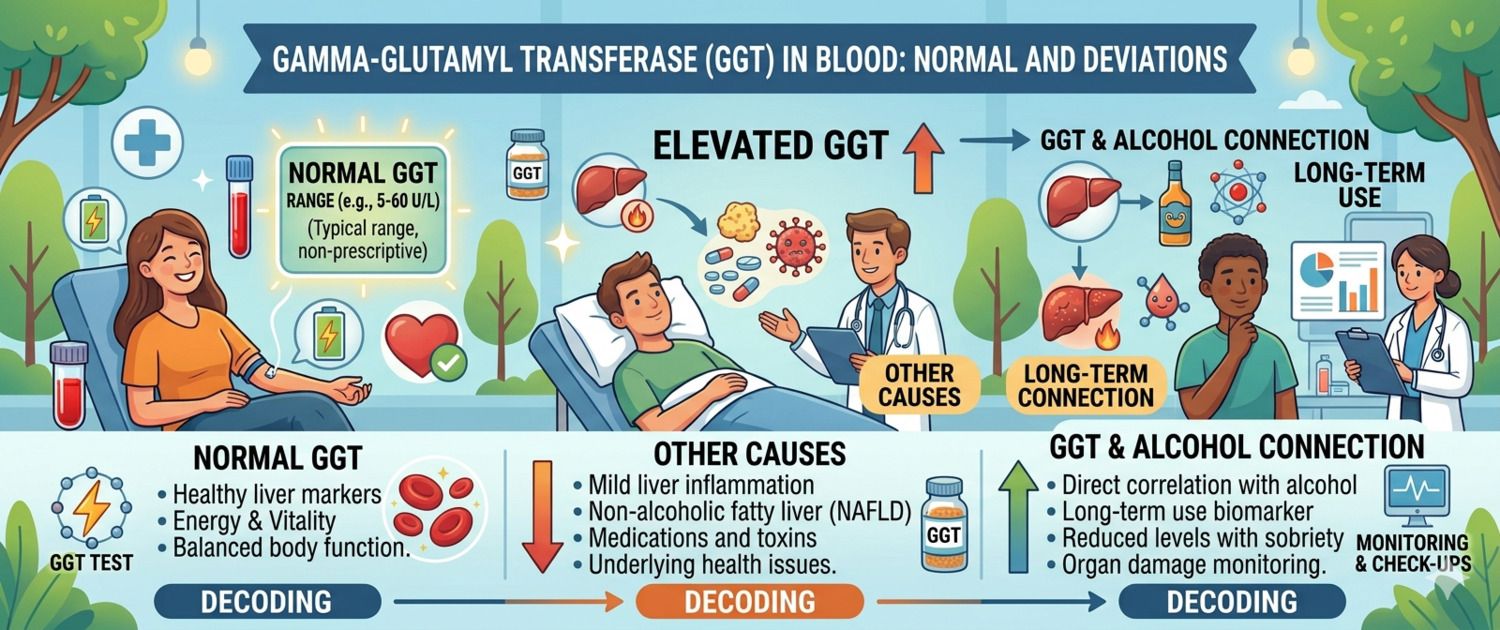
GGT rarely gets much attention on a routine panel — it tends to be noticed when other liver markers are also abnormal, or when a patient is puzzled by an unexpected elevation. Yet gamma-glutamyltransferase is one of the most sensitive — and least specific — hepatic markers: it reacts to virtually everything affecting the liver and biliary tract, as well as to alcohol, dozens of medications, and even obesity. Context is the key to correct interpretation.
What GGT Is and Where It Is Found
GGT (gamma-glutamyltransferase, gamma-GT) is an enzyme involved in glutathione metabolism and amino acid transport across cell membranes. It is present in many organs, but diagnostically relevant concentrations are found primarily in biliary epithelial cells (the lining of the bile ducts), hepatocytes, and renal tubular epithelium.
Under normal conditions, only trace amounts of GGT enter the blood. Elevation occurs in two distinct ways: cell damage with enzyme leakage, and enzyme induction — an increase in synthesis without cell destruction. This distinction is fundamental. Alcohol, many medications, and cholestasis raise GGT through induction: the cells are intact but produce substantially more enzyme. This is why an elevated GGT does not always indicate cell death.
The key biological role of GGT in biliary epithelial cells is participation in glutathione synthesis — the cell's principal intracellular antioxidant. With any cholestasis — impaired bile flow — biliary cells upregulate GGT expression in response to accumulating bile acids. This makes it the most sensitive biochemical marker of cholestasis, detecting it earlier than even bilirubin.
Normal GGT Levels by Sex and Age
Reference values for GGT depend substantially on sex: male thresholds are approximately 1.5–2 times higher than female. This reflects greater liver and biliary epithelial mass, higher microsomal enzyme activity, and differences in hormonal milieu.
| Group | Normal GGT (U/L) |
|---|---|
| Newborns (under 1 month) | 13–147 |
| Infants 1–12 months | 12–123 |
| Children 1–3 years | 5–18 |
| Children 3–6 years | 10–22 |
| Children 6–12 years | 11–22 |
| Male adolescents 12–17 years | 15–45 |
| Female adolescents 12–17 years | 10–30 |
| Men 18–60 years | 10–71 |
| Men over 60 years | 12–75 |
| Women 18–45 years | 6–42 |
| Women over 45 years | 8–55 |
Key nuances:
In newborns, GGT is physiologically high during the first weeks of life — far above the adult range. This reflects immature hepatobiliary development and requires no intervention.
During pregnancy, GGT often falls in the first and second trimesters due to hemodilution, then rises modestly in the third trimester. Elevation above the normal range in pregnancy is an early marker of intrahepatic cholestasis of pregnancy.
Obesity and metabolic syndrome independently raise GGT — even without alcohol and without overt liver disease — through the mechanism of non-alcoholic steatohepatitis.
How to Prepare for a GGT Blood Test
GGT is measured in serum as part of a comprehensive liver function panel. Specific preparation is minimal, but several factors critically influence the result.
- Fasting for at least 8–12 hours — fatty meals activate bile secretion and transiently elevate GGT
- Complete abstinence from alcohol for 72 hours — an absolute requirement. Even a moderate dose the night before raises GGT by 20–50%; with regular consumption, the increase is several-fold. Without this condition, the result has no diagnostic value
- Disclose all medications: more than 50 drug classes elevate GGT through microsomal enzyme induction
- For serial monitoring: test at the same time of day in the same laboratory
- Moderate physical exercise has some influence — avoid intense training for 24 hours before the draw
When GGT is first found elevated: repeat after 4–6 weeks of complete alcohol abstinence and, if feasible, discontinuation of suspected medications. This separates induced elevation from organic pathology.
Causes of Elevated GGT
GGT is the most sensitive marker of hepatobiliary disease in the standard biochemical panel. But that sensitivity comes at the cost of specificity: the list of causes is broad.
| Cause | Degree of elevation | Characteristic features |
|---|---|---|
| Alcoholic liver disease | Moderate–significant (2–20× ULN) | AST/ALT > 2; elevated MCV |
| Non-alcoholic fatty liver disease (NAFLD) | Mild–moderate | Obesity, insulin resistance |
| Viral hepatitis | Moderate | Elevated ALT/AST; positive viral markers |
| Cholestasis (any cause) | Significant | Elevated ALP, bilirubin, itch |
| Gallstones / choledocholithiasis | Moderate–significant | Right upper quadrant pain |
| Liver, bile duct, or pancreatic cancer | Significant | Progressive jaundice, weight loss |
| Drug-induced hepatitis | Mild–significant | Clear link to drug initiation |
| Liver cirrhosis | Variable | Reduced albumin, thrombocytopenia |
| Congestive heart failure | Moderate | Hepatomegaly, edema |
| Type 2 diabetes mellitus | Mild–moderate | Obesity, insulin resistance |
| Hyperthyroidism | Mild | Concurrent thyroid symptoms |
| Chronic kidney disease | Mild | Parallel creatinine elevation |
Drug-induced GGT elevation deserves special attention. The most frequent enzyme-inducing agents: anticonvulsants (phenytoin, carbamazepine, phenobarbital), statins, antibiotics (rifampicin, isoniazid, amoxicillin/clavulanate), oral contraceptives, antipsychotics, anticoagulants (warfarin), anabolic steroids. Drug-induced GGT elevation is isolated or accompanied by modest alkaline phosphatase elevation, while ALT and AST remain normal or only minimally elevated.
Mild isolated GGT elevation (up to 2× ULN) with normal ALT, AST, ALP, and bilirubin in a patient taking medications or carrying excess weight is not always pathological. But it is not a result to ignore: the first priority is to exclude alcohol and drug induction, and then — if the elevation persists — to investigate for an organic cause.
GGT as a Marker of Alcohol-Related Liver Damage
Among all routine laboratory tests, GGT is the most sensitive marker of chronic alcohol misuse. It is elevated in 70–80% of people with alcohol-related liver damage — well before symptoms appear and often before ALT and AST change.
The mechanism is dual: alcohol simultaneously induces GGT synthesis in hepatocytes (via cytochrome P450 2E1) and causes direct toxic injury to biliary epithelial cells.
Characteristic patterns in alcohol-related liver disease:
- Isolated elevated GGT with normal ALT and AST — early stage or moderate consumption
- Markedly elevated GGT + AST/ALT ratio > 2 (de Ritis ratio > 2) — alcoholic hepatitis
- Elevated GGT + elevated MCV (macrocytosis on ALT blood test panel CBC) — a highly specific combination for chronic heavy alcohol use
GGT dynamics during alcohol abstinence: the half-life of GGT elevation is approximately 14–26 days. With complete abstinence, levels begin falling within 1–2 weeks and normalize within 4–8 weeks. This kinetics makes GGT a useful objective measure of abstinence compliance — relevant when monitoring alcohol use disorder treatment.
Important: a normal GGT does not exclude alcoholism — in patients with high alcohol tolerance, the enzyme may remain within range even with substantial intake.
GGT, ALT, AST and ALP: Differential Diagnosis
GGT is always interpreted alongside other liver markers — primarily alkaline phosphatase (ALP) and the transaminases. The combination of findings points to the mechanism of injury.
| Pattern | GGT | ALT/AST | ALP | Most likely cause |
|---|---|---|---|---|
| Hepatocellular | ↑ moderate | ↑↑↑ | Normal/↑ | Viral hepatitis, toxic injury |
| Cholestatic | ↑↑ | Normal/↑ | ↑↑↑ | Biliary obstruction, PBC |
| Alcoholic | ↑↑ | ↑ (AST > ALT) | ↑ | Alcoholic hepatitis / steatohepatitis |
| Drug-induced | ↑ | Normal/↑ | Normal/↑ | Enzyme induction |
| Infiltrative | ↑ | Normal | ↑↑ (ALP > GGT) | Metastases, granulomatosis |
| Isolated ↑ ALP + normal GGT | Normal | Normal | ↑↑ | Bone pathology (bone ALP isoenzyme) |
The last row is critically important: when ALP is elevated but GGT is normal, the ALP elevation is of bone origin — Paget's disease, osteomalacia, bone metastases, or active skeletal growth in children — not hepatic. GGT therefore serves as the "separator" between bone and hepatic ALP — without it, an isolated ALP elevation cannot be interpreted.
A parallel elevation in GGT and CRP with normal ALT/AST may reflect systemic inflammation involving the biliary tract or early-stage inflammatory liver disease.
When Elevated GGT Requires Medical Attention
Mild GGT elevation (up to 2× ULN) with normal companion liver markers and a clear explanation (medications, moderate alcohol, excess weight) calls for lifestyle correction and follow-up monitoring. Any more substantial elevation or combination with other abnormalities warrants active investigation.
Scheduled visit to a GP or gastroenterologist when:
- GGT > 2× ULN on repeat testing after 4–6 weeks of complete alcohol abstinence
- GGT > ULN combined with any elevation in ALT, AST, ALP, or bilirubin
- Mild isolated GGT elevation without an identifiable cause
- Skin itch combined with any GGT elevation — a sign of cholestasis
Seek urgent care when:
- GGT > 5–10× ULN — regardless of symptoms
- Jaundice combined with significantly elevated GGT
- Right upper quadrant pain, fever, and jaundice — Charcot's triad of cholangitis
- Rapidly rising GGT in a patient with known liver disease — possible decompensation or malignant transformation
This article is for informational purposes only and does not replace professional medical advice. Consult a GP or gastroenterologist if your GGT is elevated.
For informational purposes only
This article is for informational purposes only and does not constitute medical advice, diagnosis, or treatment. Please consult a healthcare professional for medical guidance.