Liver Function Tests: Panel, Normal Values and Interpretation
Reviewed by the LabReadAI medical team
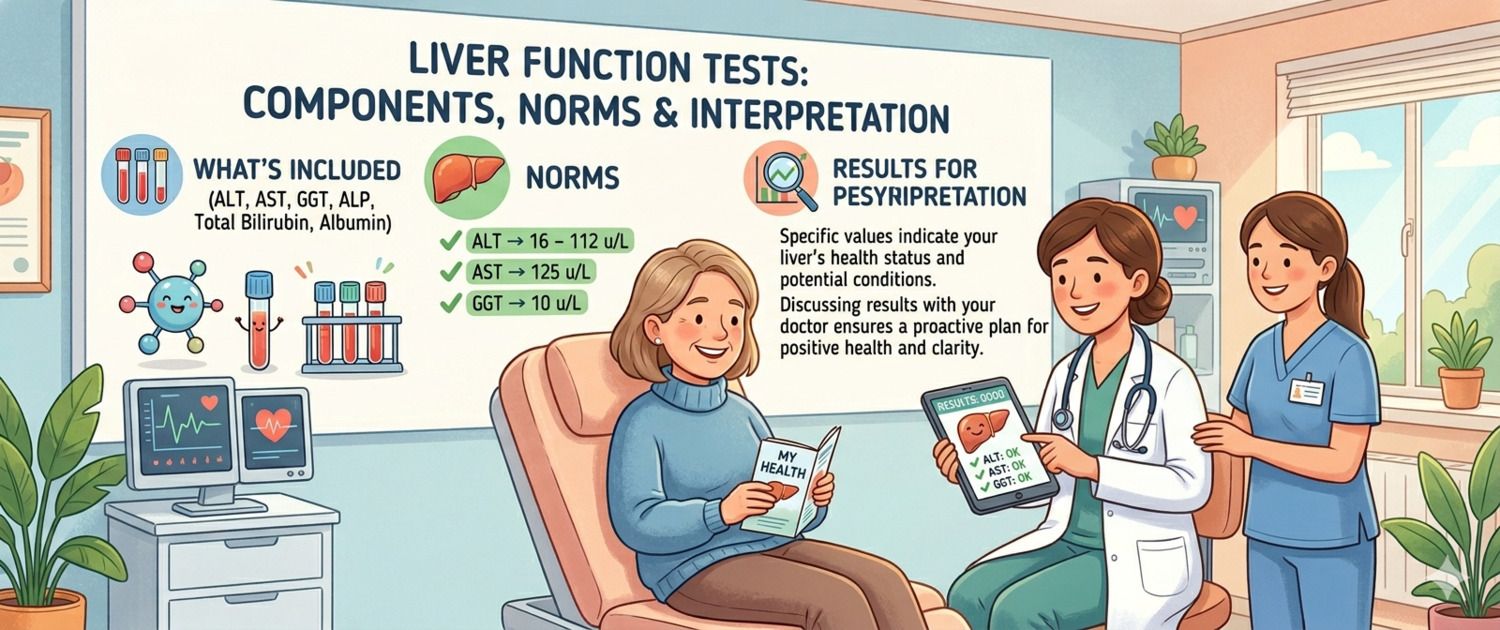
A yellowish tint to the skin, heaviness in the right upper abdomen, unexplained fatigue — these are signals that will prompt a doctor to order liver function tests (LFTs) as a first step. But LFTs are also ordered without symptoms: to monitor hepatotoxic medications, during routine checkups, before surgery, and throughout pregnancy. A liver function panel is a group of biochemical blood markers, each illuminating a different aspect of liver health: some detect cell death, others signal impaired bile flow, and still others reflect the organ's declining ability to synthesize proteins. This article covers what the panel includes, how to prepare, and what each deviation means.
What Are Liver Function Tests and What Do They Show?
The liver is the body's largest internal organ and its metabolic hub: it neutralizes toxins, synthesizes blood proteins, produces bile, and participates in the metabolism of virtually every nutrient. When liver cells are damaged, they release intracellular enzymes into the bloodstream. When bile flow is obstructed, bilirubin accumulates. When the liver loses its ability to synthesize proteins, albumin falls. Liver function tests detect precisely these changes.
A standard panel evaluates three pathological syndromes simultaneously:
- Cytolysis — hepatocyte destruction: markers ALT and AST
- Cholestasis — impaired bile flow: markers GGT, alkaline phosphatase, direct bilirubin
- Impaired synthetic function — markers total protein, albumin, prothrombin time
An important note: LFTs identify the fact and character of damage — they do not establish a diagnosis. Cirrhosis, hepatitis, fatty liver disease, and gallstones can all produce similar laboratory patterns. A diagnosis is made from the full clinical picture.
When Liver Function Tests Are Ordered
Indications fall into symptomatic and preventive categories. Symptoms that will prompt an LFT order:
- Jaundice — yellowing of the skin or whites of the eyes
- Dark urine and pale stools
- Pain or heaviness in the right upper abdomen
- Nausea or aversion to fatty foods
- Unexplained skin itching without a rash
Preventive and monitoring indications:
- Long-term use of hepatotoxic drugs — statins, antituberculosis agents, certain antibiotics, NSAIDs
- History of significant alcohol use
- Obesity and metabolic syndrome — screening for non-alcoholic fatty liver disease
- Known or suspected viral hepatitis B or C
- Pregnancy — mandatory screening each trimester
- Pre-operative evaluation
- Annual health screening after age 40
How to Prepare and Get Tested
Liver function tests are part of a biochemical blood panel — blood is drawn from a vein, typically in the morning.
Preparation guidelines:
- Blood must be drawn strictly fasting: no food for 8–12 hours beforehand. A fatty meal the night before can falsely elevate alkaline phosphatase and GGT — making a repeat test necessary.
- Avoid alcohol for 48 hours before the draw. Even a small amount elevates GGT and AST for several days.
- Do not smoke for 30 minutes before the draw.
- Inform your doctor of all medications you are taking: dozens of drugs affect liver enzymes, and this must be considered when interpreting results.
- Intense physical activity within 24 hours elevates AST — do not test after a workout.
- If you are taking a hepatotoxic drug and the goal is to monitor its safety, test at the same time of day as previous draws to keep trends comparable.
What the Panel Includes: ALT, AST, GGT, Bilirubin and Albumin
The exact composition of the panel varies by clinical question. Here are the core markers and what each reflects.
ALT (alanine aminotransferase) is an enzyme concentrated primarily in liver cells. Its elevation is the most specific marker of cytolysis. Even a two- to three-fold rise above normal warrants further investigation. For a detailed breakdown of the indicator and its causes, see ALT in blood.
AST (aspartate aminotransferase) is less liver-specific: significant AST is also found in cardiac muscle and skeletal muscle. The AST/ALT ratio (de Ritis ratio) helps characterize the damage: above 2 is typical of alcoholic hepatitis; below 1 is more consistent with viral hepatitis.
GGT (gamma-glutamyl transferase) is a sensitive marker of cholestasis and alcohol-related liver injury. Isolated GGT elevation with normal ALT and AST often points to alcohol use, certain medications, or non-alcoholic fatty liver disease.
Alkaline phosphatase (ALP) is a second cholestasis marker. A high ALP with normal GGT should prompt a search for non-hepatic causes: bone disease, hyperparathyroidism, or normal physiological elevation in growing children and pregnant women.
Bilirubin (total, direct, indirect) is the breakdown product of hemoglobin, processed and cleared by the liver. Bilirubin exists in two forms: indirect (free, toxic) and direct (conjugated, water-soluble). A predominance of indirect bilirubin suggests increased red blood cell breakdown; a predominance of direct bilirubin points to bile flow obstruction.
Total protein and albumin are markers of the liver's synthetic function. Albumin is the main plasma protein, produced exclusively in the liver. Its decline in chronic liver disease signals that the organ is losing its functional reserve — a late but significant finding.
Prothrombin time (PT/INR) is a coagulation test that indirectly reflects hepatic synthetic function. A fall in clotting factor levels is another sign of depleted liver reserve.
Liver Panel Normal Values: Summary Table
Reference ranges vary between laboratories — always check the values printed on your own report.
| Parameter | Men | Women | Pregnancy |
|---|---|---|---|
| ALT (U/L) | < 45 | < 34 | < 35 |
| AST (U/L) | < 40 | < 32 | < 32 |
| GGT (U/L) | < 55 | < 38 | < 38 |
| ALP (U/L) | 40–130 | 35–105 | up to 250 (3rd trimester) |
| Total bilirubin (µmol/L) | 3.4–20.5 | 3.4–20.5 | 3.4–17.1 |
| Direct bilirubin (µmol/L) | 0–5.1 | 0–5.1 | 0–4.3 |
| Albumin (g/L) | 35–50 | 35–50 | 28–44 |
| Total protein (g/L) | 64–83 | 64–83 | 56–80 |
ALP rises physiologically in the third trimester due to the placental isoenzyme — this is normal, not pathological. A mild ALT rise in the first trimester may be related to morning sickness and does not always require treatment.
Interpreting Deviations: Cytolysis and Cholestasis Syndromes
Doctors interpret LFTs not by individual values but by patterns — combinations of changes that point to specific pathological processes.
Cytolysis syndrome — significantly elevated ALT and AST. The greater the multiple of the upper limit, the more acute the process. A 2- to 5-fold rise is moderate, typical of fatty liver disease, drug-induced injury, or mild alcoholic hepatitis. A 10- to 50-fold or greater rise suggests acute viral or toxic hepatitis. Normal ALT and AST do not rule out chronic hepatitis or cirrhosis: in advanced cirrhosis, there are too few surviving cells left to release enzymes.
Cholestasis syndrome — predominantly elevated GGT, ALP, and direct bilirubin, with mildly elevated or normal transaminases. This indicates impaired bile flow — either within the liver (primary biliary cholangitis, drug-induced cholestasis) or outside it (gallstones, pancreatic tumor, ductal compression).
Hepatic failure syndrome — falling albumin, prolonged prothrombin time, often combined with a drop in cholesterol. This indicates severe or long-standing injury with loss of synthetic capacity.
Isolated hyperbilirubinemia (predominantly indirect bilirubin with normal enzymes) — Gilbert's syndrome. This is a benign, genetically determined variant found in 5–8% of the population. It requires no treatment.
When Liver Function Test Results Require Urgent Medical Attention
Most mild LFT abnormalities call for a scheduled visit to a GP or gastroenterologist. Some findings, however, require prompt evaluation:
- ALT or AST more than 10 times the upper limit of normal — possible acute hepatitis
- Rapidly deepening jaundice with abdominal pain — cholangitis or acute biliary obstruction
- Albumin below 28 g/L with prolonged INR — signs of severe hepatic failure
- Any abnormality in a pregnant woman, especially in the second half of pregnancy: HELLP syndrome and acute fatty liver of pregnancy are life-threatening conditions
- Dark urine, jaundice, and fever simultaneously — Charcot's triad of cholangitis
Mild deviations without symptoms should not be self-interpreted — clinical context changes everything.
Conclusion
Liver function tests are not a single assay but a carefully designed combination of markers, each illuminating a different facet of liver function. ALT and AST capture cell death; GGT and alkaline phosphatase flag impaired bile flow; albumin and prothrombin time reflect the organ's synthetic reserve. Proper preparation — fasting, avoiding alcohol and intense exercise beforehand — ensures reliable results. When something looks abnormal, resist drawing immediate conclusions: a final diagnosis always depends on the full clinical picture, not one lab sheet.
This content is for informational purposes only and does not replace professional medical advice.
For informational purposes only
This article is for informational purposes only and does not constitute medical advice, diagnosis, or treatment. Please consult a healthcare professional for medical guidance.