Creatinine Blood Test: Normal Levels by Age and eGFR
Reviewed by the LabReadAI medical team
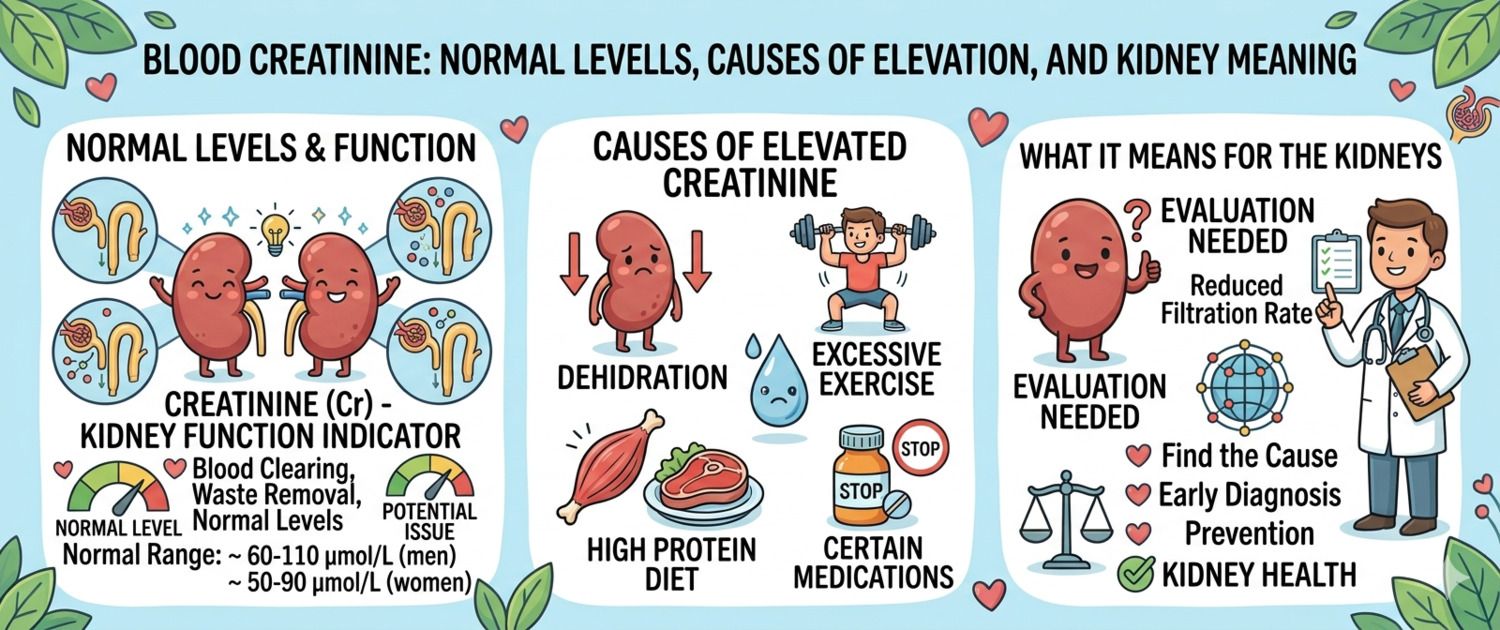
Creatinine is one of those markers that stays "quiet" for years while kidney function silently declines by half. This is not a metaphor: the kidneys have enormous functional reserve, and blood creatinine only starts rising noticeably once the glomerular filtration rate falls below 50–60% of normal. This is precisely why the absolute number always comes second to the calculated eGFR — which is what actually determines the stage of kidney disease and guides treatment.
What Creatinine Is and Where It Comes From
Creatinine is the end product of phosphocreatine metabolism. Phosphocreatine is used by muscles for rapid ATP synthesis, and it spontaneously and irreversibly breaks down to creatinine at a rate proportional to muscle mass. This makes creatinine production relatively constant for any given individual.
Once formed, creatinine enters the bloodstream and is excreted by the kidneys almost exclusively through glomerular filtration — with minimal tubular reabsorption or secretion (though a small degree of tubular secretion does exist and becomes proportionally larger at low GFR). This near-unidirectional relationship — kidneys filter, blood accumulates — makes creatinine a reliable marker of kidney function.
Blood creatinine concentration is inversely proportional to GFR: when kidney function halves, creatinine approximately doubles. The relationship is nonlinear: at normal GFR (90 mL/min/1.73 m²), small changes produce little creatinine rise — the "invisible reserve." But at GFR below 30 mL/min, even a minor decline in filtration sharply elevates creatinine.
A kidney function test always includes creatinine as the mandatory primary marker — it is the basis for eGFR calculation.
Normal Creatinine Levels by Sex and Age
Reference values differ substantially by sex and age: men have higher normal ranges due to greater muscle mass; in older adults, muscle mass declines — and creatinine falls even as kidney function deteriorates.
| Group | Normal creatinine (µmol/L) | Normal (mg/dL) |
|---|---|---|
| Infants under 1 year | 18–35 | 0.2–0.4 |
| Children 1–14 years | 27–62 | 0.3–0.7 |
| Adolescents 14–18 years | 44–88 | 0.5–1.0 |
| Men 18–60 years | 62–115 | 0.7–1.3 |
| Men over 60 years | 65–120 | 0.7–1.4 |
| Women 18–60 years | 44–97 | 0.5–1.1 |
| Women over 60 years | 48–100 | 0.5–1.1 |
| Pregnant women | 35–70 | 0.4–0.8 |
Unit conversion: µmol/L ÷ 88.4 = mg/dL.
Key nuance: an older patient with muscle atrophy may have significantly impaired kidney function with a creatinine of 80 µmol/L — technically "normal" on the lab report. This is one of the main reasons why eGFR calculation is mandatory — the absolute number alone is misleading.
During pregnancy, GFR physiologically rises by 40–60%, so creatinine falls. A level of 90 µmol/L — normal outside pregnancy — in the third trimester already signals reduced kidney function.
How to Prepare for a Creatinine Blood Test
Creatinine is a relatively stable marker, but several factors significantly affect results.
- Fasting or draw 3–4 hours after a light meal
- Avoid intense physical exercise for 24–48 hours: heavy training — especially resistance exercise — raises creatinine through accelerated phosphocreatine breakdown, with a transient rise of 10–30%
- Limit meat intake the day before: cooked meat and bone broth contain preformed creatinine — consuming 250 g of meat can raise levels by 20–30 µmol/L. A plant-based diet the day before is preferable
- Disclose medications: metformin, trimethoprim, and cimetidine block tubular secretion and overestimate creatinine without actually reducing GFR
- For serial monitoring: same laboratory, same method
- Potassium, albumin, electrolytes, and urea are drawn from the same blood sample for a complete kidney function picture
Causes of High Creatinine
Creatinine elevation — azotemia — is classified as prerenal (reduced kidney blood flow), renal (intrinsic kidney damage), and postrenal (obstruction to urine outflow).
| Cause | Mechanism | Characteristic features |
|---|---|---|
| Dehydration and hypovolemia | Reduced renal perfusion → falling GFR | Reversible with fluid repletion |
| Acute kidney injury (AKI) | Direct tubular/glomerular damage | Rapid rise over hours–days; oliguria |
| Chronic kidney disease | Progressive nephron loss | Gradual rise over months–years |
| Glomerulonephritis | Immune-mediated glomerular injury | Proteinuria; hematuria |
| Chronic pyelonephritis | Renal parenchymal scarring | History of recurrent infections |
| Diabetic nephropathy | Glomerulosclerosis in diabetes | Heavy proteinuria; diabetes |
| Hypertensive nephropathy | Glomerular damage from hypertension | Long-standing poorly controlled hypertension |
| Obstruction (kidney stones, tumor, prostatic enlargement) | Impaired outflow → hydronephrosis | Ultrasound: dilated pelvicalyceal system |
| Rhabdomyolysis | Direct myoglobin tubulotoxicity | Dark urine; very high CK |
| Nephrotoxic drugs | Direct tubular injury | Aminoglycosides, NSAIDs, contrast agents, calcineurin inhibitors |
| Heart failure | Cardiorenal syndrome | Low cardiac output → reduced renal perfusion |
Nephrotoxic medications are among the most frequently underestimated causes of creatinine elevation. NSAIDs (ibuprofen, diclofenac) reduce prostaglandin synthesis that maintains afferent arteriolar vasodilation — in patients with already-reduced kidney function, this can precipitate acute kidney injury. Uric acid frequently rises alongside creatinine in CKD, reflecting the same decline in renal clearance.
Causes of Low Creatinine
Low creatinine — below the reference lower limit — is less common and almost always reflects reduced muscle mass, the source of creatinine production.
Main causes:
- Sarcopenia and muscle atrophy — in older adults, after prolonged immobility, in cachexia. Reduced muscle mass decreases creatinine production
- Pregnancy — physiological reduction due to increased renal blood flow and hemodilution
- Veganism and strict vegetarianism — absence of exogenous dietary creatine from meat produces a modest reduction
- Severe liver disease (cirrhosis) — impaired hepatic creatine synthesis (creatinine's precursor)
- Myopathies — genetic or acquired muscle diseases with reduced muscle mass
An isolated low creatinine in a young person without the above conditions is most often a normal variant with low muscle mass or predominantly plant-based dietary habits.
The clinically dangerous scenario: a severely cachectic patient with markedly reduced muscle mass can have a "normal" or even "elevated" creatinine of 100–120 µmol/L — with an actual GFR of 20–25 mL/min. This is the classic trap of "normal" creatinine in severe CKD in cachectic patients.
eGFR: Calculation and Stages of Chronic Kidney Disease
The estimated glomerular filtration rate (eGFR) is the gold standard for assessing kidney function. It is calculated from the serum creatinine level adjusted for age, sex, and race.
CKD-EPI formula (the most accurate in current clinical practice): A complex mathematical equation implemented in all modern laboratory analyzers and online calculators. The result is expressed in mL/min/1.73 m².
CKD stages by eGFR (KDIGO classification):
| Stage | eGFR (mL/min/1.73 m²) | Description |
|---|---|---|
| G1 | ≥ 90 | Normal or high — CKD only if kidney damage markers present |
| G2 | 60–89 | Mildly reduced |
| G3a | 45–59 | Mildly to moderately reduced |
| G3b | 30–44 | Moderately to severely reduced |
| G4 | 15–29 | Severely reduced |
| G5 | < 15 | Kidney failure (dialysis or transplantation) |
CKD is diagnosed when kidney damage markers persist for > 3 months OR when eGFR is persistently < 60 mL/min/1.73 m² regardless of cause. Important: stage G1–G2 means CKD only when additional kidney damage markers are present.
Kidney damage markers that define CKD at normal eGFR:
- Albuminuria > 30 mg/day (or urine albumin-to-creatinine ratio > 30 mg/g)
- Persistent hematuria without urological explanation
- Structural abnormalities on ultrasound (polycystic kidneys, scarring, hydronephrosis)
When Creatinine Abnormalities Require Medical Attention
Scheduled visit to a GP or nephrologist when:
- Any creatinine above the upper reference limit for sex and age on repeat testing
- Calculated eGFR < 60 mL/min/1.73 m² — regardless of symptoms; stage G3a and above requires nephrology follow-up
- Creatinine rise > 26 µmol/L within 48 hours or > 50% from baseline within 7 days — acute kidney injury
- Starting nephrotoxic medications in a patient with already-reduced kidney function
Seek urgent care or call emergency services when:
- Rapid creatinine rise combined with oliguria (urine output < 400 mL/day) or anuria
- Hyperkalemia (> 6.0 mmol/L) combined with elevated creatinine — arrhythmia risk
- Uremic symptoms: nausea, vomiting, confusion, ammonia breath, seizures
- Sudden creatinine rise in a transplant recipient — possible rejection
This article is for informational purposes only and does not replace professional medical advice. Consult a GP or nephrologist if your creatinine is outside the normal range.
For informational purposes only
This article is for informational purposes only and does not constitute medical advice, diagnosis, or treatment. Please consult a healthcare professional for medical guidance.