Kidney Function Test: Panel, Normal Values and Interpretation
Reviewed by the LabReadAI medical team
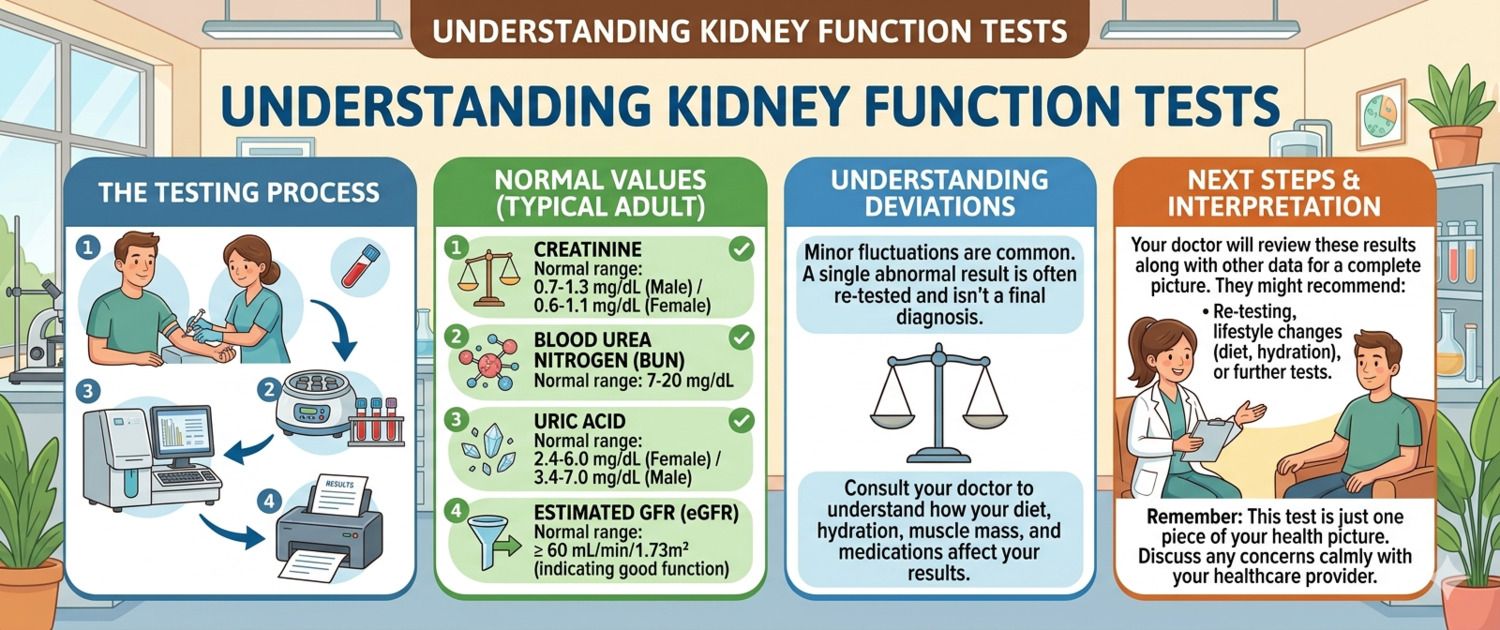
The kidneys work silently — until they stop coping. Chronic kidney disease progresses without symptoms for years, and by the time oedema, fatigue, and changes in urine appear, the organ may have already lost a significant portion of its functional reserve. A kidney function test is a group of biochemical assays that can assess the kidneys' filtering and excretory capacity long before clinical signs appear. This article covers which markers make up the renal panel, how to prepare, what counts as normal, and how to interpret abnormalities in each value.
What Is a Kidney Function Test and What Does It Assess?
The kidneys perform three essential tasks: filtering waste products from the blood, regulating the body's fluid and electrolyte balance, and maintaining acid-base equilibrium. When any of these functions is impaired, substances that should be excreted in urine accumulate in the blood — and their concentrations become measurable markers of damage.
The renal panel is not a single test but a set of assays reflecting different aspects of kidney function:
- Filtration — how efficiently the glomeruli clean the blood: creatinine, blood urea nitrogen (BUN), estimated glomerular filtration rate (eGFR)
- Fluid and electrolyte balance — the kidney's ability to regulate ions: sodium, potassium, chloride, phosphorus
- Synthetic and excretory function — markers of filtration barrier damage: urinary albumin, uric acid
- Acid-base balance — bicarbonate and pH
A doctor selects the specific tests based on the clinical question: a minimal screening set includes only creatinine and eGFR; an expanded panel adds BUN, electrolytes, uric acid, and urine albumin testing.
When Is a Kidney Function Test Ordered?
Indications are divided into diagnostic, preventive, and monitoring categories.
Symptoms that make the test mandatory:
- Oedema of the legs, face, or around the eyes — especially on waking
- Changes in urine: dark, frothy, or reddish
- Significant decrease or increase in daily urine volume
- Flank or lower back pain
- Persistent hypertension that does not respond to standard treatment
- Unexplained fatigue and nausea
Preventive screening is recommended for:
- Diabetes mellitus — annually, regardless of symptoms
- Arterial hypertension — at least once a year
- Long-term use of nephrotoxic drugs: NSAIDs, aminoglycosides, lithium, certain antivirals
- Systemic diseases: lupus, rheumatoid arthritis, vasculitis
- Obesity and metabolic syndrome
- Pregnancy — screening each trimester
- Family history of chronic kidney disease
A urine test always accompanies the blood panel: together they give the full picture. Urinalysis reveals protein, red blood cells, and casts — signs of filter damage — where blood tests may still be silent.
How to Prepare and Get Tested
Kidney function markers are sensitive to several external factors that can significantly shift results.
Preparation guidelines:
- Blood is drawn fasting — at least 8–12 hours after the last meal. A high-protein meal the evening before elevates BUN and, to a lesser degree, creatinine.
- Limit meat intake for 24 hours beforehand: a large serving of red meat or creatine supplements can transiently raise creatinine.
- Do not become dehydrated: fluid deficit concentrates all markers and can mimic kidney failure.
- Avoid intense physical activity for 24 hours — exercise raises creatinine through increased muscle breakdown.
- Inform your doctor of all medications: NSAIDs, ACE inhibitors, angiotensin receptor blockers, and certain antibiotics affect the results or the kidneys directly.
- For monitoring purposes, always test at the same laboratory at the same time of day — differences in eGFR calculation formulas between labs make cross-comparison unreliable.
What the Panel Includes: Core Kidney Function Markers
Creatinine is the end product of creatine metabolism in muscles, excreted exclusively by the kidneys. It is the central marker of filtration function: its blood concentration rises proportionally as kidney function declines. An important caveat: creatinine levels depend on muscle mass, so in elderly patients and women with low muscle mass, the kidneys can be significantly impaired while creatinine still appears normal.
Estimated GFR (eGFR) is a derived value calculated using the CKD-EPI or MDRD formula from creatinine, age, sex, and race. It is the best integrated measure of kidney function, expressed in mL/min/1.73 m², and directly shows how many millilitres of blood the kidneys filter per minute. Normal in adults: above 90 mL/min/1.73 m². A declining eGFR is the basis for staging chronic kidney disease.
Blood urea nitrogen (BUN / urea) is a protein metabolism waste product cleared by the kidneys. It is less specific than creatinine: BUN rises with high-protein diet, dehydration, gastrointestinal bleeding, and catabolic states. It is evaluated alongside creatinine — the BUN-to-creatinine ratio helps distinguish a renal from a pre-renal cause of elevation.
Uric acid is the end product of purine metabolism. The kidneys excrete approximately 70% of the daily load. Chronically elevated uric acid directly damages renal tubules — creating a vicious cycle: gout impairs kidney function, and kidney failure worsens hyperuricemia.
Electrolytes (sodium, potassium, chloride, phosphorus) — their balance is actively regulated by the kidneys. Disturbances are characteristic of advanced kidney failure: potassium accumulates and creates arrhythmia risk, phosphorus rises and disrupts calcium metabolism, and sodium reflects the body's fluid balance.
Urinary albumin (albuminuria) is a sensitive early marker of glomerular filter damage. Normally, albumin does not pass through. Microalbuminuria (30–300 mg/g creatinine) is the first laboratory sign of diabetic nephropathy, preceding eGFR changes by years. Albumin in urine is mandatory screening in diabetes and hypertension.
Cystatin C is an alternative eGFR marker independent of muscle mass. It is ordered in complex diagnostic cases — in patients with sarcopenia, in elderly individuals, in pregnancy — when the standard creatinine-based calculation is unreliable.
Kidney Panel Normal Values: Summary Table
Reference ranges vary between laboratories — always check the values on your own report.
| Parameter | Men | Women | Pregnancy |
|---|---|---|---|
| Creatinine (µmol/L) | 62–115 | 53–97 | 40–80 |
| eGFR (mL/min/1.73 m²) | > 90 | > 90 | > 90 |
| BUN / Urea (mmol/L) | 2.5–6.4 | 2.5–6.4 | 1.5–5.3 |
| Uric acid (µmol/L) | 200–430 | 140–360 | 120–270 |
| Sodium (mmol/L) | 136–145 | 136–145 | 133–143 |
| Potassium (mmol/L) | 3.5–5.1 | 3.5–5.1 | 3.3–5.0 |
| Albuminuria (mg/g) | < 30 | < 30 | < 30 |
In pregnancy, eGFR physiologically increases by 40–65% due to elevated cardiac output and renal blood flow — meaning a creatinine value that is normal for a non-pregnant adult may already signal impaired function during pregnancy.
Interpreting Deviations: What Rising Creatinine and Falling eGFR Mean
Doctors interpret the renal panel as a whole, looking for patterns of change rather than isolated numbers.
Rising creatinine + falling eGFR — the central pattern of kidney failure. Three subtypes by cause:
- Pre-renal — the kidneys are intact but blood flow to them is reduced: dehydration, heart failure, shock. BUN rises disproportionately; the BUN-to-creatinine ratio exceeds 20. Restoring fluid volume normalises results rapidly.
- Renal — damage to the kidney tissue itself: glomerulonephritis, acute tubular necrosis, drug-induced nephropathy. BUN and creatinine rise roughly proportionally.
- Post-renal — obstruction of urine outflow: kidney stone, tumour, enlarged prostate. Ultrasound confirms the cause.
Chronic eGFR decline is staged by the CKD classification:
| Stage | eGFR (mL/min) | Description |
|---|---|---|
| G1 | ≥ 90 | Normal or high, but damage markers present |
| G2 | 60–89 | Mildly reduced |
| G3a | 45–59 | Mildly to moderately reduced |
| G3b | 30–44 | Moderately to severely reduced |
| G4 | 15–29 | Severely reduced |
| G5 | < 15 | Kidney failure |
Hyperkalaemia (potassium above 5.5 mmol/L) in kidney failure is an emergency: life-threatening arrhythmias can develop rapidly.
Isolated microalbuminuria with normal eGFR is an early signal of glomerular damage, especially in diabetics and hypertensives. This is the point at which intensive treatment is most effective at slowing progression.
When Kidney Function Test Results Require Urgent Medical Attention
Most changes in the renal panel call for a scheduled appointment. But some situations are medical emergencies:
- Creatinine doubling within a few days from a previously normal baseline
- eGFR below 15 mL/min without a previously established CKD diagnosis
- Potassium above 6.0 mmol/L — risk of cardiac arrest
- Anuria or sharply reduced urine output (less than 400 mL per day)
- Oedema + hypertension + frothy urine simultaneously — nephrotic syndrome
- Any abnormality in a pregnant woman, particularly in the second half of pregnancy: pre-eclampsia progresses rapidly and is life-threatening
- Progressive uraemic symptoms: nausea, vomiting, confusion, metallic taste in the mouth
With moderate abnormalities and no symptoms, a scheduled visit to a GP or nephrologist is sufficient. Restricting fluid or protein intake in response to "bad kidney results" without medical guidance is a potentially dangerous mistake.
Conclusion
A kidney function test is a multi-angle evaluation of the organ: filtration capacity, metabolic waste clearance, electrolyte balance, and filtration barrier integrity — all assessed together. No single marker tells the full story; diagnostic value comes from the pattern of results. The key to reliable findings is proper preparation: moderate protein intake the day before, normal hydration, and avoiding nephrotoxic drugs as advised by your doctor. Early detection of kidney impairment is the only way to halt progression before irreversible damage occurs.
Uric acid is an important nephrology marker reflecting kidney filtration status. For male-specific reference ranges and cardiovascular risks, see the article uric acid in men.
This content is for informational purposes only and does not replace professional medical advice.
For informational purposes only
This article is for informational purposes only and does not constitute medical advice, diagnosis, or treatment. Please consult a healthcare professional for medical guidance.