Uric Acid in Men: Normal Blood Levels, High Levels and Causes
Reviewed by the LabReadAI medical team
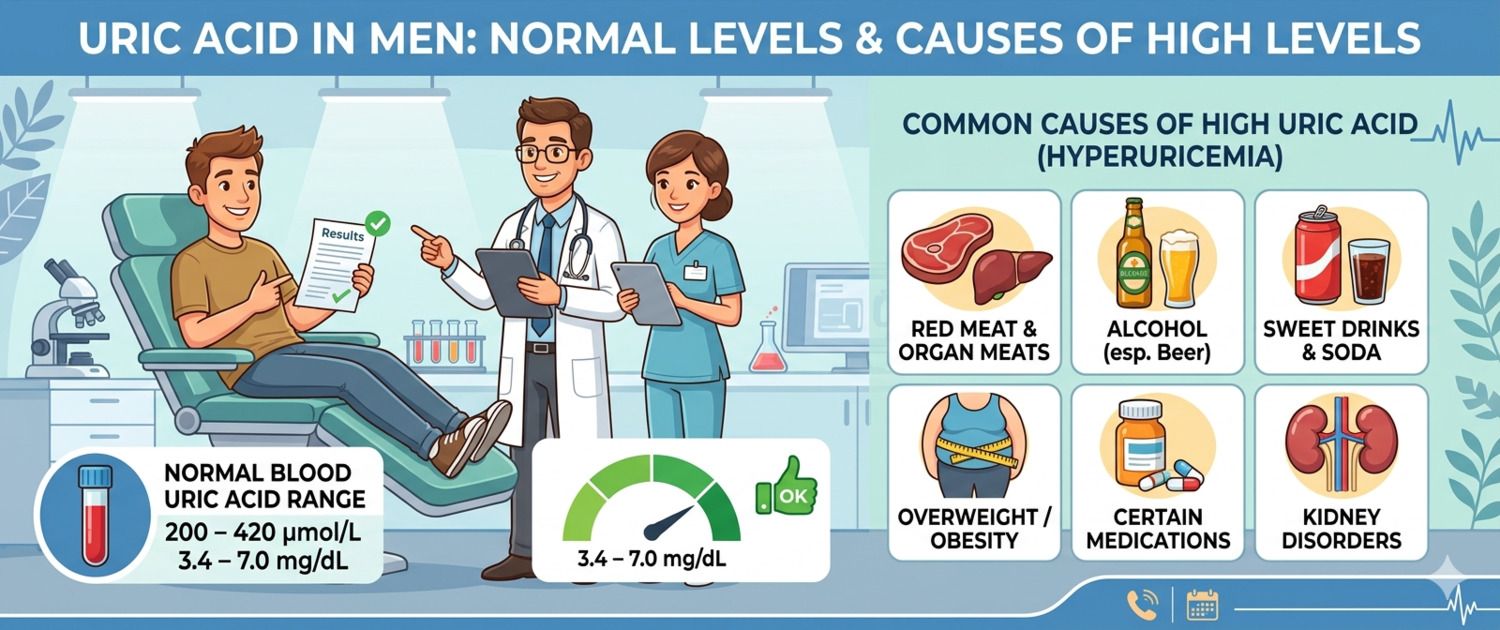
Uric acid in a man's blood test is one of the most underappreciated metabolic health markers. Most people only know it in the context of gout — but high uric acid begins causing harm long before the first attack: it damages blood vessels, impairs kidney function and is an independent marker of insulin resistance. In men, this value is systematically higher than in women, and the thresholds that define "normal" matter directly for long-term health.
Uric Acid in Men: Normal Blood Levels by Age
Uric acid in men is measured in a biochemistry blood panel (urate, UA). Reference ranges vary by laboratory method, but the general picture:
| Age | Reference (µmol/L) | Reference (mg/dL) | Functional optimum (µmol/L) |
|---|---|---|---|
| 18–30 years | 200–420 | 3.4–7.0 | 240–360 |
| 31–50 years | 210–430 | 3.5–7.2 | 250–360 |
| 51–60 years | 220–440 | 3.7–7.4 | 250–370 |
| Over 60 | 230–450 | 3.9–7.5 | 250–380 |
The lower reference boundary (200–230 µmol/L) also matters: very low uric acid is associated with elevated risk of neurodegenerative disease — uric acid has antioxidant properties in the central nervous system. The longevity optimum is the middle of the reference range, not the extremes.
Why Uric Acid Is Higher in Men Than in Women
Uric acid in men is consistently higher than in women of reproductive age for several physiological reasons.
Oestrogen enhances renal uric acid excretion in women (uricosuric effect). After menopause, women's uric acid levels approach those of men — which explains the sharp increase in female gout incidence after age 55–60.
Men lack this protective mechanism. Male muscle mass is greater, purine turnover higher, and the typical male diet is richer in red meat and alcohol. As a result, the average male uric acid level runs 50–80 µmol/L higher than in age-matched women.
High Uric Acid in Men: Main Causes
Uric acid above 420 µmol/L in a man is not a diagnosis — it is a signal. Causes divide into nutritional and metabolic.
Nutritional factors: red meat, organ meats (liver, kidney), shellfish, alcohol (especially beer) — all are purine-rich or impair uric acid excretion. Fructose (sugary drinks, juices) drives uric acid synthesis via an ATP-dependent pathway — even without a direct purine source.
Metabolic factors: insulin resistance reduces renal uric acid excretion — one of the mechanisms by which obesity and pre-diabetes elevate uric acid levels. Arterial hypertension (and antihypertensive drugs, especially thiazide diuretics) impairs renal reabsorption. Chronic kidney disease reduces filtration capacity.
Endogenous factors: active cell breakdown (intense exercise, chronic inflammation, malignancy) raises uric acid synthesis from purines released by dying cells.
Uric Acid and Metabolic Syndrome: A Reinforcing Cycle
The link between uric acid and metabolic syndrome is bidirectional and self-reinforcing. Insulin resistance reduces renal uric acid clearance — levels rise. In turn, high uric acid amplifies adipose tissue inflammation, impairs pancreatic beta-cell function and increases hepatic fat production.
Uric acid above 360 µmol/L is an independent predictor of type 2 diabetes development, with a stronger correlation than fasting glucose alone. This means elevated uric acid in a man without diabetes is a metabolic warning signal requiring attention well before the first hyperglycaemia.
The link with insulin: men with elevated fasting insulin (>10 µIU/mL) consistently show higher uric acid levels — precisely because insulin reduces renal urate excretion.
Uric Acid and Cardiovascular Risk in Men
Uric acid above 360–400 µmol/L is an independent cardiovascular risk factor. The mechanism operates at multiple levels:
Uric acid stimulates oxidative stress in vascular endothelium, reduces bioavailability of nitric oxide (the key vasodilator), activates pro-inflammatory pathways and drives arterial hypertension. C-reactive protein and uric acid together are markers of systemic vascular inflammation.
Meta-analyses show: for every 60 µmol/L rise in uric acid, cardiovascular event risk in men increases by 10–12%. The association holds after adjustment for blood pressure, glucose and lipids.
Uric Acid and Kidney Health in Men
The kidneys handle approximately 70% of uric acid excretion. With chronically elevated levels, urates crystallise not only in joints but also in kidney tissue (urate nephropathy) and the urinary tract (kidney stones).
Urate nephropathy is one of the main causes of chronic interstitial nephritis in men over 50. It progresses slowly and asymptomatically — kidney function declines over years without pain or obvious symptoms. The marker: kidney function tests — rising creatinine and falling GFR in trend context with persistently high uric acid.
Uric acid above 480–500 µmol/L chronically is a direct indication to assess kidney function.
When Uric Acid in Men Requires Treatment
Not every elevation requires medication. The key thresholds:
Lifestyle correction (360–420 µmol/L): reduce dietary purines, restrict alcohol, increase water intake, lose weight if obese. Levels normalise in 50–70% of men with dietary changes alone.
Pharmacological treatment (above 420 µmol/L with risk factors OR above 480 µmol/L asymptomatically): in the presence of CKD, cardiovascular disease or persistently high levels unresponsive to diet. The treatment target is not simply "within range" but below 360 µmol/L — the threshold below which urates do not crystallise.
Detailed treatment protocols and dietary guidance for elevated uric acid are in the hyperuricaemia guide. A comprehensive longevity programme with the full blood test panel is in the article how to live long and healthy. Hs-CRP and uric acid as coupled markers of chronic inflammation — hs-CRP and longevity. Insulin resistance as a cause of chronic hyperuricaemia — fasting insulin and HOMA-IR.
This article is for informational purposes. Interpreting test results and prescribing treatment is the responsibility of a qualified doctor.
For informational purposes only
This article is for informational purposes only and does not constitute medical advice, diagnosis, or treatment. Please consult a healthcare professional for medical guidance.