Metabolic Syndrome: Symptoms, Diagnostic Criteria and Treatment
Reviewed by the LabReadAI medical team
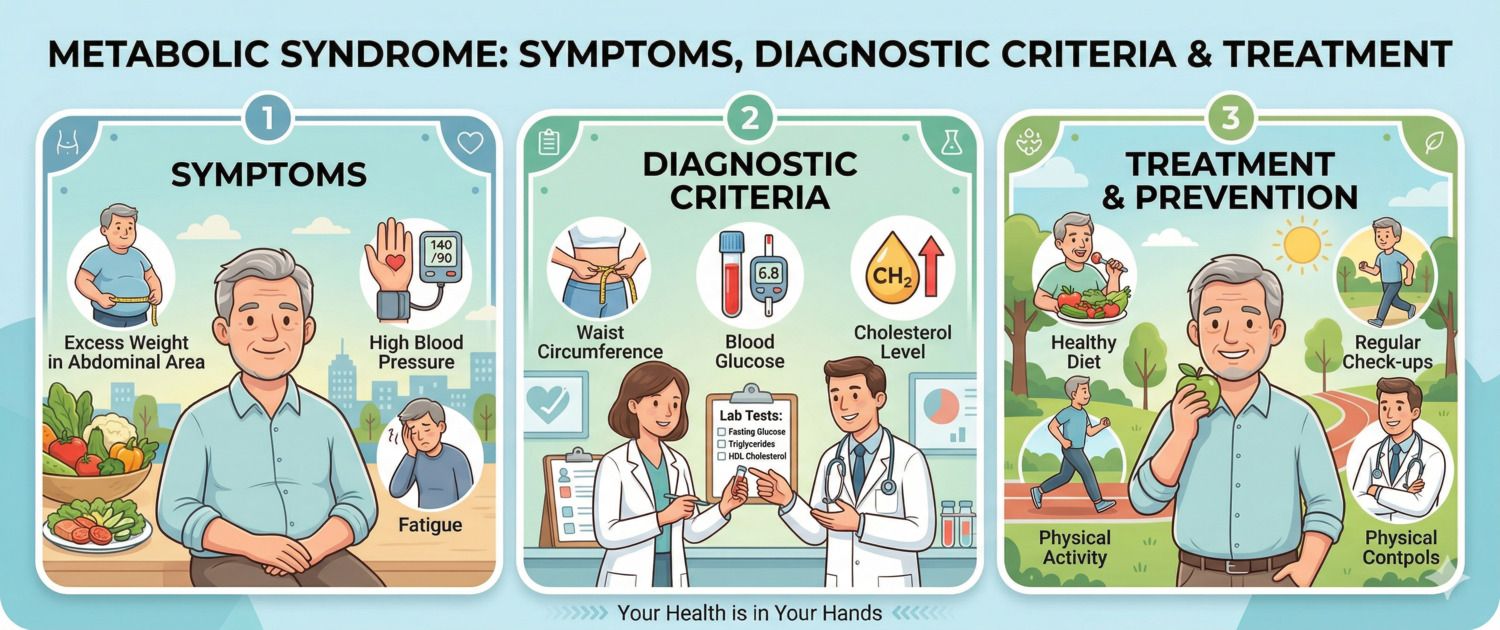
Physicians call it the "deadly quartet" — and not for dramatic effect. Metabolic syndrome is not a single disease but a combination of four interlinked disturbances: abdominal obesity, high blood pressure, impaired glucose metabolism, and dyslipidaemia. Each one individually raises cardiovascular risk. Together, they multiply it by an order of magnitude. Approximately one in four adults worldwide meets the criteria for metabolic syndrome, and most have no idea — the condition progresses silently for years, until a first heart attack or stroke.
What Is Metabolic Syndrome and Why Does It Develop
At the centre of metabolic syndrome sits insulin resistance — a state in which muscle, liver and adipose cells stop responding normally to insulin. Think of insulin as a key that unlocks a cell's access to glucose. In insulin resistance, the lock has seized: the key goes in, but the door will not open. The pancreas responds predictably — it produces ever more insulin to force the lock. Hyperinsulinaemia sets off a chain of disturbances: glucose accumulates in the blood, the liver ramps up triglyceride synthesis, the kidneys retain sodium — and blood pressure rises.
Visceral fat — stored not under the skin but around the internal organs — acts as an active endocrine organ. It releases pro-inflammatory cytokines and free fatty acids directly into the portal vein, attacking the liver and amplifying insulin resistance. This creates a self-sustaining vicious cycle: more visceral fat → greater insulin resistance → higher insulin levels → more fat deposition.
The predisposition to metabolic syndrome has a genetic basis, but it is expressed through lifestyle. Three main triggers: hypercaloric nutrition with excess simple carbohydrates and saturated fats, physical inactivity, and chronic stress — the last of which acts directly through cortisol to promote abdominal fat accumulation.
Diagnostic Criteria: How to Identify Metabolic Syndrome
Metabolic syndrome is diagnosed by the presence of central obesity plus any two of four additional criteria. The most widely used are the IDF (International Diabetes Federation, 2005) criteria:
| Criterion | Threshold value |
|---|---|
| Waist circumference (central obesity) | ≥ 94 cm in European men; ≥ 80 cm in women |
| Triglycerides | ≥ 1.7 mmol/L (or on medication) |
| HDL cholesterol | < 1.0 mmol/L in men; < 1.3 mmol/L in women (or on medication) |
| Blood pressure | ≥ 130/85 mmHg (or on antihypertensive treatment) |
| Fasting glucose | ≥ 5.6 mmol/L (or previously diagnosed type 2 diabetes) |
Waist circumference thresholds differ by ethnicity: in South and South-East Asian populations — ≥ 90 cm in men and ≥ 80 cm in women.
One critical point: waist circumference is a mandatory criterion, not simply one of five. Without central obesity the diagnosis of metabolic syndrome is not made, even if all four other parameters are abnormal. Visceral fat — not subcutaneous — determines metabolic risk, which is why a lean person with a normal BMI but an abdominal fat pattern can have this syndrome.
Symptoms of Metabolic Syndrome: Why It Is So Often Missed
Metabolic syndrome does not hurt and does not interfere with daily life — for a long time. This is precisely what makes it dangerous. Indirect signs that should prompt attention:
- Fat concentrated at the abdomen — even with a relatively normal overall weight. Trousers fit the hips but will not button at the waist — the classic "apple" body shape
- Persistent fatigue and drowsiness after meals — especially after carbohydrate-rich food: cells cannot access glucose efficiently despite high circulating levels
- Intense craving for sugar and refined carbohydrates — a consequence of unstable blood glucose levels
- Elevated blood pressure, especially when found in a young adult without an obvious cause
- Dark, velvety skin folds in the groin, armpits or neck (acanthosis nigricans) — a visible marker of hyperinsulinaemia
- Fatty liver (NAFLD) — often found incidentally on an abdominal ultrasound
In women, metabolic syndrome frequently coexists with PCOS — both share insulin resistance as a common pathogenetic root. In men, it is often accompanied by hypogonadism: excess visceral fat accelerates conversion of testosterone to oestradiol.
Which Blood Tests to Order for Metabolic Syndrome
The diagnosis is largely clinical — a tape measure and blood pressure cuff are sufficient. But laboratory assessment is essential for quantifying the degree of metabolic disturbance and risk of complications.
Fasting glucose — the primary screening test. A level of 5.6–6.9 mmol/L indicates prediabetes; ≥ 7.0 mmol/L indicates diabetes. Blood must be drawn strictly fasting — even a light snack shifts the result.
Glycated haemoglobin (HbA1c) — reflects mean glucose over the past 2–3 months. No fasting required; resistant to single-occasion dietary variation. Used both for diagnosing glucose metabolism disturbances in metabolic syndrome and for monitoring their trajectory on treatment.
Triglycerides — one of the five diagnostic criteria. Levels above 1.7 mmol/L combined with low HDL constitute the atherogenic dyslipidaemia that is the characteristic lipid pattern of metabolic syndrome.
HDL cholesterol — the "protective" cholesterol that transports lipids back to the liver. It is reduced in metabolic syndrome: adipose tissue and the liver disrupt its synthesis. The lower the HDL, the higher the cardiovascular risk.
LDL cholesterol — not a formal diagnostic criterion, but frequently elevated in metabolic syndrome and dominated by small dense LDL particles — the most atherogenic fraction. Critical for assessing atherosclerotic risk.
Lipid panel — measures all fractions simultaneously: total cholesterol, LDL, HDL, triglycerides. The starting point for initial assessment.
Fasting insulin + HOMA-IR calculation — direct assessment of insulin resistance. HOMA-IR = (fasting glucose × fasting insulin) / 22.5. A value above 2.5–3.0 indicates insulin resistance. This test is not part of formal diagnostic criteria but is highly useful for gauging severity and guiding treatment.
Treating Metabolic Syndrome: Diet, Exercise and Cardiometabolic Risk Reduction
Metabolic syndrome is a reversible condition. This is one of the rare situations in medicine where lifestyle genuinely changes prognosis — often faster and more effectively than medication.
Lifestyle Modification — First and Primary Line of Therapy
Weight loss. Losing 7–10% of baseline body weight improves all five components of metabolic syndrome simultaneously: blood pressure falls, glucose normalises, HDL rises, triglycerides drop. Reducing visceral fat specifically matters most — this is most effectively achieved by combining caloric restriction with regular physical activity.
Physical activity. 150–300 minutes of moderate aerobic exercise per week (brisk walking, swimming, cycling) reduces insulin resistance independently of weight change. Resistance training 2–3 times weekly adds to the effect: muscle tissue is the body's primary consumer of glucose.
Nutrition. The most evidence-based dietary patterns:
- Mediterranean diet — rich in fibre, unsaturated fats and polyphenols; reduces cardiovascular risk by 30% in high-risk patients
- Restriction of fast carbohydrates (sugar, white flour, sugary drinks) — direct reduction of postprandial hyperinsulinaemia
- Restriction of trans fats and animal saturated fats
| What to limit | What to increase |
|---|---|
| Sugar and sweet drinks | Vegetables and legumes (fibre) |
| White bread, pastries, white rice | Whole grains |
| Red and processed meat | Fatty fish (omega-3) |
| Trans fats (margarine, fast food) | Olive oil, nuts, avocado |
| Alcohol | Unsweetened tea, black coffee |
Pharmacotherapy — When Lifestyle Is Not Enough
Medications are added in a targeted, stepwise manner for each disturbed component:
- Metformin — for impaired glucose metabolism (prediabetes or diabetes); reduces insulin resistance, modest weight benefit
- Statins — for elevated LDL and high cardiovascular risk; reduce the risk of heart attack and stroke by 25–35%
- Fibrates — for isolated hypertriglyceridaemia or the combination of high triglycerides and low HDL
- Antihypertensives — when blood pressure remains above 140/90 mmHg despite lifestyle changes; ACE inhibitors and ARBs are preferred as metabolically neutral or beneficial
- Weight-loss medications — orlistat or GLP-1 receptor agonists (semaglutide, liraglutide) for BMI ≥ 30 or ≥ 27 with complications; GLP-1 agents simultaneously improve glycaemia and reduce cardiovascular risk
Metabolic Syndrome and Associated Conditions
Metabolic syndrome is the intersection of several major diseases, and these connections demand attention.
Type 2 diabetes — the most frequent complication. People with metabolic syndrome face a fivefold higher risk of developing diabetes. In practical terms, metabolic syndrome is the pre-stage of diabetes — and this is where intervention is most powerful: preventing the disease rather than managing it.
Atherosclerosis and cardiovascular disease — dyslipidaemia and chronic inflammation in metabolic syndrome accelerate plaque formation. The risk of myocardial infarction is 2–3 times higher than average in these patients.
Non-alcoholic fatty liver disease (NAFLD) — present in 70–80% of people with metabolic syndrome. Excess insulin drives free fatty acids into the liver, where they deposit. Without treatment, NAFLD can progress to steatohepatitis and cirrhosis.
Gout, PCOS and obstructive sleep apnoea each have well-documented associations with metabolic syndrome and warrant parallel assessment at the time of diagnosis.
When to See a Doctor
Metabolic syndrome calls for a planned but prompt visit to a GP or endocrinologist. Urgent attention is needed in these situations:
- Blood pressure above 160/100 mmHg — even without symptoms; high risk of acute vascular events
- Fasting glucose above 7.0 mmol/L — criterion for manifest diabetes; treatment must begin promptly
- Chest pain, breathlessness or palpitations in the context of metabolic syndrome — possible signs of acute cardiac pathology
- Rapidly increasing waist circumference (more than 5 cm in 6 months) — indicates accumulating visceral fat mass
A diagnosis of metabolic syndrome is not a sentence — it is a warning. At this stage, lifestyle changes can fully reverse the syndrome before irreversible damage to target organs takes hold.
On how elevated uric acid links with metabolic syndrome in men, see the article uric acid in men. For how metabolic syndrome biomarkers affect biological age, see biological age by blood tests.
This article is for informational purposes only. Diagnosis and treatment are the responsibility of an endocrinologist or general practitioner.
For informational purposes only
This article is for informational purposes only and does not constitute medical advice, diagnosis, or treatment. Please consult a healthcare professional for medical guidance.