Gout: Symptoms, Causes, Treatment and Diet During an Attack
Reviewed by the LabReadAI medical team
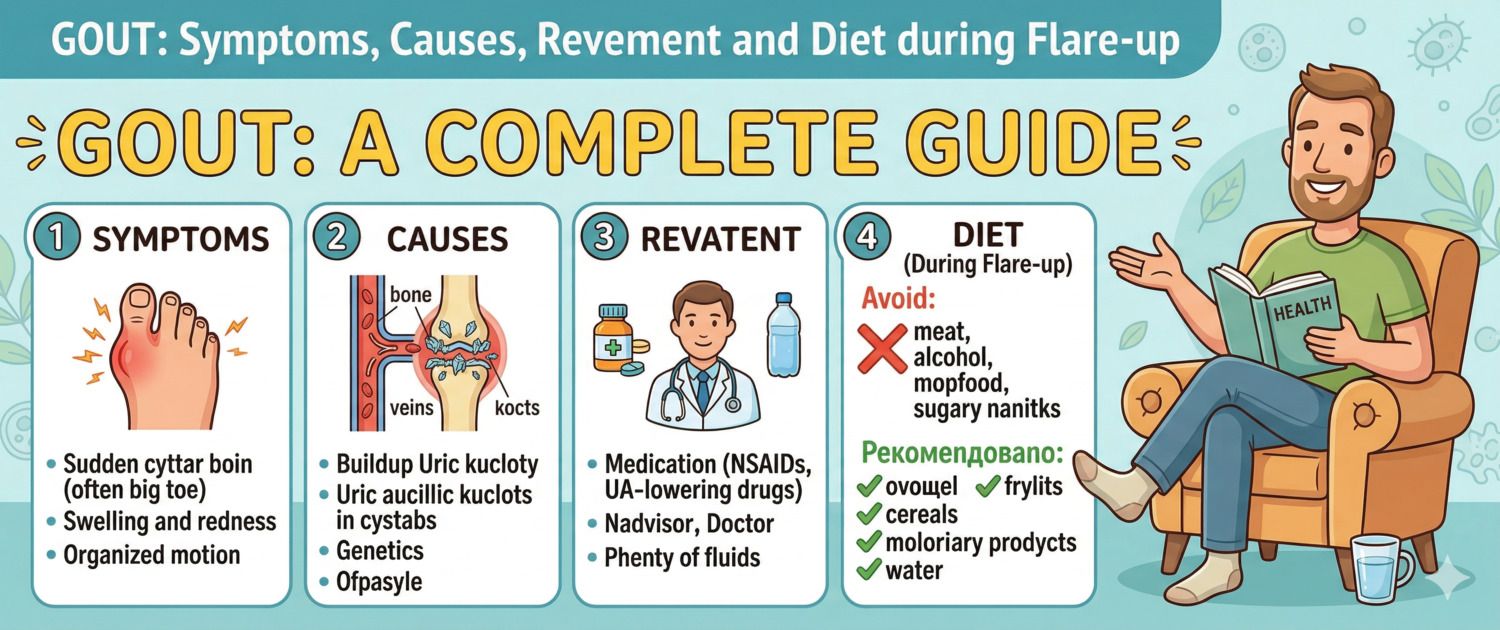
In the middle of the night — sudden, excruciating pain in the big toe. It's red, hot, swollen, and even the touch of a sheet is unbearable. This is the classic onset of an acute gout attack, one of the oldest diseases known to medicine. Hippocrates described it in the 5th century BC, and medieval physicians called it "the disease of kings" due to its link with rich eating. Today gout affects about 1–2% of the adult population worldwide — and that number is rising. Here is what happens in the body during an attack, why the disease keeps coming back, and how to bring it under control.
What Is Gout and How Does It Develop
Gout is a chronic metabolic disease in which crystals of monosodium urate deposit in joints and soft tissues. Picture the joint space as a narrow corridor where microscopic needles start to accumulate. The immune system reacts to them as foreign invaders: an inflammatory cascade fires, fluid floods the joint, tissues swell — and the person wakes up in pain that many compare to a joint being crushed in a vice.
At the root of everything is uric acid. This is the final breakdown product of purines — molecules found in DNA and RNA — which come both from the body's own cell turnover and from food. Normally, uric acid is filtered out by the kidneys and excreted in urine. If too much is produced, or the kidneys clear it less efficiently than usual, the blood level rises. When it exceeds the solubility threshold (~400 µmol/L), crystallisation begins. Urate salts deposit where it is slightly cooler — in peripheral joints, especially the first metatarsophalangeal joint of the foot.
The disease progresses through stages: asymptomatic hyperuricemia → first acute attack → intercritical period → chronic tophaceous gout.
Symptoms of Gout: What an Acute Attack Looks Like
Acute gouty arthritis is one of the most painful episodes in medicine. Its features are so characteristic that an experienced clinician often makes the diagnosis clinically, before any lab results.
Typical presentation:
- Sudden onset, most often at night or in the early morning — when body and joint temperature is lowest, favouring crystallisation
- Agonising pain escalating over 6–12 hours to a peak
- Single joint involvement (monoarthritis) — in 50–70% of first episodes this is the first metatarsophalangeal joint of the big toe (podagra, from Greek for "foot trap")
- Pronounced swelling, redness, and warmth over the joint; skin is stretched and shiny
- Without treatment, an acute attack subsides spontaneously within 5–10 days
When the disease goes untreated and attacks recur, urate crystals accumulate as tophi — firm, chalky nodules under the skin. Favourite sites: ear helix, elbow, dorsum of feet, Achilles tendon. Tophi indicate long-standing chronic gout with years of uncontrolled uric acid levels.
Causes of Hyperuricemia and Risk Factors
Elevated uric acid develops through two main mechanisms — and they often operate together.
Excess urate production:
- Purine-rich diet (red meat, organ meats, oily fish, shellfish)
- Alcohol, especially beer — it simultaneously increases uric acid synthesis and impairs renal excretion
- High-fructose beverages and juices
- Rapid cell breakdown during chemotherapy, radiotherapy, or severe infections
Impaired renal urate excretion:
- Chronic kidney disease — lower filtration means slower urate clearance
- Thiazide and loop diuretics
- Low-dose aspirin (blocks tubular secretion of urate)
- Dehydration
| Risk factor | Relative contribution |
|---|---|
| Male sex (40–60 years) | High — kidneys excrete urate less efficiently in men |
| Postmenopausal women | High — oestrogen's uricosuric effect is lost |
| Purine-rich and high-fructose diet | High |
| Alcohol (especially beer) | High |
| Obesity | Moderate |
| Hypertension and diuretic use | Moderate |
| Chronic kidney disease | High |
| Heredity | Moderate — multiple genes regulate urate transport |
Diagnosis: Which Blood Tests to Order for Gout
Gout is one of the rare conditions where a single "normal" result can mislead. During an acute attack, serum uric acid often dips below its usual level — the body actively drives urate into the inflamed joint. Blood tests are most informative when drawn during the intercritical period, or at least two weeks after an attack has resolved.
Uric acid in blood — the key marker. Diagnostically significant levels: above 420 µmol/L in men, above 360 µmol/L in women. The treatment target is below 360 µmol/L (below 300 µmol/L when tophi are present).
Kidney function test — essential. The kidneys are affected by gout in two directions: impaired function promotes urate retention; prolonged hyperuricemia in turn damages tubular cells. This vicious cycle needs assessment from the outset.
Creatinine — a marker of glomerular filtration. When elevated, GFR is reduced and doses of urate-lowering drugs require adjustment.
C-reactive protein (CRP) — an acute-phase inflammation marker, sharply elevated during an attack. Helps distinguish gout from other arthritides and monitor the response to anti-inflammatory therapy.
Complete blood count — leukocytosis and elevated ESR are expected during an attack. Also important for baseline assessment before starting NSAIDs.
The gold standard of diagnosis is synovial fluid analysis under polarised-light microscopy — identification of needle-shaped monosodium urate crystals directly confirms the diagnosis. In most outpatient settings this is unavailable, so gout is diagnosed clinically, supported by lab data.
Gout Treatment: Acute Attack and Long-Term Strategy
Gout management involves two fundamentally different processes that must not be confused.
Treating an acute attack — the goal is to extinguish inflammation quickly. Three options are used depending on contraindications:
- NSAIDs (naproxen, indomethacin, etoricoxib) — maximum dose at the first sign; most effective when started early
- Colchicine — most specific for gouty arthritis; works by suppressing neutrophil migration to urate crystals
- Glucocorticoids — when the first two are contraindicated, or when multiple joints are involved
A critical point that is often ignored: do not start urate-lowering therapy during an acute attack. A sudden shift in uric acid levels during active inflammation can prolong the attack or trigger a new one.
Long-term urate lowering — the cornerstone of relapse prevention:
- Allopurinol — blocks the enzyme xanthine oxidase, reducing uric acid synthesis; started at a low dose and titrated slowly under lab monitoring
- Febuxostat — a more selective xanthine oxidase inhibitor; used when allopurinol is not tolerated
- Uricosuric agents — enhance renal urate excretion; used less often, contraindicated in nephrolithiasis
Treatment target: sustained uric acid below 360 µmol/L. At this level, existing crystals gradually dissolve and attack frequency falls. In patients with tophi the target is tighter — below 300 µmol/L.
Gout Diet: What to Eliminate and What to Keep
Diet alone cannot replace medication, but no treatment delivers lasting results without dietary correction.
| Category | Foods | Approach |
|---|---|---|
| 🔴 Eliminate | Organ meats (liver, kidneys, brain), game meat, anchovies, sardines, mackerel, alcohol (especially beer), fructose-sweetened drinks | Complete avoidance |
| 🟡 Limit | Red meat, seafood, poultry, legumes, spinach, asparagus, cauliflower, mushrooms | No more than one portion per day |
| 🟢 Unrestricted | Low-fat dairy, eggs, most vegetables, grains, potatoes, bread, cherries | No restriction |
A few specific points:
- Water — 2–3 litres daily. Good hydration supports renal urate excretion and reduces the risk of urate kidney stones.
- Cherries — have a moderate evidence base: anthocyanins reduce uric acid levels and inflammation; some trials showed a 35% reduction in attack frequency.
- Coffee — paradoxically, moderate intake (2–4 cups daily) is associated with lower uric acid levels. The proposed mechanism is that caffeine competes with purines for xanthine oxidase.
Gout and Comorbidities: Why a Broader View Matters
Gout rarely arrives alone. It sits within a cluster of metabolic conditions and frequently coexists with diseases that require parallel management.
Metabolic syndrome — obesity, insulin resistance, dyslipidaemia, and hypertension — is present in 60–70% of gout patients. Insulin resistance directly reduces renal urate excretion, which is one of the physiological links between the two conditions.
Chronic kidney disease — the connection is bidirectional. Impaired renal filtration promotes urate retention; conversely, prolonged hyperuricemia can accelerate kidney damage through direct inflammatory injury to tubular cells. Monitoring kidney function in gout patients is not optional.
Elevated uric acid is independently associated with increased cardiovascular risk: hypertension, coronary artery disease, and stroke. Cardiology follow-up is often part of long-term gout management.
When to See a Doctor Urgently
Several situations call for medical attention without delay:
- First acute arthritis episode — acute joint pain always requires examination. Differentiating gout from septic arthritis, pseudogout, and reactive arthritis cannot be done at home.
- Fever with arthritis — temperature above 38°C combined with a swollen joint may indicate septic arthritis, a medical emergency.
- Tophi appearing — especially if growing rapidly or breaking through the skin; this signals uncontrolled hyperuricemia requiring therapy adjustment.
- Flank pain or blood in urine — may indicate urate kidney stones.
- Uric acid above 600 µmol/L — even without symptoms, requires medical supervision.
Gout is a disease that can genuinely be controlled. With appropriate therapy and lifestyle changes, most patients achieve long-term remission without attacks. The key: do not endure the pain and do not wait for it to pass on its own.
This article is for informational purposes only. Diagnosis and treatment are the responsibility of a qualified rheumatologist or general practitioner.
For informational purposes only
This article is for informational purposes only and does not constitute medical advice, diagnosis, or treatment. Please consult a healthcare professional for medical guidance.