Serotonin Blood Test: Normal Range, Deficiency and Symptoms
Reviewed by the LabReadAI medical team
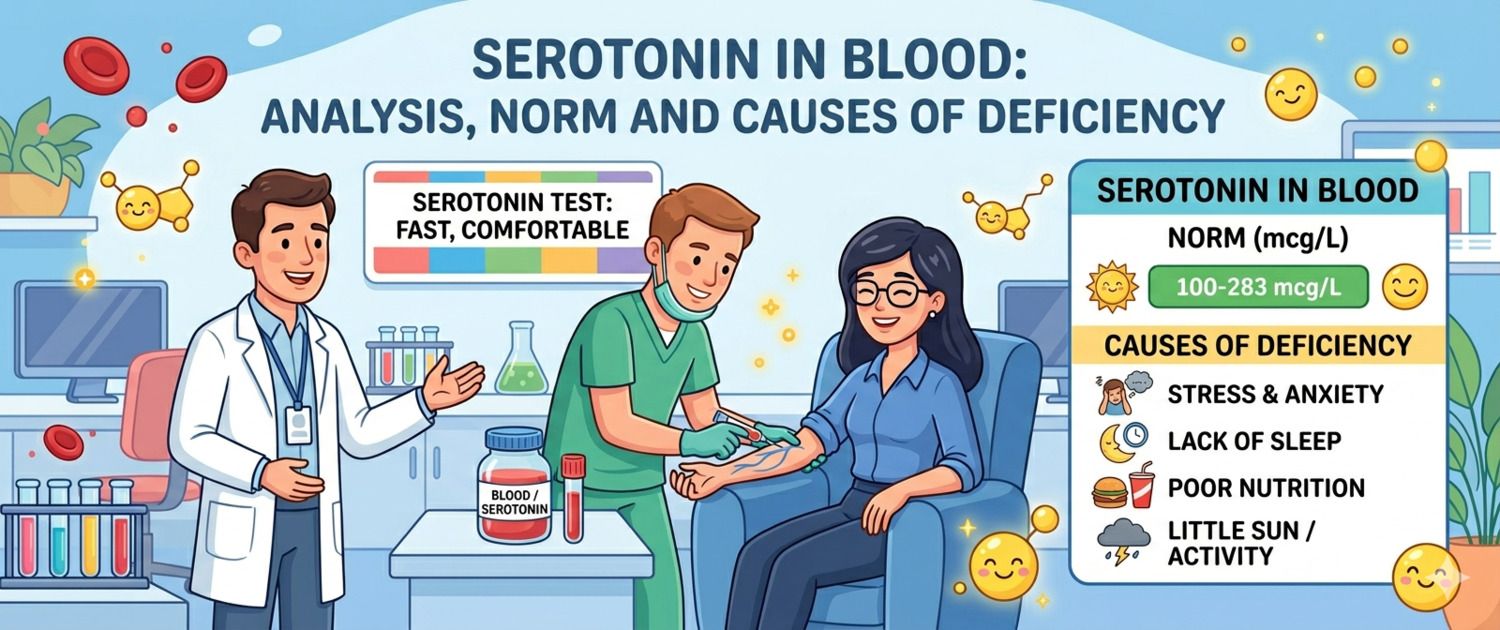
Serotonin is one of the most well-known and most misunderstood biomarkers. It's called the "happiness hormone," yet 95% of body serotonin is in the gut, not the brain. A blood serotonin test says nothing about brain serotonin, and a low result by itself is not a diagnosis. To know when this test is useful, you need to understand the biochemistry and what is actually being measured.
What Serotonin Is and Where It Is Made
Serotonin (5-hydroxytryptamine, 5-HT) is a biogenic amine synthesized from the amino acid tryptophan. It functions both as a neurotransmitter and a tissue hormone, regulating mood, anxiety, appetite, sleep, gut motility, blood clotting, and vascular tone.
Distribution of serotonin in the body:
- Gut (95%) — enterochromaffin cells of the GI mucosa; regulate motility, secretion, and gut immune response
- Platelets (~3%) — capture circulating serotonin and store it in granules; release it on activation, contributing to clotting and vasoconstriction
- Nervous system (~2%) — neurons of the brainstem raphe nuclei; this small fraction governs mood, anxiety, and sleep regulation
This distribution explains a fundamental interpretation challenge: a blood test reflects mainly platelet (tissue) serotonin, not brain serotonin. Serotonin does not cross the blood-brain barrier, so the central pool is synthesized autonomously in the brain from tryptophan that does cross.
Serotonin is the biochemical precursor to melatonin: at night the pineal gland converts serotonin into melatonin, which is why chronically low serotonin frequently coexists with sleep disturbance.
For an overview of serotonin's role as a mood hormone and its link to the gut-brain axis, see the article serotonin: what it is.
Normal Serotonin Range in Blood
Blood testing measures total serotonin (predominantly the platelet fraction). Reference values depend on the laboratory and assay (HPLC, immunoassay).
| Marker | Normal range |
|---|---|
| Serum serotonin (adults) | 50–220 ng/mL |
| Whole-blood serotonin (adults) | 100–280 ng/mL |
| 24-hour urinary 5-HIAA (metabolite) | 1.4–8.0 mg/24h |
5-hydroxyindoleacetic acid (5-HIAA) — the final urinary serotonin metabolite — is often more informative than blood serotonin, particularly for suspected carcinoid syndrome, where 5-HIAA rises far above the upper reference limit.
Unit conversion: ng/mL × 5.68 = nmol/L.
Important caveat: a one-off blood serotonin level is a poor marker of mood or anxiety. Diurnal variation is large, and diet, exercise, and acute stress all distort the result.
How to Prepare for a Serotonin Test
Serotonin is a biochemically unstable analyte requiring strict pre-analytical conditions.
Preparation:
- Strictly fasting, morning (8:00–11:00 AM); 8–14 hours fast beforehand
- For 3 days, avoid foods rich in serotonin and its precursors: bananas, pineapple, kiwi, avocado, tomatoes, eggplant, walnuts, chocolate, cheese, cocoa — they cause falsely elevated results
- Avoid coffee, alcohol, and nicotine for 24 hours
- For 5–7 days, after consulting your doctor, withhold serotonin-active drugs: SSRI antidepressants, MAO inhibitors, methyldopa, high-dose acetaminophen, lithium
- Avoid stress and strenuous exercise the day before testing
Indications for serotonin testing:
- Suspected carcinoid syndrome (neuroendocrine tumor of gut or lung)
- Differential workup of chronic diarrhea, flushing, bronchospasm
- Comprehensive neurotransmitter assessment in prolonged anxiety or depressive states (as part of an extended panel)
- Monitoring serotonin-active drug therapy
A standalone serotonin assay is rarely informative — it is usually evaluated together with magnesium, vitamin B6, ferritin, and a thyroid panel. A full set of these markers is included in the hormone panel and the sleep disorders panel.
Low Serotonin: Causes and Symptoms
Low blood serotonin alone is not a diagnosis — it is a signal to look further.
Causes of low blood serotonin:
| Cause | Mechanism |
|---|---|
| Dietary tryptophan deficiency | Insufficient substrate for synthesis |
| Vitamin B6, magnesium, or zinc deficiency | Cofactors of tryptophan-to-serotonin conversion |
| Vitamin D deficiency | Regulates the key synthetic enzyme (TPH2) |
| Chronic stress and hypercortisolism | Cortisol suppresses tryptophan-to-serotonin conversion |
| Chronic GI disease (IBS, SIBO, celiac) | Disrupts gut serotonin synthesis |
| Long-term SSRI use | Lowers blood levels by blocking platelet reuptake |
| Chronic inflammation | IDO enzyme activation diverts tryptophan into the kynurenine pathway |
| Low omega-3 intake | Impairs serotonin receptor function |
Symptoms associated with serotonin deficiency:
- Low mood, apathy, anhedonia
- Anxiety, intrusive thoughts, panic states
- Sleep disturbance — difficulty falling asleep, light sleep
- Carbohydrate and sugar cravings (rapid but short-lived tryptophan boost)
- Irritability, emotional lability
- Chronic fatigue, migraines, digestive complaints
These symptoms are nonspecific and overlap with hypothyroidism, B12 deficiency, iron deficiency, and chronic stress — so diagnosis requires the full clinical picture, not a single result.
High Serotonin: Causes
Elevated serotonin is less common but clinically more serious than deficiency.
| Cause | Notes |
|---|---|
| Carcinoid syndrome (neuroendocrine tumor) | High urinary 5-HIAA, flushing, diarrhea, bronchospasm |
| Serotonin syndrome (SSRI/MAOI/triptan overdose) | Hyperthermia, muscle rigidity, confusion — medical emergency |
| Dumping syndrome after GI surgery | Episodic elevation |
| Dietary elevation (bananas, nuts, chocolate) | Transient, not pathology |
| Stress, exercise | Transient elevation |
Persistently elevated serotonin (or urinary 5-HIAA more than 2× the upper limit) mandates oncologic screening for a neuroendocrine tumor.
Serotonin and Sleep: The Path to Melatonin
Serotonin is the biochemical precursor to melatonin. During the day, serotonin accumulates in the pineal gland and other tissues; at darkness onset, the enzymes NAT and HIOMT convert it to melatonin. As a result:
- Low serotonin → low melatonin → impaired sleep onset
- Chronic stress with hypercortisolism lowers both hormones simultaneously
- Deficiency of magnesium, B6, or zinc disrupts both synthetic branches
This explains why people with depression and anxiety so often suffer from insomnia — both their serotonin and melatonin systems are simultaneously depleted. The biochemistry of this pair is covered in depth in the article melatonin: what it is.
Serotonin, Dopamine, GABA: Neurotransmitter Balance
Serotonin is just one of four key mood and behavior neurotransmitters. Their balance matters more than any isolated value.
- Serotonin — mood, anxiety, appetite, sleep
- Dopamine — motivation, pleasure, focus
- GABA — inhibition, calming, anti-stress effect
- Noradrenaline — alertness, wakefulness, stress mobilization
Trying to raise or lower a single neurotransmitter in isolation is biochemically naive. Anxious depression, apathetic depression, and panic states represent different patterns of neurotransmitter imbalance and need different therapeutic approaches. A blood serotonin test is useful only as one element of a wider picture.
Synthesis cofactors for all four neurotransmitters overlap: B6, B12, folate, magnesium, zinc, and iron. Their deficiency is a common cause of "neurotransmitter" symptoms, often resolved before psychopharmacology becomes necessary.
When to See a Doctor
- Blood serotonin or urinary 5-HIAA more than 2× the upper reference — mandatory exclusion of a neuroendocrine tumor (abdominal/chest CT or MRI, chromogranin A)
- Persistently low serotonin alongside symptoms of depression and anxiety lasting more than 2 weeks — consultation with a psychiatrist or psychotherapist; in parallel — workup for iron deficiency, B12, vitamin D, and TSH
- Suspected serotonin syndrome (antidepressant + triptan + new tremor, fever, agitation) — emergency medical care
- Chronic diarrhea, flushing, bronchospasm — mandatory 24-hour urinary 5-HIAA testing
This article is for informational purposes only and does not replace professional medical advice. A blood serotonin test has limited diagnostic value outside specific clinical contexts.
For informational purposes only
This article is for informational purposes only and does not constitute medical advice, diagnosis, or treatment. Please consult a healthcare professional for medical guidance.