Polycystic Ovary Syndrome (PCOS): Symptoms, Tests and Treatment
Reviewed by the LabReadAI medical team
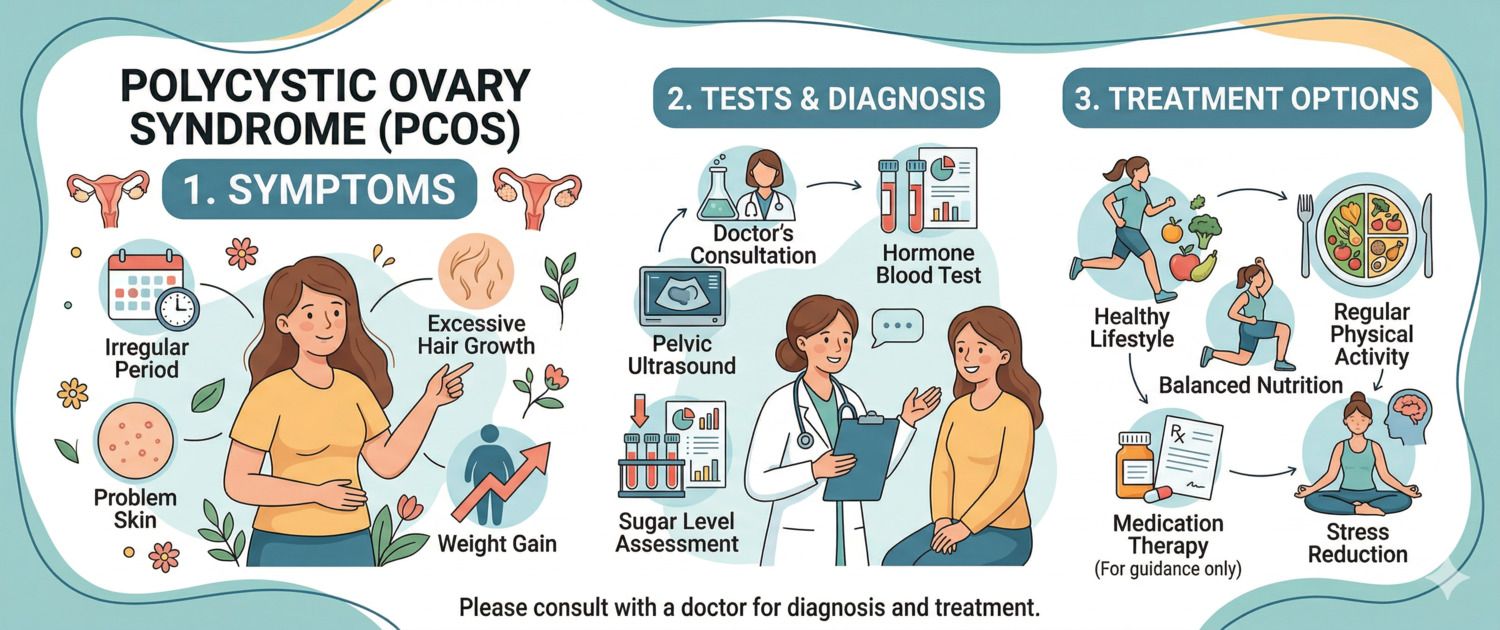
Irregular periods, weight that refuses to budge despite any diet, persistent acne past the age of 25, and unwanted hair in unexpected places — each of these signs on its own can seem trivial. Together, they may point to a single diagnosis: polycystic ovary syndrome. PCOS is the most common endocrine disorder in women of reproductive age, affecting around 10–13% of women worldwide. A significant proportion only discover they have it when they start trying to conceive. Here is what happens in the body with PCOS, and how to manage it effectively.
What Is PCOS and How Does It Develop
Polycystic ovary syndrome is a chronic endocrine condition rooted in dysregulation of female sex hormones. The name is slightly misleading: "polycystic" sounds like multiple cysts, but what it actually describes is a collection of small, immature follicles that cannot complete development and release an egg — in other words, anovulation. This is not the same as an ovarian cyst — a distinct lesion that calls for a different approach.
In a healthy cycle, follicle-stimulating hormone (FSH) and luteinising hormone (LH) operate in a precise rhythm: FSH drives follicle maturation, LH triggers ovulation. In PCOS this balance breaks down: LH is chronically elevated relative to FSH, with an LH:FSH ratio exceeding 2–3:1. The ovaries receive a distorted signal and begin overproducing androgens — chiefly testosterone. Excess testosterone blocks final follicular maturation, and the follicles "stall" at an intermediate stage — this is what produces the characteristic ultrasound appearance: an ovary ringed with 12 or more small follicles around its periphery.
The second key mechanism is insulin resistance. In 65–70% of women with PCOS, cells respond poorly to insulin, and the pancreas compensates by secreting more. Hyperinsulinaemia directly stimulates the ovaries to produce even more androgens — closing the loop. This is why weight loss in PCOS often restores the menstrual cycle: each excess kilogram amplifies insulin resistance, and losing it breaks the vicious circle.
Symptoms of PCOS in Women
PCOS is a heterogeneous syndrome, and two women with the same diagnosis can look very different. Nevertheless, three clusters of features appear most consistently.
Menstrual cycle disturbances:
- Oligomenorrhoea — infrequent periods with cycles longer than 35 days (most common)
- Amenorrhoea — absence of periods for more than 3 months
- Unpredictable cycle length
- Heavy periods after a long gap — due to accumulated endometrium
Signs of hyperandrogenism — excess male sex hormones:
- Hirsutism — male-pattern hair growth: upper lip, chin, chest, abdomen, inner thighs
- Acne and oily skin resistant to standard treatment
- Androgenic alopecia — thinning of scalp hair in a male pattern at the crown
Metabolic disturbances:
- Overweight or obesity, particularly abdominal (fat concentrated around the waist)
- Dark, velvety skin folds in the armpits, neck or groin — acanthosis nigricans, a marker of severe insulin resistance
- Chronic fatigue and mood fluctuations linked to unstable blood sugar levels
An important caveat: PCOS can exist at normal weight and without obvious hirsutism. A slim woman with an irregular cycle is no less likely a candidate for this diagnosis than a woman with obesity and acne.
Causes of PCOS and Risk Factors
The exact cause of PCOS has not been established — this is one of the few areas where medicine openly acknowledges incomplete understanding. The condition clearly has a genetic basis: the risk of PCOS in daughters and sisters of affected women is 5–8 times higher than average. But genes are a predisposition, not a sentence — environment determines whether they are expressed.
| Factor | Role |
|---|---|
| Heredity | Strong — multiple genes regulating insulin sensitivity and steroidogenesis |
| Excess body weight | Amplifies insulin resistance → more ovarian androgens |
| Intrauterine androgen exposure | Epigenetic programming of the ovarian–pituitary axis before birth |
| Gut dysbiosis | Affects oestrogen metabolism and insulin resistance — an active research area |
| Chronic stress | Disrupts the hypothalamus–pituitary–ovarian axis via cortisol |
| Physical inactivity | Reduces tissue insulin sensitivity |
Diagnosing PCOS: Rotterdam Criteria and Blood Tests
The diagnosis is made using the 2003 Rotterdam Criteria — at least two of three must be present:
- Ovulatory dysfunction (oligo- or anovulation)
- Clinical or biochemical signs of hyperandrogenism
- Polycystic ovarian morphology on ultrasound (12+ follicles of 2–9 mm diameter in one ovary, or ovarian volume > 10 mL)
Before confirming PCOS, other causes of the same symptoms must be excluded: hypothyroidism, hyperprolactinaemia, congenital adrenal hyperplasia, and androgen-secreting tumours.
Essential blood tests:
- LH and FSH — ratio and absolute values assessed. In PCOS, LH:FSH > 2–3:1, though this is not a mandatory diagnostic criterion. Drawn on cycle days 2–5.
- Testosterone — total and free; elevated in 60–80% of women with PCOS. Drawn fasting in the morning on cycle days 2–5.
- Oestradiol — may be normal or mildly reduced in PCOS; important for assessing follicular function.
- Insulin fasting + glucose → HOMA-IR calculation. The practical gold standard for insulin resistance assessment in outpatient practice.
- Glucose fasting and oral glucose tolerance test (OGTT) — the risk of prediabetes in PCOS is 5–7 times higher than in the general population.
- TSH — hypothyroidism produces overlapping symptoms and must be excluded first.
- HbA1c — reflects average glucose over three months; recommended as a metabolic screening tool in PCOS.
Pelvic ultrasound — transvaginal preferred; ovarian morphology and endometrial thickness are assessed. Ideally performed on cycle days 5–7 when a cycle is present.
Treating PCOS: Insulin Resistance, Weight Loss and What Actually Works
There is no single "PCOS pill" — treatment is tailored to the specific goal: restoring the cycle, managing hirsutism and acne, preparing for pregnancy, or correcting metabolic disturbances.
Lifestyle modification — first line for every goal:
Weight loss of 5–10% from baseline in overweight women restores ovulation in 30–55% of patients without any medication. The mechanism is direct: less fat → less insulin resistance → fewer ovarian androgens. Moderate aerobic exercise (150 minutes per week) amplifies this effect independently of weight change.
Metformin — the primary drug for the metabolic variant of PCOS:
- Reduces insulin resistance and androgen levels
- Restores cycle regularity in approximately 50% of women
- Lowers the risk of developing type 2 diabetes
- Prescribed when carbohydrate metabolism is impaired or cardiometabolic risk is high
Combined oral contraceptives (COCs) — when the goal is cycle regulation and management of hirsutism/acne without wanting pregnancy:
- Suppress excess LH secretion → reduce ovarian androgen synthesis
- Raise sex hormone-binding globulin (SHBG) → lower free testosterone
- COCs containing antiandrogenic progestins (drospirenone, cyproterone) are most effective for acne and hirsutism
When pregnancy is desired:
- Letrozole (aromatase inhibitor) — first-line agent for ovulation induction in PCOS; superior in efficacy to previously used clomiphene
- Metformin may be added as an adjunct
- IVF — when ovulation induction fails over 3–6 cycles
PCOS and Pregnancy: What to Know
PCOS is a common cause of anovulatory infertility, but it is not a verdict. Most women with PCOS can conceive — with treatment or, in milder cases, without it. When conception does not happen, a doctor orders female infertility tests to assess ovulation, tubal patency and ovarian reserve.
During pregnancy, PCOS is associated with elevated risks of:
- Gestational diabetes — 2–3 times higher than average (due to underlying insulin resistance)
- Preeclampsia and gestational hypertension
- Preterm labour
- First-trimester miscarriage
This does not mean pregnancy is contraindicated — it means it requires closer monitoring. Glucose and blood pressure surveillance, early gestational diabetes screening (OGTT at 24–28 weeks, or earlier when risk factors are present) are standard practice.
One important point that is often not communicated: in anovulatory PCOS, standard ovulation predictor kits are unreliable — the cycle is irregular, and chronically elevated LH produces false positives on ovulation tests. Tracking ovulation in PCOS is best done with ultrasound follicle monitoring by a reproductive gynaecologist.
When to See a Doctor
PCOS is a chronic condition that requires ongoing management, not a one-off course of treatment. See a gynaecologist or endocrinologist if:
- Cycles are irregular (longer than 35 days or shorter than 21) for more than 3 months
- There is significant hair growth on the face or body, or acne that does not respond to standard treatment
- Weight is increasing on a habitual diet, especially around the abdomen
- Pregnancy is planned and cycles are irregular — do not wait the standard 12 months of trying that applies with regular ovulation; PCOS warrants earlier specialist review
- PCOS symptoms are present in a woman with a family history of type 2 diabetes or cardiovascular disease — metabolic risk is substantially higher in this group
PCOS responds well to management. A tailored approach — accounting for weight, goals and coexisting metabolic disturbances — allows most women to live with PCOS without significant impact on quality of life, and to fulfil their reproductive plans.
This article is for informational purposes only. Diagnosis and treatment are the responsibility of a gynaecologist or endocrinologist.
For informational purposes only
This article is for informational purposes only and does not constitute medical advice, diagnosis, or treatment. Please consult a healthcare professional for medical guidance.