Testosterone: Normal Range for Men and Women, Causes
Reviewed by the LabReadAI medical team
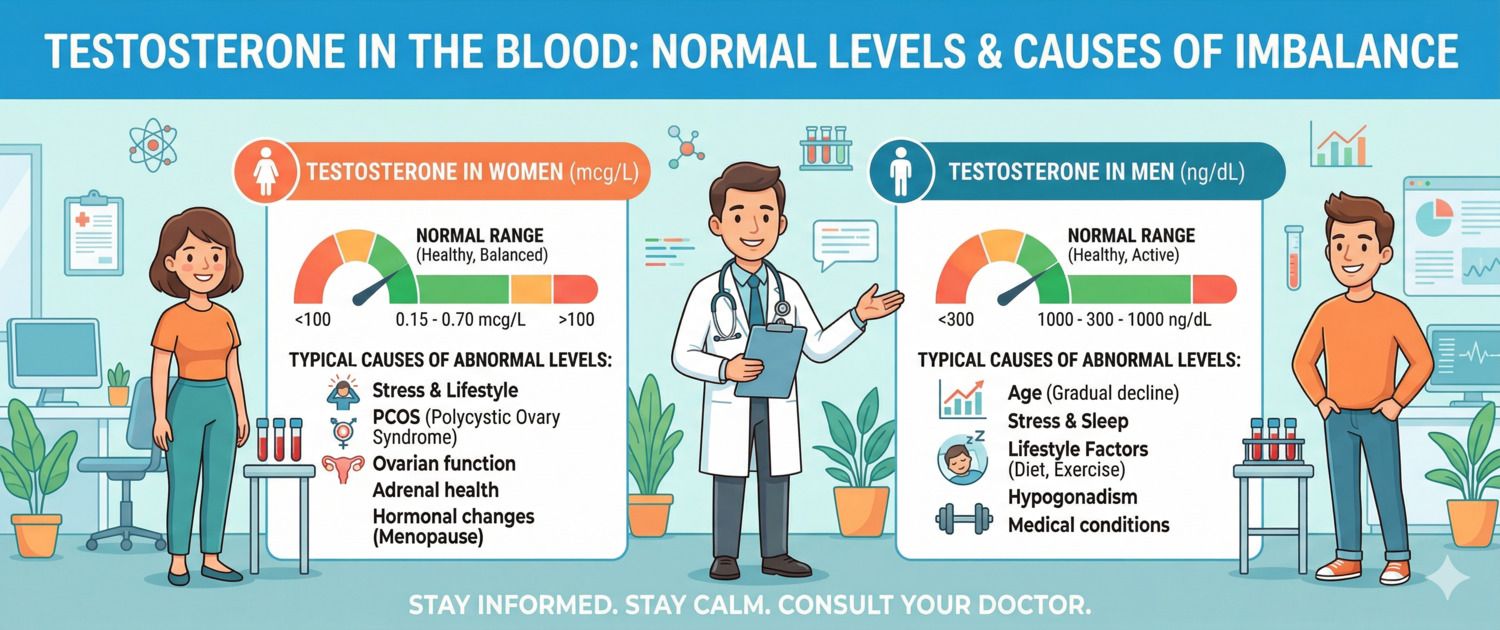
Testosterone is a hormone most people have opinions about but few truly understand. In men it is associated with strength and libido; in women it is often seen as "male" and unwanted. Reality is more nuanced: testosterone is essential for both sexes, normal ranges differ dramatically between them, and the raw number in a test result can be misleading without accounting for SHBG (sex hormone-binding globulin). Here is what to measure, how to interpret it, and when an abnormal result actually warrants attention.
What Is Testosterone and Why Is It Measured
Testosterone is a steroid hormone from the androgen group. In men, approximately 95% is produced by Leydig cells in the testes under the control of luteinising hormone (LH) from the pituitary gland. In women, testosterone is synthesised in the ovaries, adrenal glands, and peripheral tissues — in considerably smaller amounts, but with an important biological role.
Testosterone's functions extend well beyond reproduction. It regulates muscle mass and strength, bone density, fat distribution, libido, erythropoiesis (hence the higher haemoglobin in men), mood, and cognitive function. In women, testosterone influences libido, energy, and muscle tone.
Testing is ordered for: symptoms of deficiency in men (reduced libido, erectile dysfunction, fatigue, muscle loss), signs of excess in women (acne, hirsutism, cycle disorders — PCOS), infertility, gynaecomastia in men, delayed puberty in adolescents, and monitoring of hormonal therapy.
Normal Testosterone Levels: Total, Free and SHBG
Testosterone in the bloodstream exists in three forms. Approximately 60% is tightly bound to SHBG — biologically inactive. Around 38% is loosely bound to albumin — weakly enough to be released. Only 1–3% is free testosterone, acting directly on cellular receptors.
This is why normal total testosterone does not guarantee normal hormonal status: when SHBG is elevated, the active fraction may be reduced despite a normal total figure. This is especially relevant in older men and women taking oestrogen-containing medications (oral contraceptives raise SHBG and lower free testosterone).
Normal total testosterone in men:
| Age | Normal range (nmol/L) |
|---|---|
| 18–50 years | 12.0–35.0 |
| 50–60 years | 10.0–30.0 |
| Over 60 years | 8.0–28.0 |
Normal total testosterone in women:
| Age | Normal range (nmol/L) |
|---|---|
| 18–50 years (reproductive) | 0.31–3.78 |
| Postmenopause | 0.10–1.70 |
Free testosterone in men: 0.20–0.70 nmol/L (5.8–20.5 pg/mL) Free testosterone in women: 0.003–0.030 nmol/L
Reference ranges vary substantially between laboratories and methods — always use the values printed on your specific report.
Why Is Testosterone Low in Men?
Total testosterone below 12 nmol/L in men is called hypogonadism. It is divided into primary (testicular failure) and secondary (insufficient pituitary stimulation).
Primary hypogonadism: testicular trauma, orchitis, cryptorchidism, chemotherapy or radiotherapy, Klinefelter syndrome (XXY), age-related testicular decline.
Secondary hypogonadism — LH/FSH deficiency: pituitary adenoma, hyperprolactinaemia (prolactin suppresses LH), hypothyroidism (disrupted GnRH regulation via TSH changes), chronic stress (elevated cortisol competes with testosterone for pregnenolone), obesity (adipose tissue aromatase converts testosterone to oestradiol), insulin resistance and type 2 diabetes.
Symptoms of low testosterone in men: reduced libido, erectile dysfunction, chronic fatigue, loss of muscle mass and strength, increased abdominal fat, gynaecomastia, depression, cognitive impairment, and reduced bone density.
For a detailed discussion of causes and correction strategies, see the article how to increase testosterone in men.
Why Is Testosterone High in Women?
In women, moderately elevated testosterone is one of the key biochemical markers of PCOS and hyperandrogenaemia.
Polycystic ovary syndrome (PCOS) — the most common cause of hyperandrogenaemia in women of reproductive age. Total and free testosterone are elevated; SHBG is often reduced, amplifying the androgenic effect.
Congenital adrenal hyperplasia (CAH) — impaired cortisol synthesis leads to excess production of androgenic precursors.
Androgen-secreting ovarian or adrenal tumours — rare but important. Very high testosterone (> 5–6 nmol/L in a woman) makes a tumour the first priority to exclude.
Symptoms of hyperandrogenaemia in women: acne (particularly on the chin and neck), hirsutism (excess hair growth in a male-pattern distribution), male-pattern hair thinning, menstrual irregularities, anovulation and infertility, and voice deepening in severe cases.
Testosterone and Cardiovascular Risk
The relationship between testosterone and cardiometabolic health is bidirectional. Low testosterone in men is associated with insulin resistance, dyslipidaemia (reduced HDL, elevated LDL), obesity, and increased cardiovascular risk. Monitoring the lipid profile via a lipid panel is part of a comprehensive assessment in hypogonadism.
In women with PCOS, elevated testosterone frequently coexists with metabolic syndrome and an increased risk of diabetes.
How to Prepare for a Testosterone Test
Testosterone has a pronounced diurnal rhythm: it peaks in the morning (7:00–10:00 am) and falls by 20–35% by evening. Therefore:
- Blood must be drawn strictly in the morning, between 7:00 and 10:00 am, fasting
- Avoid intense physical exercise for 24–48 hours before the test — it temporarily raises testosterone
- Avoid stress the day before — elevated cortisol suppresses testosterone
- Inform the doctor about hormonal medications, anabolic steroids, and corticosteroids
- For suspected hypogonadism — repeat on a second day to confirm
For a complete picture, testosterone is always evaluated alongside SHBG — only then can free testosterone be calculated and true androgenic activity assessed. When secondary hypogonadism is suspected, LH, FSH, and prolactin are also measured.
Spermatogenesis in the context of low testosterone is evaluated separately through a semen analysis.
When to See a Doctor
Schedule an appointment with an endocrinologist or andrologist if:
- Testosterone is persistently low (two measurements below 12 nmol/L in men) with clinical symptoms
- Signs of hyperandrogenaemia in a woman — acne, hirsutism, cycle irregularities
- Infertility in a couple — testosterone is part of the baseline investigation for both partners
- Gynaecomastia in a man — requires excluding a hormonal cause
Urgent consultation is needed for:
- Very high testosterone in a woman (> 5 nmol/L) — to rule out an androgen-secreting tumour
- Low testosterone combined with visual field defects or severe headaches — possible pituitary adenoma
Testosterone is easy to measure incorrectly and easy to interpret out of context. A morning draw, SHBG assessment, and clinical picture — three conditions without which a number on a report tells you very little.
For age-specific reference ranges by decade and test preparation guidance, see the article testosterone after 40 in men.
This article is for informational purposes only. Interpreting test results and prescribing treatment is exclusively the responsibility of a physician.
For informational purposes only
This article is for informational purposes only and does not constitute medical advice, diagnosis, or treatment. Please consult a healthcare professional for medical guidance.