Kruger Sperm Morphology: Normal Values and Interpretation
Reviewed by the LabReadAI medical team
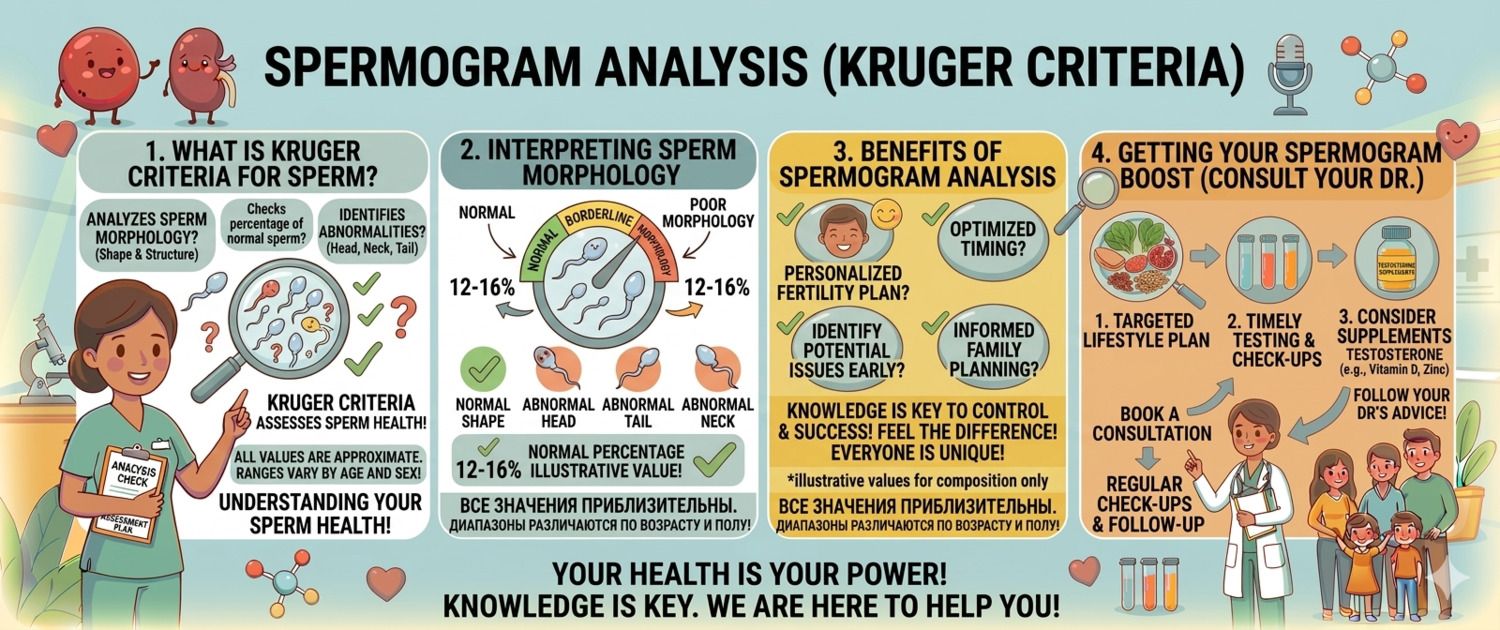
A couple has been trying to conceive for several months without success — and the doctor refers the man for a semen analysis. The report reads: "Kruger morphology — 2%." What does this mean and how serious is it? The Kruger strict criteria spermogram is the most rigorous standard for assessing sperm morphology, used in reproductive medicine and IVF preparation. Unlike a standard semen analysis, Kruger criteria evaluate the shape of each spermatozoon with exceptional precision. This article explains what is measured, how to interpret the result, what causes abnormalities, and what can genuinely be done to improve them.
What Is the Kruger Spermogram and How It Differs from a Standard Analysis
A spermogram is a comprehensive semen analysis that covers several parameters: volume, concentration, motility, and morphology of spermatozoa. A standard WHO spermogram assesses morphology using "loose" criteria — only an obviously malformed sperm cell is classified as abnormal.
The Kruger strict criteria spermogram (Tygerberg strict criteria) applies a fundamentally different approach: only a spermatozoon with a perfect head, neck, and tail geometry is considered normal. Any deviation from the ideal disqualifies the cell. This is why the percentage of normal forms by Kruger criteria is always significantly lower than by standard criteria.
Why such strictness? Research has shown that Kruger morphology correlates with fertility far more accurately than loose criteria. When morphology falls below 4%, the probability of fertilisation in natural conception and standard IVF drops sharply. This indicator is what determines whether ICSI (intracytoplasmic sperm injection) is needed instead of conventional IVF.
Spermogram Reference Values: Full WHO 2021 Table
The current WHO reference values (5th and 6th edition guidelines) are the international standard for semen analysis interpretation.
| Parameter | Normal (WHO 2021) |
|---|---|
| Ejaculate volume | ≥ 1.4 mL |
| Sperm concentration | ≥ 16 million/mL |
| Total sperm count | ≥ 39 million |
| Progressive motility (PR) | ≥ 30% |
| Total motility (PR + NP) | ≥ 42% |
| Morphology by Kruger (normal forms) | ≥ 4% |
| Vitality (live spermatozoa) | ≥ 54% |
| pH | 7.2–8.0 |
| Liquefaction time | ≤ 60 minutes |
One key point after the table: the 4% Kruger morphology threshold reflects the fact that in most fertile men only 4–15% of spermatozoa have an ideal shape. This is not an error — it reflects biological reality: nature produces large numbers of "imperfect" cells, but even a small percentage of morphologically normal ones is sufficient for fertilisation.
Interpreting Kruger Morphology: What Is Assessed
Strict Kruger criteria evaluate each spermatozoon across three sections.
Head — the most critical part. A normal head is oval, with a smooth outline, length 3–5 µm, width 2–3 µm, length-to-width ratio 1.5–1.75. The acrosome covers 40–70% of the head area. Any deviation — large, small, double, pyriform, round, pin, or amorphous head — classifies the cell as abnormal.
Neck and midpiece — must be thin and regular, without thickenings or angulations.
Tail — straight or slightly curved, approximately 45 µm long. Coiled, shortened, double, or broken tails are abnormal.
A high proportion of abnormal forms is called teratozoospermia — defined as morphology below 4% by Kruger criteria. Isolated teratozoospermia with normal concentration and motility often responds well to correction.
Other terms commonly seen in semen analysis reports: oligozoospermia (reduced concentration < 16 million/mL), asthenozoospermia (reduced motility), azoospermia (no spermatozoa present), oligoasthenoteratozoospermia (OAT syndrome) — combined impairment of all three parameters.
Causes of Spermogram Abnormalities
Spermogram abnormalities are rarely isolated — most have one of several well-studied underlying causes.
Hormonal disorders. Reduced testosterone impairs spermatogenesis — testosterone is the primary anabolic signal for the spermatogenic epithelium. Hyperprolactinaemia: elevated prolactin suppresses LH and reduces testosterone, indirectly impairing sperm production. Thyroid disorders (abnormal TSH) also affect sperm quality through hormonal environment changes.
Varicocele — dilation of the pampiniform venous plexus. The most common correctable cause of male infertility: it raises testicular temperature, impairs blood supply, and worsens all spermogram parameters. Identified by ultrasound.
Inflammatory conditions. Past orchitis (especially mumps orchitis in adults), epididymitis, and chronic prostatitis all reduce sperm quality. In a complete blood count, active inflammation produces leucocytosis.
Cryptorchidism — a history of undescended testis, even after surgical correction, reduces spermatogenesis.
Lifestyle and environmental factors. Chronic stress via cortisol suppresses testosterone — the mechanism is explained in the article how to lower cortisol (the stress physiology is identical in both sexes). Testicular overheating (hot baths, saunas, prolonged sitting, tight underwear) — testes must be kept 2–4°C below body temperature. Smoking, alcohol, anabolic steroids (the latter completely suppress endogenous testosterone and halt spermatogenesis). Occupational hazards: pesticides, heavy metals, radiation, organic solvents.
Genetic causes. Klinefelter syndrome (XXY), Y-chromosome microdeletions, CFTR gene mutations — when azoospermia or severe oligozoospermia is found, genetic testing is mandatory.
How to Prepare for a Spermogram
Preparation critically affects the result — failure to follow these rules renders the analysis meaningless:
- Sexual abstinence of 2–5 days before the test. Less than 2 days — insufficient concentration and count. More than 7 days — motility and morphology worsen as sperm "age."
- No alcohol for at least 5–7 days, ideally 2–3 weeks.
- No overheating for 2–3 weeks: sauna, hot bath, exercise causing groin overheating.
- No acute illness or fever in the 3 months before testing — the spermatogenesis cycle takes 72–74 days, and any febrile illness will impair results for months.
- Collection — by masturbation into a sterile container, preferably at the laboratory. Condoms and coitus interruptus are not acceptable — contamination.
- Delivery — within 30–60 minutes at body temperature (carried in a breast pocket).
When an initial result is poor, always repeat the analysis after 2–3 months. A single poor spermogram is not a diagnosis: stress, illness, or failure to prepare correctly can temporarily worsen all parameters.
How to Improve Spermogram Results
The fundamental principle: spermatogenesis takes 72–74 days. The results of any lifestyle changes or treatment cannot be assessed in less than 3 months.
For varicocele — surgical treatment (microsurgical varicocelectomy) improves spermogram parameters in 60–80% of patients and increases the probability of natural conception. The decision is made by the andrologist based on the clinical picture.
For hormonal disorders — correct the underlying cause. Normalising testosterone, reducing prolactin with dopamine agonists, and treating hypothyroidism with levothyroxine often independently improve the spermogram. For more detail on testosterone, see the article how to increase testosterone in men.
Lifestyle: normalise sleep (testosterone is synthesised at night), reduce stress, stop alcohol and smoking, take moderate exercise (avoiding groin overheating), achieve a healthy weight.
Antioxidants: oxidative stress is a leading cause of sperm DNA damage. Coenzyme Q10, vitamin C, vitamin E, zinc, selenium, and folic acid — the evidence base is moderate, but a combination of risk factors combined with these nutrients at physiological doses is reasonable.
ICSI — when Kruger morphology is below 4% and teratozoospermia is severe, the standard ART procedure is not conventional IVF but ICSI: a single selected normal spermatozoon is injected directly into the egg. This bypasses the requirement for a large number of normal-form sperm.
When to See an Andrologist or Reproductive Specialist
A routine appointment is appropriate when any spermogram parameter is abnormal on a confirmed repeat test at 2–3 months.
Urgent consultation is needed for:
- Azoospermia (no spermatozoa present) — urgent diagnostics: secretory versus obstructive cause, genetics, hormonal profile
- Severe oligozoospermia (< 5 million/mL) — high probability of a genetic cause
- Poor spermogram combined with testicular pain, asymmetry, or a palpable lump — rule out varicocele and testicular tumour
In a couple where the woman's ovulation and cycle are normal yet pregnancy does not occur — a male factor is present in approximately 50% of cases. A Kruger spermogram is neither a verdict nor a final answer — it is the starting point of a diagnostic process that, for most causes, has a concrete treatment path.
This article is for informational purposes only and does not replace medical advice. For any spermogram abnormalities, consult an andrologist or reproductive specialist.
For informational purposes only
This article is for informational purposes only and does not constitute medical advice, diagnosis, or treatment. Please consult a healthcare professional for medical guidance.