Prolactin: What This Hormone Is, Normal Levels and High Causes
Reviewed by the LabReadAI medical team
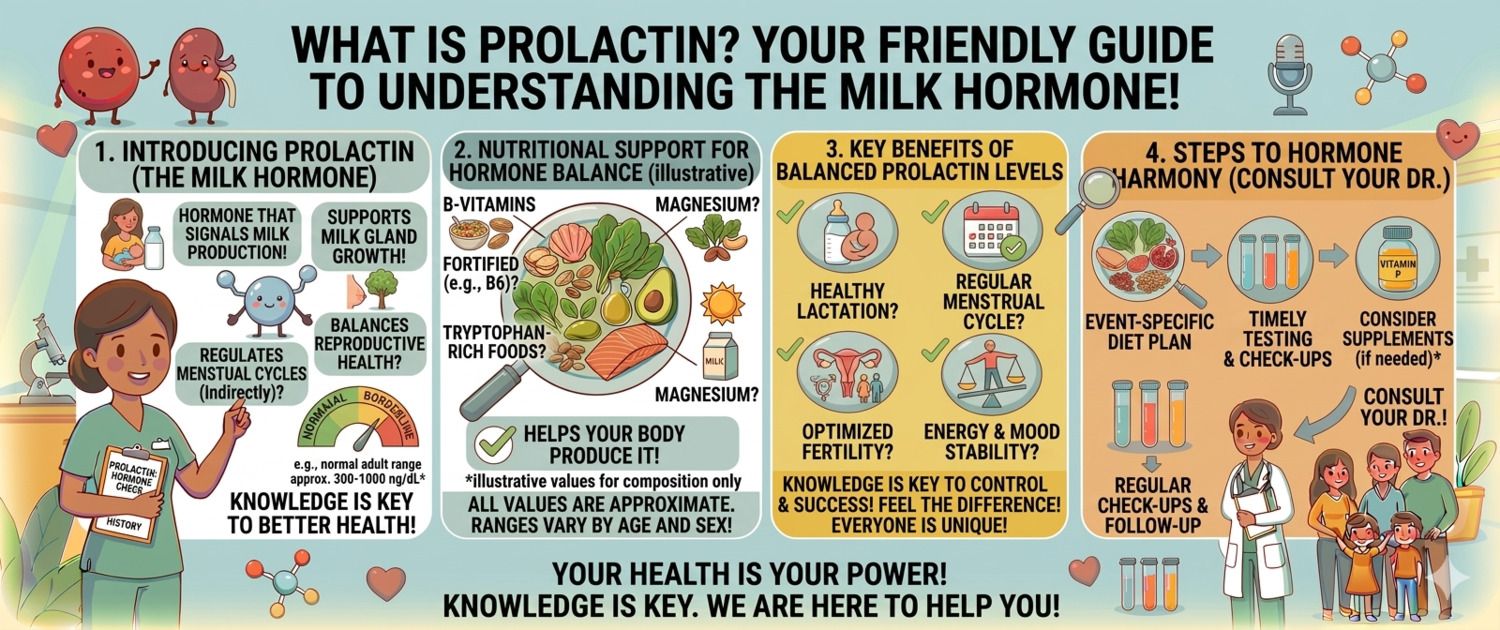
Nipple discharge outside of pregnancy and breastfeeding, unexplained menstrual irregularities, or a significant drop in libido in a man — all of these can point to excess of a single hormone. Prolactin is produced by the pituitary gland and orchestrates lactation, but its influence on the body extends much further: it interferes with sex hormones, immune function, and even pain perception. Elevated prolactin is one of the most common endocrine findings on routine testing — and one of the most underestimated. This article explains what the hormone does, what counts as normal, why it rises, and what to do when levels are chronically elevated.
What Is Prolactin and What Does It Do?
Prolactin is a protein hormone synthesised by lactotroph cells in the anterior pituitary gland. Its best-known function is stimulating milk production after delivery. But the hormone's role extends well beyond that.
What else prolactin does:
- Suppresses ovulation — the high prolactin of breastfeeding provides physiological contraception. The same mechanism, when triggered pathologically, disrupts the menstrual cycle and causes infertility.
- Affects libido and potency — it inhibits gonadotropin secretion (FSH and LH), reducing testosterone production in men and oestrogen in women.
- Participates in immune function — prolactin receptors are expressed on lymphocytes, and the hormone modulates inflammation.
- Regulates fluid and salt balance — acting on the kidneys alongside aldosterone.
- Has analgesic properties — elevated prolactin during stress partially raises pain thresholds.
Prolactin secretion is regulated by dopamine: dopamine tonically inhibits prolactin release from the pituitary. Any factor that reduces dopamine levels or blocks its receptors leads to a rise in prolactin — which explains most drug-induced and stress-related hyperprolactinaemias.
How to Get Tested: Preparation and Conditions
Prolactin is one of the most sensitive hormones from a pre-analytical standpoint. Its level responds to dozens of physiological stimuli, and without proper preparation the result will be unreliable.
Preparation guidelines:
- Blood is drawn fasting in the morning — at least 8–12 hours after the last meal.
- At least 2–3 hours should pass between waking and the blood draw: prolactin is physiologically elevated in the first hours after sleep.
- Avoid sexual activity and breast stimulation for 24 hours — these are powerful physiological triggers of prolactin secretion.
- Avoid intense physical exercise for 24 hours beforehand.
- Minimise stress before the draw — even venepuncture itself raises prolactin in anxious patients. In cases of significant anxiety, blood may be drawn through an intravenous catheter after 30 minutes of rest.
- Inform your doctor of all medications: antipsychotics, antidepressants, metoclopramide, verapamil, domperidone, and many others raise prolactin pharmacologically.
For monitoring prolactin over time — always use the same laboratory and the same collection conditions. A single elevated result without symptoms is not a diagnosis: the level can rise from a breast examination performed just hours before the draw.
An important concept: macroprolactin. Approximately 15–25% of laboratory hyperprolactinaemia is explained by circulating large prolactin molecules (macroprolactin), which are biologically inactive. These patients have no symptoms but the test shows a high level. To exclude this, a macroprolactin test using polyethylene glycol precipitation is ordered.
Prolactin Normal Range: Table for Women, Men and Pregnancy
Reference ranges differ substantially by sex, age, and physiological state. Units also vary: mIU/L and ng/mL (1 ng/mL ≈ 21 mIU/L).
| Category | Normal (mIU/L) | Normal (ng/mL) |
|---|---|---|
| Women of reproductive age | 40–530 | 2–25 |
| Postmenopausal women | 40–290 | 2–14 |
| Men | 40–360 | 2–17 |
| Pregnant (1st trimester) | up to 3,500 | up to 165 |
| Pregnant (2nd trimester) | up to 7,000 | up to 330 |
| Pregnant (3rd trimester) | up to 10,000 | up to 470 |
| Breastfeeding women | up to 20,000+ | up to 950+ |
The rise in prolactin during pregnancy is physiological, driven by oestrogen stimulation — entirely normal. In non-breastfeeding women after delivery, levels return to normal within 2–3 weeks; in breastfeeding women, they remain elevated throughout lactation.
Norms vary considerably between laboratories depending on the method — always check the reference range on your specific report.
High Prolactin (Hyperprolactinaemia): Causes and Symptoms
Hyperprolactinaemia is a prolactin level above the upper limit of normal for one's sex and physiological state. By mechanism, it is divided into physiological, pharmacological, pathological, and idiopathic forms.
Physiological causes (normal, no treatment needed):
- Pregnancy and breastfeeding
- Sleep and the first hours after waking
- Physical exertion, stress, pain
- Sexual intercourse and breast stimulation
- Hypoglycaemia
Pharmacological causes — the second most common group in non-pregnant individuals:
- Antipsychotics (haloperidol, risperidone, chlorpromazine) — block dopamine receptors
- Metoclopramide, domperidone — prokinetics frequently prescribed for nausea
- Antidepressants (tricyclics, some SSRIs)
- Verapamil — a calcium channel blocker
- Oral contraceptives with high oestrogen doses
- Opioid analgesics with prolonged use
Pathological causes — require investigation and treatment:
Prolactinoma — a benign pituitary adenoma that secretes prolactin. The most common hormonally active pituitary tumour. Microprolactinomas (< 10 mm) are far more common in women; macroadenomas (> 10 mm) are more frequent in men. Prolactin in prolactinoma often exceeds 2,000–3,000 mIU/L; with a macroadenoma it can reach 100,000 mIU/L or more.
Hypothyroidism — reduced thyroid function raises TSH, which stimulates prolactin release. This is why TSH is always checked alongside prolactin when cycle irregularities are investigated — the connection is direct and clinically significant.
Polycystic ovary syndrome (PCOS) — mild hyperprolactinaemia occurs in 15–20% of women with PCOS.
Kidney and liver disease — impair prolactin clearance.
Other hypothalamic-pituitary tumours — craniopharyngioma, meningioma — can mechanically disrupt dopaminergic control through a "stalk effect."
Symptoms of hyperprolactinaemia in women:
- Menstrual cycle disorders — from irregular periods to complete amenorrhoea
- Galactorrhoea — nipple discharge unrelated to pregnancy or breastfeeding
- Infertility due to suppressed ovulation
- Reduced libido and vaginal dryness
- Osteoporosis from prolonged oestrogen deficiency
Symptoms in men:
- Reduced libido and erectile dysfunction
- Gynaecomastia — breast tissue enlargement
- Galactorrhoea (uncommon)
- Impaired fertility — disrupted spermatogenesis
- Osteoporosis with prolonged disease
Prolactin and Reproductive Health: Effect on the Cycle and Fertility
Prolactin is one of the primary disruptors of the reproductive axis. The mechanism is straightforward: hyperprolactinaemia suppresses pulsatile GnRH secretion in the hypothalamus, reducing FSH and LH output from the pituitary. Without adequate levels of these hormones, follicles cannot mature to the dominant stage, ovulation does not occur, and the cycle becomes anovulatory.
For more on how suppressed ovulation manifests clinically and which methods confirm an anovulatory cycle, see ovulation: what it is and how to track it.
In men, elevated prolactin suppresses testosterone synthesis in Leydig cells and impairs sperm maturation. This is frequently discovered when couples are investigated for infertility — moderate hyperprolactinaemia is found in the male partner with a normal pituitary MRI, and fertility recovers after prolactin is normalised.
The good news: most hyperprolactinaemias respond well to medical treatment. Dopamine agonists (cabergoline, bromocriptine) normalise prolactin in 80–90% of patients, restoring menstrual cycles and fertility without surgery.
Low Prolactin: When Does It Matter?
Hypoprolactinaemia — prolactin below the lower reference limit — is far less common than hyperprolactinaemia and is clinically insignificant in most cases outside the postpartum period.
The exception is the postpartum period. If prolactin does not rise after delivery and a woman cannot breastfeed, this may indicate Sheehan's syndrome — pituitary necrosis from massive blood loss during childbirth. This is rare but serious, and affects the entire pituitary function.
In all other settings, a low prolactin without symptoms is a laboratory finding with no clinical significance. It may occur with dopamine agonist therapy, levodopa use, or hypopituitarism of any cause.
When Prolactin Results Require Medical Attention
A mildly elevated prolactin (up to 1,000–1,500 mIU/L) without symptoms calls for a repeat test under proper conditions before drawing any conclusions. But several situations require prompt endocrinology consultation:
- Prolactin above 2,000 mIU/L on two tests with proper preparation — high likelihood of prolactinoma
- Prolactin above 5,000 mIU/L — pituitary MRI is mandatory
- Galactorrhoea in a woman who is not breastfeeding, or in any man
- Menstrual cycle disruption or amenorrhoea combined with elevated prolactin
- Infertility in a couple with confirmed hyperprolactinaemia in one partner
- Headaches and visual disturbance (bitemporal hemianopia) with high prolactin — signs of a large pituitary tumour
- Erectile dysfunction and reduced libido in a man with elevated prolactin
- High prolactin with a normal pituitary MRI — secondary causes must be excluded: hypothyroidism, renal failure, drug effect
Treatment depends on the cause: drug-induced hyperprolactinaemia is managed by switching the medication; prolactinoma is treated with dopamine agonists; secondary forms are addressed by treating the underlying disease. Self-treatment without an established cause is not appropriate.
Conclusion
Prolactin is a hormone that extends far beyond lactation. Chronically elevated levels disrupt the menstrual cycle, suppress ovulation, reduce libido in both women and men, lead to infertility, and — over time — to osteoporosis. Correct interpretation requires two things: proper sample preparation (to exclude physiological causes) and a full clinical assessment (to avoid treating a laboratory number rather than a patient). For persistent hyperprolactinaemia with symptoms, an endocrinology consultation and pituitary MRI are the right next steps — not attempts to lower the level through unproven remedies.
This content is for informational purposes only and does not replace professional medical advice.
For informational purposes only
This article is for informational purposes only and does not constitute medical advice, diagnosis, or treatment. Please consult a healthcare professional for medical guidance.