Thyroid Panel: What's Included, Normal Values and Results
Reviewed by the LabReadAI medical team
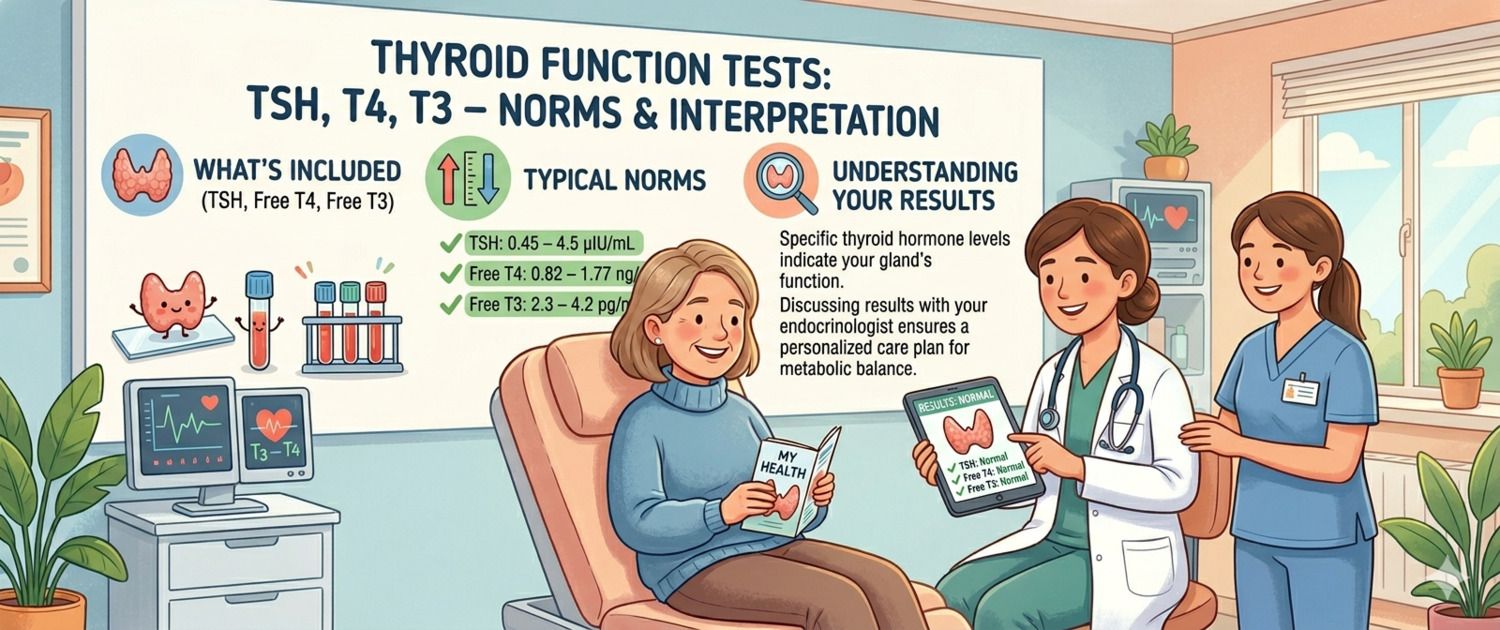
Fatigue that persists even after a full night's sleep, weight gain without changes in diet, or — on the opposite end — unexplained weight loss, constant chills or heat intolerance: all of these can be signals from the thyroid gland. A thyroid panel is a group of blood tests that assess the function of one of the body's primary metabolic regulators. This article covers everything in the panel: what tests are included, how to prepare, what normal values look like, and what deviations in each indicator mean.
What Is a Thyroid Panel and When Is It Ordered?
The thyroid gland — a small butterfly-shaped organ at the front of the neck — produces hormones that govern the pace of virtually every metabolic process in the body: heart rate, body temperature, nutrient absorption, and nervous system function. When the gland is overactive or underactive, nearly every organ feels the effect.
A thyroid panel is not a single test but a group of tests that a doctor selects based on the clinical situation. The minimum screening set includes only TSH. An expanded panel adds free T4, free T3, and antibodies.
Indications for ordering the panel:
- Symptoms of chronic fatigue, hair loss, edema, or unexplained weight changes
- Cardiac arrhythmias without a cardiological cause
- Menstrual irregularities or fertility problems
- Pregnancy planning or the first trimester
- Monitoring treatment of known hypothyroidism or hyperthyroidism
- Routine screening after age 35, especially in women
- Family history of thyroid disease
How to Prepare and Get Tested
Thyroid hormones are relatively stable throughout the day, but several factors can distort results enough to require a repeat test.
Preparation guidelines:
- Blood is drawn in the morning on an empty stomach — no food for at least 8–10 hours.
- Avoid alcohol and intense physical activity for 24 hours beforehand.
- If you take levothyroxine, take your tablet after the blood draw, not before. Taking it beforehand produces a falsely elevated free T4.
- Iodine-containing supplements should be stopped 2–3 days before the test, in consultation with your doctor.
- High-dose biotin (vitamin B7) should be discontinued 48 hours before the test — it interferes with immunoassay methods and can falsely lower TSH and elevate T4.
- Glucocorticoids and certain psychiatric medications also affect results — inform your doctor.
- Acute stress and recent respiratory illness can temporarily shift TSH. If the test is not urgent, it is better to wait until recovery.
For treatment monitoring, always test at the same laboratory using the same equipment: reference ranges and methods vary between labs, and trends are only reliable when tracked under consistent conditions.
What the Panel Includes: TSH, T3, Free T4 and Antibodies
Depending on the clinical question, the panel can contain from one to six indicators.
TSH (thyroid-stimulating hormone) is the primary regulator of thyroid function, produced by the pituitary gland. It is the first-choice marker for screening: it responds to abnormalities earlier than T3 and T4 and covers the widest range of disorders. TSH is the only value needed for initial screening; the others are added when clarification is required.
Free T4 (FT4) is the main hormone secreted directly by the thyroid gland. Only the free (protein-unbound) fraction is biologically active. It is analyzed alongside TSH when pathology is suspected.
Free T3 (FT3) is the active form of the thyroid hormone, produced primarily by conversion of T4 in peripheral tissues. It is ordered less frequently — mainly when isolated T3 toxicosis is suspected or for monitoring after thyroid surgery.
TPO antibodies (anti-TPO) are a marker of autoimmune damage. They are elevated in Hashimoto's thyroiditis — the most common cause of hypothyroidism in adults.
TG antibodies (anti-TG) are a second autoimmune marker. Less specific than anti-TPO, they are primarily used for follow-up after treatment of thyroid cancer.
Thyroglobulin is the protein precursor to thyroid hormones. It is used exclusively for follow-up after treatment of papillary or follicular thyroid cancer and is not part of the standard diagnostic panel.
Thyroid Hormone Normal Values: Table for Adults and Pregnant Women
Reference ranges vary considerably by laboratory and analytical method — particularly for TSH during pregnancy, where normal values shift by trimester. The values below are approximate; always check the reference ranges printed on your report.
| Parameter | Non-pregnant adults | 1st trimester | 2nd trimester | 3rd trimester |
|---|---|---|---|---|
| TSH (mIU/L) | 0.4–4.0 | 0.1–2.5 | 0.2–3.0 | 0.3–3.0 |
| Free T4 (pmol/L) | 9.0–19.0 | 10.0–20.0 | 9.0–18.0 | 8.0–17.0 |
| Free T3 (pmol/L) | 2.6–5.7 | 2.6–6.0 | 2.6–5.7 | 2.6–5.5 |
| Anti-TPO | < 34 IU/mL | < 34 IU/mL | < 34 IU/mL | < 34 IU/mL |
| Anti-TG | < 115 IU/mL | < 115 IU/mL | < 115 IU/mL | < 115 IU/mL |
In pregnant women, TSH norms shift downward — human chorionic gonadotropin (hCG) stimulates the thyroid, so a mild TSH decrease in the first trimester is physiologically normal, not pathological.
In older adults (over 70), the upper limit of normal TSH extends to 6–7 mIU/L — again, a physiological feature, not an automatic indication for treatment.
Interpreting Deviations: High and Low TSH
TSH operates on a negative feedback loop: when the thyroid produces too few hormones, the pituitary increases stimulation — TSH rises. When hormones are excessive, the pituitary pulls back — TSH falls. This is why TSH interpretation is always "mirror" to the state of the gland.
High TSH (above 4.0 mIU/L) + low free T4 → hypothyroidism. The thyroid is underperforming. Symptoms include fatigue, edema, constipation, weight gain, depression, and dry skin. The most common cause is Hashimoto's autoimmune thyroiditis. For a complete overview of the disease and its treatment, see hypothyroidism.
High TSH with normal free T4 → subclinical hypothyroidism. Symptoms may be absent, but it is an early warning. Management ranges from watchful waiting to treatment, depending on TSH level and symptoms.
Low TSH (below 0.4 mIU/L) + high free T4 → hyperthyroidism (thyrotoxicosis). The gland is overactive. Symptoms include palpitations, hand tremor, irritability, weight loss, and heat intolerance. Common causes include Graves' disease and toxic nodular goiter. Full details: hyperthyroidism.
Low TSH with normal free T4 → subclinical hyperthyroidism. Particular caution is warranted in elderly patients: even mild thyrotoxicosis increases the risk of atrial fibrillation and osteoporosis.
Isolated change in free T3 with normal TSH and T4 is an atypical pattern requiring repeat testing and physician evaluation.
TPO and TG Antibodies: When They Matter and What They Mean
Thyroid antibodies are markers of autoimmune inflammation. Their presence does not automatically mean disease — approximately 10–15% of healthy people have mildly elevated anti-TPO with normal TSH and no symptoms.
Clinical significance:
- Anti-TPO above 34 IU/mL + elevated TSH → confirms Hashimoto's autoimmune thyroiditis. This is an indication to start levothyroxine therapy.
- Elevated anti-TPO with normal TSH → increased future risk of hypothyroidism. Annual TSH monitoring is recommended.
- Elevated anti-TPO during pregnancy — a serious risk factor: it increases the likelihood of postpartum thyroiditis and early-pregnancy miscarriage.
- Anti-TG in cancer monitoring — the only context where this marker has independent diagnostic value.
An important note: reducing antibody levels is not the goal of treatment. Treatment targets the clinical picture and TSH level — not the antibody number. Attempts to "lower anti-TPO" through supplementation without medical supervision are a common but mistaken approach.
When Thyroid Panel Results Require Urgent Medical Attention
Most thyroid panel abnormalities develop slowly and do not require emergency care. Some situations are exceptions:
- TSH below 0.01 mIU/L — severe thyrotoxicosis, especially with heart rate above 100 bpm, elevated blood pressure, or fever
- TSH above 10 mIU/L with marked symptoms: facial edema, very low blood pressure, or altered consciousness
- Sensation of a lump in the throat, difficulty swallowing or breathing — possible gland enlargement requiring ultrasound
- Any abnormality in a pregnant woman — prompt endocrinologist referral, as maternal thyroid dysfunction directly affects fetal neurological development
If results are abnormal for the first time and symptoms are absent, a scheduled visit to a GP or endocrinologist is generally sufficient. Do not adjust levothyroxine dose on your own and do not start treatment without a prescription.
Conclusion
A thyroid panel is an accurate and accessible way to evaluate one of the body's key hormonal regulators. A well-designed panel of TSH, free T4, and antibodies gives a doctor all the information needed to make a diagnosis. The key to reliable results is proper preparation: holding levothyroxine and biotin before the blood draw and observing the correct fasting interval. When results show deviations, resist the urge to draw immediate conclusions — thyroid hormone interpretation requires full clinical context. If symptoms suggest dysfunction across multiple hormonal systems simultaneously, a doctor may extend the workup to a comprehensive hormone panel. When fatigue and hair loss persist despite a normal TSH, nutritional status is worth investigating: deficiencies in vitamin D, selenium and zinc directly impair the conversion of T4 to active T3 and can mimic hypothyroid symptoms — all of which are covered by a vitamin and mineral panel.
Thyroid hormones are an essential part of a woman's hormonal health check after 40. For the full panel, TSH reference ranges and TPO antibodies, see the article which hormone tests women should get after 40.
This content is for informational purposes only and does not replace professional medical advice.
For informational purposes only
This article is for informational purposes only and does not constitute medical advice, diagnosis, or treatment. Please consult a healthcare professional for medical guidance.