Which Hormone Tests Should Women Get After 40: Levels and Norms
Reviewed by the LabReadAI medical team
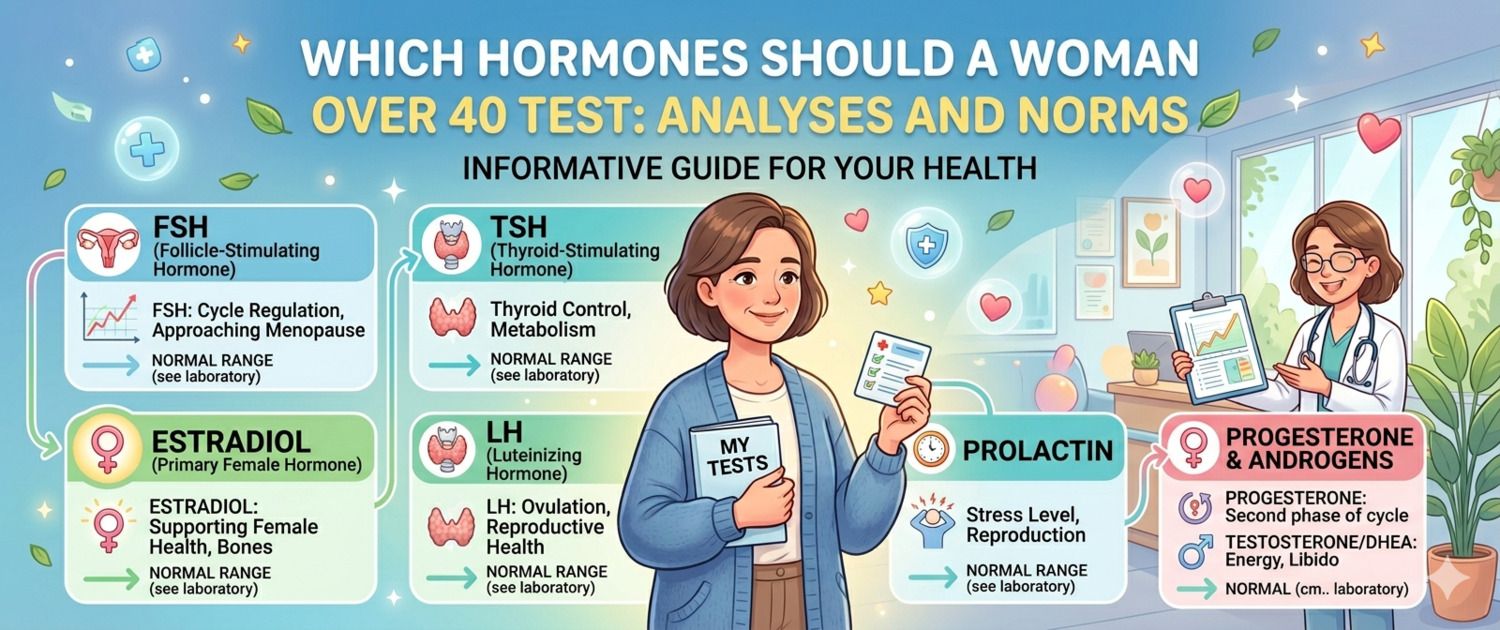
After age 35–40, a woman's hormonal landscape begins to shift — gradually, but meaningfully. Oestrogen and progesterone levels change, cycle variability increases, and symptoms appear that are hard to attribute to hormones: fatigue, mood changes, disrupted sleep. Yet most women don't know which hormones to test or when. This is a practical guide with reference values and the logic behind each test.
Which Hormones Should Women Test: A Guide by Age
Female hormonal screening covers three blocks: reproductive hormones, thyroid and stress hormones. The choice depends on age and purpose:
Under 35 (baseline screening): FSH, LH, oestradiol, prolactin, TSH. Extended panel for cycle irregularities: progesterone, DHEA-S, testosterone, anti-TPO.
Age 35–45 (peri-climacteric monitoring): FSH, LH, oestradiol, progesterone, TSH, free T4, anti-TPO. AMH (anti-Müllerian hormone) — a marker of ovarian reserve — is relevant for those planning pregnancy or assessing the pace of ovarian function decline. If conception does not happen at this age, female infertility tests are added to the hormone work-up.
After 45 (post-menopausal monitoring): FSH, oestradiol, TSH + free T4, cortisol, vitamin D, lipid panel, fasting glucose. Hormones govern cardiovascular protection, bone density and metabolic function after menopause.
Female Sex Hormones: Oestradiol, Progesterone and FSH — Normal Levels
Oestradiol. The primary female oestrogen. Fluctuates substantially across the menstrual cycle in reproductive years. Drawn on days 2–5 of the cycle (follicular phase). Follicular phase reference: 68–1,269 pmol/L. A post-menopausal level below 73 pmol/L confirms oestrogen deficiency.
Progesterone. Drawn on days 21–22 of a 28-day cycle (luteal phase). Luteal phase reference: 6.4–79.5 nmol/L. Low progesterone with a regular cycle — luteal phase insufficiency; with an irregular cycle — a sign of anovulation.
FSH (follicle-stimulating hormone). The primary marker of ovarian reserve and perimenopause. Drawn on days 2–5 of the cycle. Key thresholds:
| Stage | Follicular phase FSH | Perimenopause | Post-menopause |
|---|---|---|---|
| FSH (IU/L) | 3.5–12.5 | 12.5–25 | > 25–40 |
| LH (IU/L) | 2.4–12.6 | — | > 14.2 |
FSH above 12–15 IU/L in the follicular phase with a regular cycle signals declining ovarian reserve. FSH consistently above 25 IU/L with no menstruation for 12+ months confirms menopause.
Prolactin. Often excluded from standard "hormone panels" but important: hyperprolactinaemia suppresses FSH and LH, causing cycle irregularities and reduced libido. Drawn in the morning, 2–3 hours after waking.
Thyroid Hormones in Women: TSH, T4 and Anti-TPO
Thyroid disease affects women 5–8 times more often than men — and thyroid disorders frequently mimic climacteric symptoms: fatigue, weight changes, sleep disruption, mood swings.
TSH (thyroid-stimulating hormone). The primary screening marker — always tested first. Optimum for women aged 35–45: 1.5–2.5 µIU/mL. TSH above 4.5 — hypothyroidism. TSH below 0.5 — hyperthyroidism. If TSH is "normal" (0.5–4.5) but symptoms persist — extend to free T4 and anti-TPO.
Anti-TPO (anti-thyroid peroxidase antibodies). Elevated anti-TPO signals Hashimoto's autoimmune thyroiditis. May be elevated with normal TSH: a subclinical form that progresses to hypothyroidism over time. Anti-TPO screening is particularly important with a family history of thyroid disease.
A complete thyroid panel includes TSH, free T4, free T3 and anti-TPO.
Cortisol in Women: Stress and Hormonal Balance
Chronically elevated cortisol in women is one of the least-diagnosed hormonal disturbances. Signs: abdominal weight gain despite normal diet; cycle irregularities and reduced libido; insomnia combined with daytime fatigue; anxiety and emotional instability.
Chronic stress → high cortisol → suppressed GnRH → reduced FSH/LH → impaired ovulation and low progesterone. This cascade explains why chronic stress directly disrupts the hormonal cycle.
Optimal testing: morning serum cortisol (8–10 am). Normal morning cortisol in women: 138–635 nmol/L.
Perimenopause: Hormonal Changes After 35-40
Perimenopause typically begins 4–6 years before the last period — meaning it often starts after 40, and in some women after 38–39. It is not a disease, but a transition with characteristic hormonal changes.
Laboratory markers of perimenopause:
- FSH rises (from 12 to 25 IU/L and above in the follicular phase)
- Oestradiol becomes erratic — may be elevated (anovulatory cycles) or low
- Cycle shortens (under 25 days) or becomes irregular
- AMH progressively declines — the most consistent marker of declining ovarian reserve
Perimenopausal symptoms: hot flushes, sleep disruption, mood changes, reduced concentration, changing menstrual pattern. These symptoms often appear before FSH rises — i.e., while results still look "normal". A detailed walk-through of these signs is in the article on menopause symptoms and hot flushes.
The full picture of symptoms across the three phases and the evidence for HRT is covered in the menopause guide.
Hormone Tests for Menopause: What to Check and When
Once menstruation has been absent for 12+ months, the concept of "cycle day" no longer applies. Tests can be drawn on any day.
Basic post-menopausal profile:
- FSH + LH (confirm menopause)
- Oestradiol (degree of oestrogen deficit)
- TSH + free T4 (thyroid, frequently disrupted post-menopause)
- Cortisol (adaptive reserve)
Extended panel for long-term risk assessment:
- Vitamin D — oestrogen loss accelerates bone loss; vitamin D is critical for prevention
- Lipid panel — cardiovascular risk rises sharply after menopause
- Fasting glucose + HbA1c — declining oestrogen impairs insulin sensitivity
The sex hormone panel is the standard starting point for initial hormonal assessment in women at any age.
How to Prepare for Female Hormone Blood Tests
Most errors in female hormone testing involve the wrong day of the cycle:
- FSH, LH, basal oestradiol: days 2–5 of the cycle (day 1 = first day of menstruation)
- Progesterone: day 21–22 of a 28-day cycle, or 7 days after ovulation
- Prolactin: morning, 2–3 hours after waking, without stress or intense exercise the day before
- TSH, anti-TPO, cortisol: any day, but morning draw
- AMH: any day — the most "convenient" female hormone to test
Oral contraceptives radically alter sex hormone levels. Assessment of FSH, oestradiol and progesterone should not be performed until at least 3 months after stopping OCP.
Women's Hormone Checkup: Annual Monitoring Plan
Age 35–45 (annual): FSH, LH, oestradiol (days 2–5), TSH + anti-TPO, prolactin, cortisol, vitamin D.
After 45 (annual + immediately if cycle changes): same set + progesterone (days 21–22 if cycle continues), AMH if cycle is irregular, lipid panel, HbA1c.
Post-menopause (1–2 times a year): FSH + oestradiol, TSH, cortisol, vitamin D, lipid panel. Bone densitometry every 2–3 years.
The molecular mechanisms driving age-related hormonal changes are covered in the article ageing of the body: causes and mechanisms. A comprehensive protocol for slowing biological ageing — in the guide how to live long and healthy. DHEA-S as an adrenal marker of hormonal ageing in women — DHEA-S and ageing. Omega-3 index and cardiovascular health during menopause — omega-3 index and longevity.
This article is for informational purposes. Interpreting hormone results and prescribing treatment is the responsibility of a gynaecologist or endocrinologist.
For informational purposes only
This article is for informational purposes only and does not constitute medical advice, diagnosis, or treatment. Please consult a healthcare professional for medical guidance.