DHEA-S: Normal Levels by Age, Interpretation and Longevity Link
Reviewed by the LabReadAI medical team
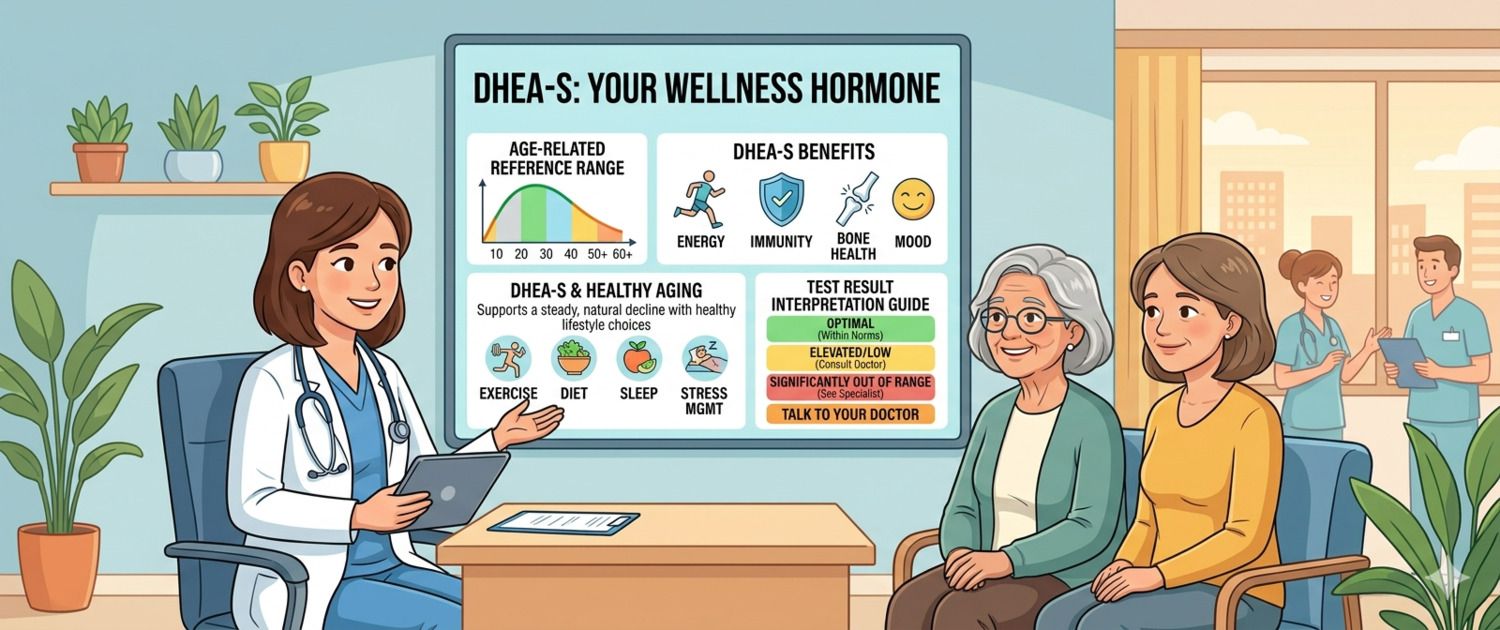
Of all hormones that decline with age, DHEA-S follows the steepest curve: from its peak at 25–30 years, levels fall roughly 2% per year. By age 70, most people retain only 10–20% of their peak level. Interpreting DHEA-S results requires age context — a value that is "normal" at 70 would indicate severe deficiency at 30.
DHEA-S (dehydroepiandrosterone sulphate) is a sex hormone precursor, a neurosteroid and one of the body's primary immunomodulators. Its connection to ageing is multi-layered.
DHEA-S Decline with Age: Norms and Interpretation by Age Group
Interpretation of DHEA-S must account for age. Approximate reference ranges for men (µmol/L):
| Age | DHEA-S µmol/L |
|---|---|
| 20–29 | 7–19 |
| 30–39 | 5–16 |
| 40–49 | 4–12 |
| 50–59 | 3–9 |
| 60+ | 2–6 |
Women average 20–30% lower. More meaningful than absolute values is trajectory: a decline exceeding 30% relative to your level 5–10 years ago is a biomarker of accelerated biological ageing.
The best personal benchmark is your own level from age 25–35 if measured. Without this, target the upper quartile of the age-appropriate reference range.
DHEA-S and Ageing: Mechanisms and Research
DHEA-S is a prohormone: in peripheral tissues it converts to testosterone and oestrogens. With age this conversion slows, but DHEA-S exerts independent biological effects through receptors in immune cells, brain and adipose tissue.
Key data from ageing research:
- DHEA-SAge Study (1,700 participants, 25 years): low DHEA-S independently associated with higher all-cause mortality
- DHEA-S decline correlates with rising cortisol: the cortisol/DHEA ratio increases with age, signalling a chronic catabolic shift
- DHEA inhibits NF-κB — the same pathway implicated in inflammaging, linking it to hs-CRP
Inverse relationship with insulin resistance: people with higher DHEA-S show significantly better insulin sensitivity; DHEA suppresses hepatic gluconeogenesis.
DHEA-S Deficiency Symptoms: Fatigue, Immunity and Libido
Clinically significant DHEA-S deficiency presents as:
- Chronic fatigue — especially morning fatigue despite adequate sleep
- Reduced libido — in both men and women (DHEA is the main adrenal androgen source in women)
- Weakened immunity — frequent infections, slow recovery
- Loss of muscle mass — DHEA's anabolic effect supports muscle maintenance
- Low mood and anxiety — neurosteroid effects on GABA receptors
- Skin and mucosal dryness in postmenopausal women
None of these symptoms is specific to DHEA-S alone — blood testing is required for diagnosis.
DHEA-S and Neuroprotection: Brain and Stress Resilience
DHEA is a neuroactive steroid. In the brain it acts as a negative modulator of NMDA receptors (reducing neuronal excitation) and a positive modulator of GABA-A receptors (reducing anxiety). DHEA deficiency is therefore associated with anxiety, depression and cognitive decline.
A parallel point: IGF-1 and DHEA-S decline together with age and synergistically support neurotrophic activity. Combined deficiency of both accelerates neurodegeneration more than either alone.
Taking DHEA as a Supplement: Protocol and Risks
DHEA is available as an over-the-counter supplement in many countries. Safe supplementation requires:
Test first: baseline DHEA-S, testosterone, PSA (men) and oestradiol before starting. Without baseline levels, neither effect nor safety can be assessed.
Starting dose: 25–50 mg/day for men, 10–25 mg/day for women. Begin at the lower end.
Form: transdermal DHEA has better bioavailability than oral. Transdermal creams are preferred for maintaining steady levels.
Monitoring: retest after 8–12 weeks. Target: upper quartile of the age 30–40 reference range.
Avoid excess: in men, DHEA converts to oestradiol — high doses can cause gynaecomastia. In women, it converts to testosterone and DHT (acne, hair growth).
Who Should Not Take DHEA: Contraindications
DHEA is contraindicated in: prostate, breast, ovarian and uterine cancer (hormone-sensitive tumours). Relative contraindication: polycystic ovary syndrome (risk of worsening hyperandrogenism), severe liver disease.
In certain autoimmune conditions (lupus, rheumatoid arthritis), DHEA may be beneficial — only under medical supervision.
For monitoring frequency: DHEA-S as part of the annual blood test checklist from age 40. Full hormonal context in how to live longer: the evidence base.
For informational purposes only
This article is for informational purposes only and does not constitute medical advice, diagnosis, or treatment. Please consult a healthcare professional for medical guidance.