DHEA-S Blood Test: Normal Levels by Age, Interpretation and Ageing
Reviewed by the LabReadAI medical team
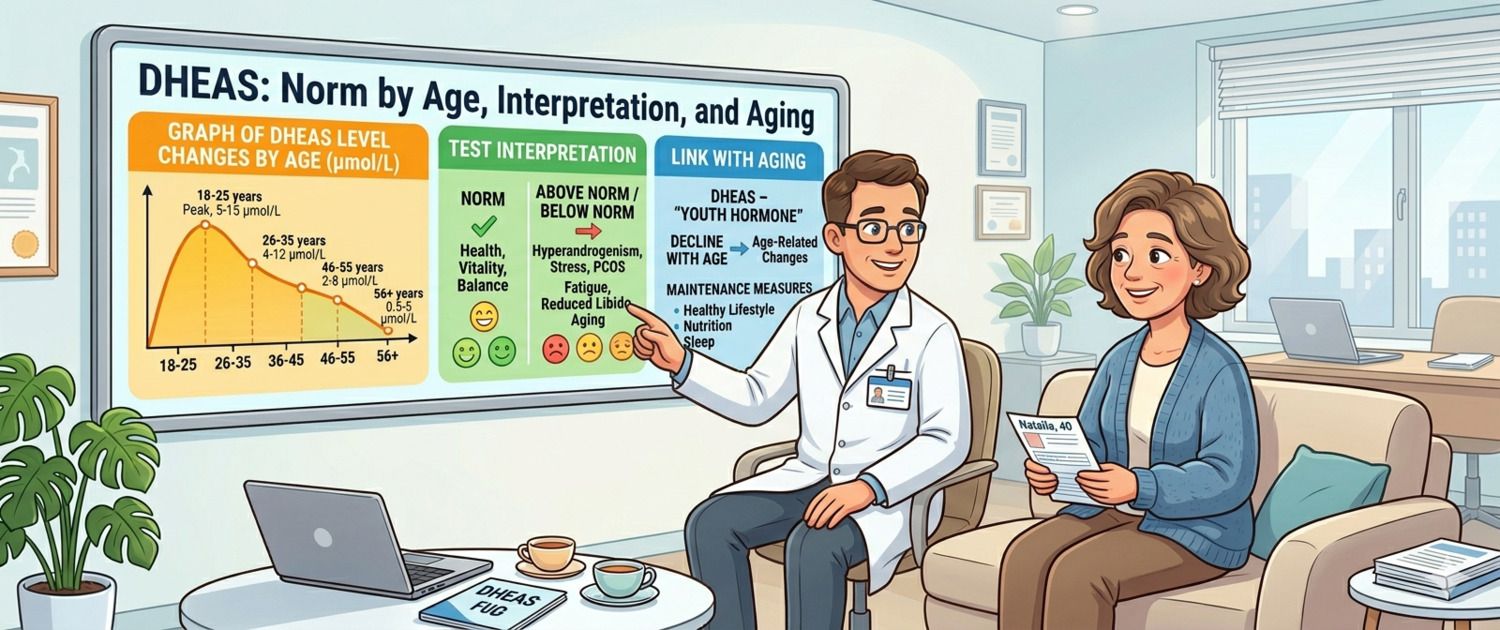
DHEA-S is one of the few hormones that declines predictably and almost linearly with age. At age 25 it is at its peak; by age 70 it has fallen by 80–90%. This has made it a convenient marker of adrenal biological clocks. But interpretation requires care: declining DHEA-S alone is not a diagnosis and does not automatically indicate replacement therapy.
What Is DHEA-S and How Is It Produced?
DHEA-S (dehydroepiandrosterone sulphate) is the sulphated form of DHEA, a steroid hormone synthesised by the adrenal cortex. It is the most abundant steroid in human blood — present at concentrations 100–500 times higher than testosterone or oestradiol.
DHEA-S is a prohormone: it has little direct activity but is converted in peripheral tissues into active androgens (testosterone, DHT) and oestrogens. This is particularly important after the menopause, when ovarian oestrogen synthesis ceases and peripheral conversion of DHEA-S becomes the primary oestrogen source.
The "S" stands for sulphate. Unlike unsulphated DHEA, which is secreted in pulses and unstable throughout the day, DHEA-S is stable — which is why it is the preferred form for measurement.
The adrenal glands produce 80–90% of circulating DHEA-S, making it a sensitive marker of adrenal cortical function.
DHEA-S Normal Ranges by Age
Women:
| Age | Normal DHEA-S (µmol/L) |
|---|---|
| 18–25 years | 4.7–14.7 |
| 26–35 years | 3.0–12.5 |
| 36–45 years | 2.2–10.8 |
| 46–55 years | 1.5–8.5 |
| 55–65 years | 0.8–6.0 |
| > 65 years | 0.4–3.7 |
Men:
| Age | Normal DHEA-S (µmol/L) |
|---|---|
| 18–25 years | 5.7–18.0 |
| 26–35 years | 4.5–16.5 |
| 36–45 years | 3.2–12.0 |
| 46–55 years | 2.0–9.5 |
| 55–65 years | 1.5–7.5 |
| > 65 years | 0.9–4.5 |
Why DHEA-S Declines With Age
The age-related fall in DHEA-S is termed "adrenopause" — analogous to the menopause but gradual. It begins after age 25–30 and continues without arrest.
The mechanism: the zona reticularis of the adrenal cortex — the layer that produces DHEA-S — shrinks with age. Unlike cortisol, which remains relatively stable, DHEA-S falls progressively. The declining DHEA-S:cortisol ratio is thought to reflect a shift towards catabolic dominance in ageing.
The fall correlates with declining immune function, reduced stress resilience, muscle loss and diminished sexual function — but correlation does not establish causation. For more on DHEA-S in the ageing marker cluster, see DHEA-S and body ageing.
Causes of Pathologically High DHEA-S
Polycystic ovary syndrome (PCOS): excess androgen production from ovaries and adrenals; DHEA-S is elevated alongside testosterone.
Congenital adrenal hyperplasia (CAH): enzyme deficiency redirects precursors into the androgen pathway, raising DHEA-S.
Adrenal tumours: when DHEA-S is more than threefold above the upper reference limit, adrenal imaging (ultrasound or CT) is mandatory to exclude neoplasm.
Medications: anabolic steroids, valproate and metformin can influence DHEA-S.
Causes of Low DHEA-S
Primary adrenal insufficiency (Addison's disease): autoimmune or infectious destruction of the adrenal cortex. DHEA-S falls together with cortisol; clinically presents as fatigue, hypotension and hyperpigmentation.
Hypopituitarism: ACTH deficiency reduces adrenal stimulation, lowering DHEA-S.
Chronic stress: paradoxically, sustained stress raises cortisol but may exhaust adrenal capacity and reduce DHEA-S relative to normal — the so-called cortisol:DHEA imbalance in HPA axis dysregulation.
Physiological adrenopause: age-appropriate decline, does not require treatment.
DHEA Supplementation: Evidence, Risks and Rules
In the United States, DHEA is available over the counter as a dietary supplement. In Europe and Russia, it is a prescription product or not licensed.
What is established: in postmenopausal women, 25–50 mg/day of DHEA modestly improves libido, vaginal trophism and bone density — particularly in those with a low baseline DHEA-S. Evidence on cognitive function and immunity is less convincing.
Risks: conversion to active androgens can cause acne, seborrhoea and hirsutism in women; in men, conversion to oestradiol may cause gynaecomastia. Theoretical stimulation of hormone-sensitive cancers (breast, prostate) has not been established causally, but DHEA supplementation is generally avoided in those with these conditions.
Rule: take only after confirmed deficiency (below age-appropriate reference range), with DHEA-S monitoring at three months, under endocrinological supervision.
When and How to Test DHEA-S
DHEA-S is stable throughout the day — time of collection is not critical. Blood is drawn from a vein; fasting is not required. For women, the day of the menstrual cycle is irrelevant (unlike oestradiol or progesterone).
See the sex hormone panel for a complete hormonal picture: DHEA-S, testosterone, oestradiol and LH/FSH together characterise the full sex hormone axis.
For informational purposes only
This article is for informational purposes only and does not constitute medical advice, diagnosis, or treatment. Please consult a healthcare professional for medical guidance.