Sex Hormone Panel: What's Included, Normal Levels and Results
Reviewed by the LabReadAI medical team
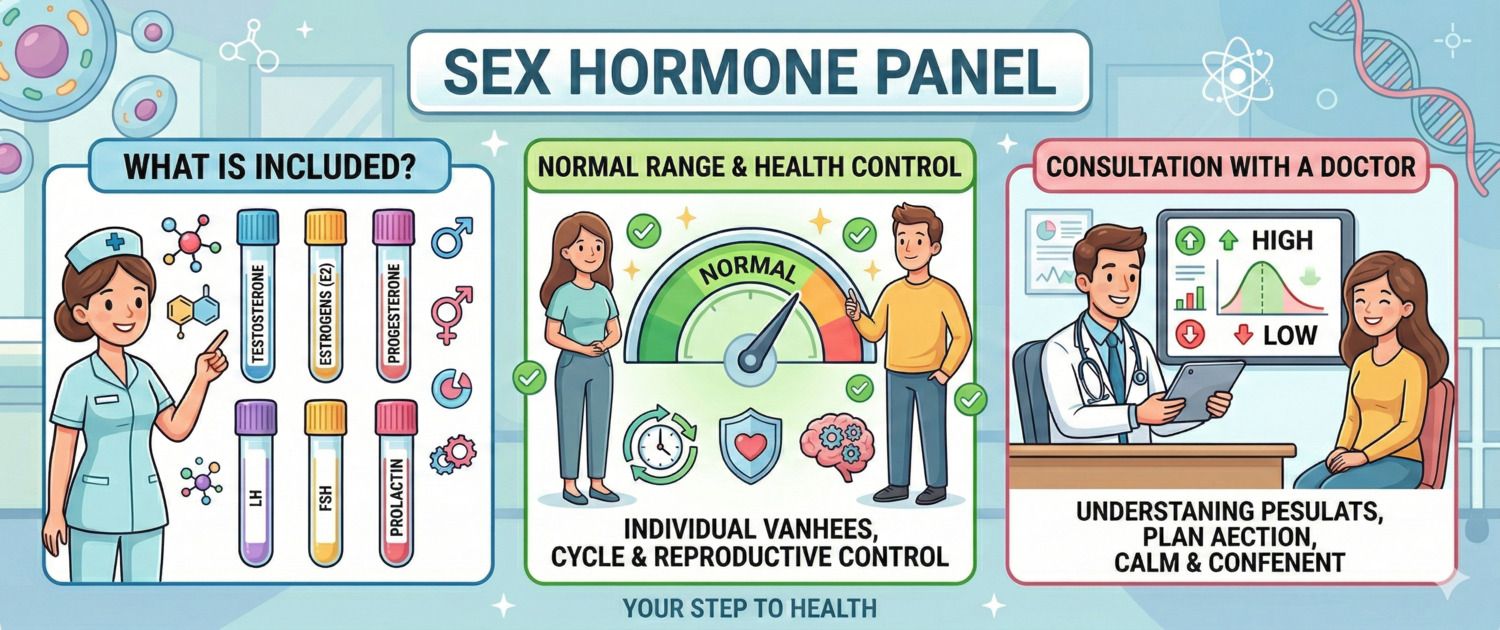
Irregular periods, difficulty conceiving, low libido, unexplained weight gain or hair loss — behind all of these symptoms, hormonal imbalance is often the underlying cause. The sex hormone panel brings together several markers, each carrying its own diagnostic information. Interpreting them requires looking at the whole picture, taking into account sex, age, and — in women — the day of the menstrual cycle.
What the Reproductive Hormone Blood Test Includes: FSH, Testosterone, Estradiol
The standard panel covers five key markers that together provide a complete picture of the hypothalamic-pituitary-gonadal axis.
Testosterone — the primary male sex hormone, produced by the testes in men and by the ovaries and adrenal glands in women. In men it governs spermatogenesis, muscle mass, libido and erection. In women at physiological concentrations it supports libido, muscle tone and bone density. Both total and free testosterone are measured: total testosterone includes bound (inactive) and free (biologically active) fractions.
Estradiol — the principal oestrogen in women of reproductive age, produced by ovarian follicles. It regulates the menstrual cycle, maintains the endometrium and influences bone density. In men it is produced in small amounts through peripheral conversion of testosterone and is essential for bone health and sexual function.
FSH (follicle-stimulating hormone) — a pituitary hormone. In women it drives follicle maturation and oestrogen production. In men it stimulates spermatogenesis. Elevated FSH alongside low sex hormones points to primary gonadal insufficiency (hypergonadotrophic hypogonadism).
LH (luteinising hormone) — also a pituitary hormone. In women, the mid-cycle LH surge triggers ovulation. In men it stimulates the Leydig cells of the testes to produce testosterone. The LH/FSH ratio is an important diagnostic index: in polycystic ovary syndrome it frequently exceeds 2–3.
Prolactin — a pituitary hormone whose physiological role is lactation. Chronically elevated prolactin (hyperprolactinaemia) suppresses FSH and LH secretion, disrupting the menstrual cycle in women and reducing testosterone in men. Prolactin is included in every sex hormone panel when reproductive dysfunction is being investigated.
Normal Ranges for Sex Hormones in Men and Women
Reference ranges vary considerably by sex, age, and — in women — cycle phase.
Testosterone (total)
| Group | Normal range |
|---|---|
| Men 18–50 years | 12–33 nmol/L (350–950 ng/dL) |
| Men > 50 years | 10–28 nmol/L |
| Women of reproductive age | 0.3–2.8 nmol/L |
| Postmenopausal women | 0.1–1.8 nmol/L |
Estradiol
| Group | Normal range |
|---|---|
| Women, follicular phase (days 1–13) | 68–1270 pmol/L |
| Women, ovulatory peak (day 14) | 131–1655 pmol/L |
| Women, luteal phase (days 15–28) | 91–861 pmol/L |
| Postmenopausal women | < 73 pmol/L |
| Men | 40–160 pmol/L |
FSH
| Group | Normal range |
|---|---|
| Women, follicular phase | 2.8–11.3 IU/L |
| Women, ovulatory peak | 5.8–21 IU/L |
| Women, luteal phase | 1.2–9 IU/L |
| Postmenopausal women | 25–135 IU/L |
| Men | 1.5–12.4 IU/L |
LH
| Group | Normal range |
|---|---|
| Women, follicular phase | 1.1–11.6 IU/L |
| Women, ovulatory peak | 17–77 IU/L |
| Women, luteal phase | 0–14.7 IU/L |
| Postmenopausal women | 11.3–40 IU/L |
| Men | 1.7–8.6 IU/L |
Prolactin
| Group | Normal range |
|---|---|
| Non-pregnant women | 102–496 mIU/L |
| Pregnant women | up to 10,000 mIU/L |
| Men | 86–324 mIU/L |
When and How to Test Correctly
The accuracy of hormonal results depends critically on when and how the blood is drawn.
For women: most sex hormones are tested on cycle days 3–5 — the standard "basal" window when the ovaries are at rest and baseline FSH, LH, estradiol and testosterone levels are most informative. Exception: progesterone and ovulation assessment — days 21–23 (mid-luteal phase). With an irregular or absent cycle, testing can be done on any day, and this should be clearly communicated to the doctor.
For men: there is no cycle to follow, but testosterone reaches its peak in the early morning (7:00–10:00 AM) and drops by 20–30% by evening — blood must be drawn in the morning.
General rules: fast for 8–12 hours; avoid alcohol, intense exercise, and sexual activity for 24 hours beforehand; no smoking for at least 1 hour before the draw; minimise stress before the test — prolactin reacts to any emotional arousal; inform the doctor about hormonal contraceptives, antidepressants, and antipsychotics, as all of these affect results.
During hormonal contraception, results reflect pharmacological suppression of the axis, not actual ovarian function. Reassessment should be done 2–3 months after discontinuation.
Sex Hormone Panel Interpretation: Typical Abnormality Patterns
In Women
High FSH + low estradiol — signals reduced ovarian reserve or menopause. FSH above 10 IU/L on cycle day 3 is associated with lower IVF success rates. FSH above 25–40 IU/L in a woman of reproductive age indicates menopause or premature ovarian insufficiency.
High LH with moderately elevated or normal FSH + LH/FSH ratio > 2 — the pattern characteristic of polycystic ovary syndrome (PCOS). This is accompanied by elevated testosterone and, frequently, signs of insulin resistance.
Elevated prolactin — menstrual irregularity, anovulation, galactorrhoea. Causes include pituitary microadenoma, antidepressants or antipsychotic medications, and hypothyroidism. Before diagnosing hyperprolactinaemia, a stress-related transient rise must be excluded: a single high result is always repeated in calm conditions.
Low FSH + low LH + low estradiol — central (secondary) hypogonadism: the pituitary is not signalling the ovaries. Causes: stress-related amenorrhoea, low body weight, pituitary tumours, Sheehan's syndrome.
In Men
Low testosterone + high FSH/LH — primary hypogonadism (testes not responding to stimulation). Causes: orchitis, varicocele, chromosomal abnormalities (Klinefelter syndrome).
Low testosterone + low FSH/LH — secondary hypogonadism (pituitary not stimulating the testes). Causes: pituitary tumours, hyperprolactinaemia, haemochromatosis, prior anabolic steroid use.
Elevated estradiol in a man — gynaecomastia, reduced libido and sperm quality. Seen in obesity (adipose tissue converts testosterone to oestrogen), liver cirrhosis, and certain tumours.
When the Sex Hormone Panel Is Ordered: Infertility, Menopause and Beyond
The panel is indicated across a wide range of clinical scenarios. In women: menstrual irregularities or absence of periods, infertility, suspected PCOS, ovarian reserve assessment, diagnosis of menopause or premature ovarian insufficiency, monitoring hormonal therapy. In men: reduced libido and erectile dysfunction, male infertility, assessment of androgen deficiency symptoms, gynaecomastia. In both sexes: delayed or precocious puberty, growth disturbances in children and adolescents. When non-specific symptoms make it unclear which hormonal system is the primary source, a doctor may order a comprehensive hormone panel covering multiple axes in a single blood draw.
For a full hormonal check-up guide for men, see the article testosterone after 40; for women, see which hormone tests women should get after 40. For the role of DHEA-S in the aging hormone panel and monitoring protocol, see the article DHEA-S and aging.
This article is for informational purposes only. Interpretation of results and treatment decisions are carried out by a gynaecologist, endocrinologist or andrologist.
For informational purposes only
This article is for informational purposes only and does not constitute medical advice, diagnosis, or treatment. Please consult a healthcare professional for medical guidance.