IGF-1 (Somatomedin C): Normal Range by Age and Growth Hormone
Reviewed by the LabReadAI medical team
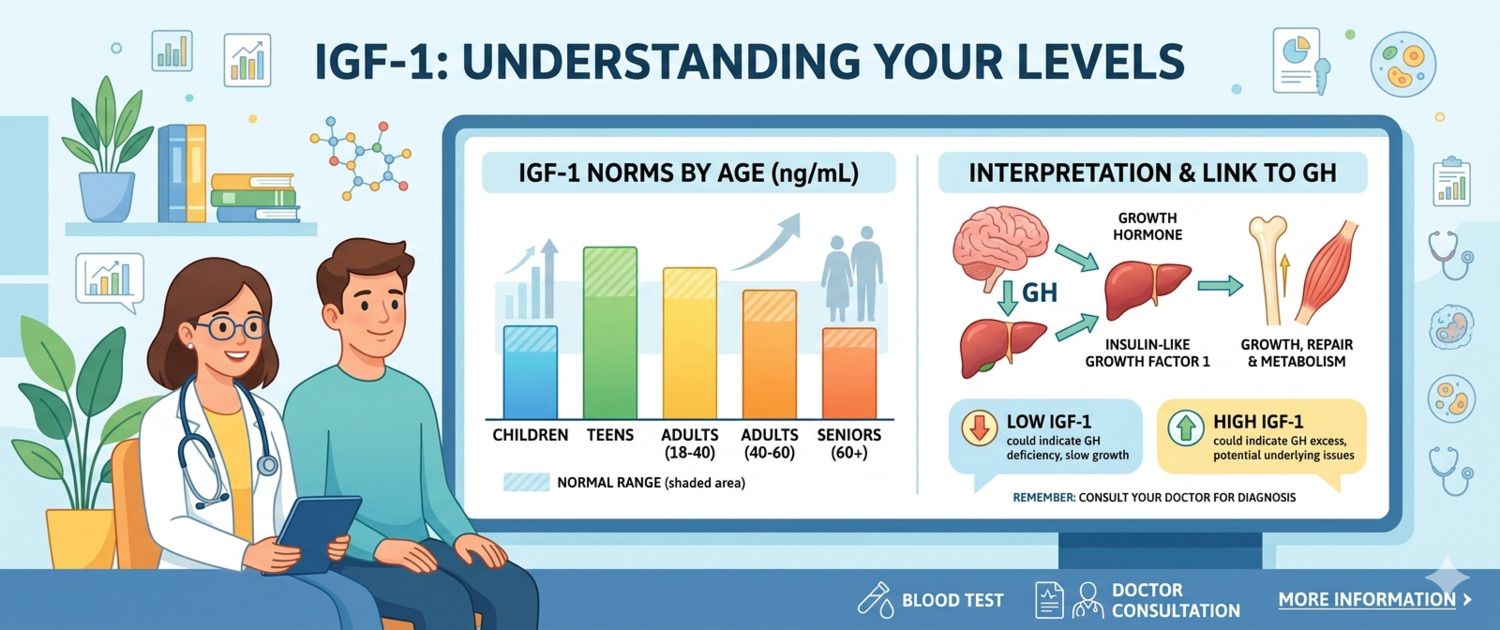
IGF-1 is one of the few blood markers that simultaneously reflects growth hormone activity and the rate of cellular proliferation. Too low a level signals a deficit in repair processes and muscle catabolism. Too high a level is linked to accelerated cell division. This is why gerontology considers IGF-1 a marker of the balance between growth and longevity.
What Is IGF-1 and How Is It Produced?
IGF-1 (insulin-like growth factor 1, somatomedin C) is a polypeptide hormone synthesised predominantly in the liver in response to growth hormone (GH). It is structurally similar to insulin but acts through different receptors and has distinct functions.
The axis works as follows: the pituitary releases GH in pulses (especially during sleep) → GH reaches the liver → the liver synthesises IGF-1 → IGF-1 circulates and binds to receptors in muscles, bone, adipose tissue and the brain.
Why measure IGF-1 rather than GH itself? Because GH is released in bursts: its level can change tenfold within 10 minutes. IGF-1 is stable throughout the day and reflects mean daily GH axis activity.
IGF-1 Normal Ranges by Age
IGF-1 levels change substantially with age. The peak occurs in adolescence (14–17 years), followed by a gradual decline of 1–2% per year after age 30.
| Age | Normal IGF-1 (ng/mL) |
|---|---|
| 20–25 years | 116–358 |
| 26–30 years | 117–329 |
| 31–40 years | 88–246 |
| 41–50 years | 71–212 |
| 51–60 years | 58–162 |
| 61–70 years | 40–140 |
| 70+ years | 28–120 |
Male and female ranges are nearly identical except during adolescence. Pregnancy significantly raises IGF-1.
Causes of Low IGF-1
Low IGF-1 in adults is common, particularly after age 40.
Growth hormone deficiency can be congenital or acquired (pituitary tumours, head trauma, cranial irradiation). In adults it presents as central adiposity, reduced muscle mass and chronic fatigue.
Undernutrition and protein deficiency — the liver produces IGF-1 only when amino acid supply is adequate. Caloric restriction or a vegan diet without protein tracking predictably lowers IGF-1.
Liver disease — cirrhosis and chronic hepatitis impair synthetic function, reducing IGF-1.
Hypothyroidism — TSH and IGF-1 are interconnected: in hypothyroidism IGF-1 synthesis slows.
Physiological age-related decline — the most common cause in adults over 40. Not a disease, but when values fall below 80 ng/mL after age 50, checking other hormones is worthwhile.
High IGF-1: Acromegaly and Other Causes
Acromegaly — a benign pituitary tumour producing excess GH. IGF-1 is 2–3 times above the upper limit of normal. Clinical features include coarsening of facial features, enlargement of hands and feet, new-onset diabetes and hypertension.
Gigantism — the same condition in children before growth plate closure.
High-protein diet in athletes — a moderate rise within the normal range. This is not pathological.
Exogenous growth hormone — used in anti-ageing or doping, causing a marked IGF-1 rise.
IGF-1 and the Longevity Axis: mTOR and Ageing
One of the most important aspects of IGF-1 in the context of health span is its connection to the mTOR (mechanistic target of rapamycin) signalling pathway. Elevated IGF-1 activates mTOR, stimulating cell growth and division — beneficial in youth, more ambiguous with age.
Longevity research shows a complex picture. IGF-1 receptor knockout in mice extends lifespan by 30–50%. In humans, however, low IGF-1 is associated with sarcopaenia, osteoporosis and cognitive decline. The apparent optimum for human longevity — from several cohort studies — is the middle range of normal for age: not too high (tumour risk, acromegaly) and not too low (muscle, bone and brain loss). See IGF-1 and the longevity axis for a detailed breakdown.
Related markers: cortisol (counteracts IGF-1's anabolic effects) and testosterone (acts synergistically with IGF-1 on muscle mass).
IGF-1 Results Interpretation: Preparation and Reference Ranges
Blood is drawn in the morning after an 8–10 hour fast. Unlike GH itself, IGF-1 is stable throughout the day — there is no benefit in repeated same-day sampling.
Factors that transiently raise IGF-1: resistance training the day before, high-protein intake. Factors that lower it: acute stress, prolonged fasting (>24 hours), acute illness at the time of testing.
When values are outside the reference range, the next step is dynamic GH testing (insulin tolerance test or GHRH-arginine test) to localise the defect to the pituitary or liver level.
For informational purposes only
This article is for informational purposes only and does not constitute medical advice, diagnosis, or treatment. Please consult a healthcare professional for medical guidance.