IGF-1 and Longevity: What High and Low Levels Mean
Reviewed by the LabReadAI medical team
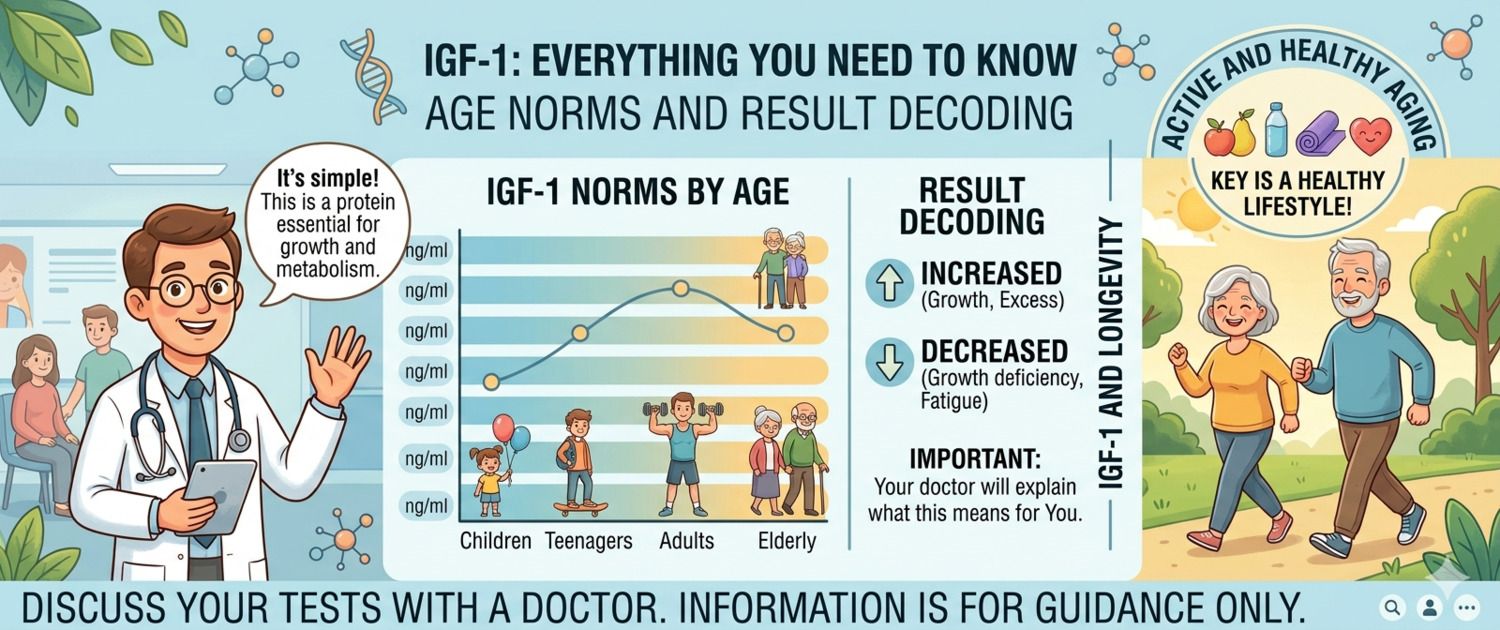
IGF-1 — insulin-like growth factor 1 — is one of the most paradoxical biomarkers in longevity science. On one hand, it is essential for maintaining muscle mass, immune function, and cognitive performance. On the other, chronically elevated IGF-1 accelerates cell proliferation, suppresses autophagy, and is associated with increased cancer risk.
Understanding this duality is the key to correctly interpreting IGF-1 test results.
What IGF-1 Is and Why Interpretation Matters
IGF-1 is synthesized mainly in the liver in response to growth hormone (GH). Unlike GH itself — which is released in pulsatile bursts — IGF-1 remains stable in the bloodstream, making it a reliable surrogate marker for somatotropic axis activity.
Interpretation of IGF-1 results requires knowing the patient's age: reference ranges at 30 and at 70 are fundamentally different. For biological age assessment, IGF-1 is always evaluated against age-specific norms.
IGF-1 is also nutrition-responsive: fasting, caloric restriction, and low-protein diets reduce it — partly explaining the longevity effects of intermittent fasting.
IGF-1 Reference Ranges by Age: Interpretation Guide
| Age | Longevity optimal | Lab range (ng/mL) |
|---|---|---|
| 20–30 years | 180–260 ng/mL | 115–307 |
| 31–40 years | 150–230 ng/mL | 94–252 |
| 41–50 years | 120–200 ng/mL | 74–212 |
| 51–60 years | 100–170 ng/mL | 58–175 |
| 61–70 years | 90–150 ng/mL | 48–148 |
| 70+ years | 80–130 ng/mL | 38–123 |
The longevity-optimal range is the upper third of the lab reference range for your age group. Values in the lower third are associated with sarcopenia and cognitive decline; values above the upper third are associated with elevated proliferative risk.
High IGF-1: Risks and Accelerated Aging Mechanisms
Chronically elevated IGF-1 activates the mTOR and PI3K/Akt pathways, suppressing autophagy — the cellular cleanup process critical for longevity. Among centenarians (90+), genetically reduced IGF-1 signaling appears far more often than in the general population.
Risks of high IGF-1:
- Increased risk of prostate, breast, and colorectal cancer (meta-analysis data)
- Accelerated cell proliferation and suppressed apoptosis
- mTOR activation → autophagy suppression → accumulation of damaged proteins
- Accelerated biological aging on epigenetic clocks
When IGF-1 exceeds the upper third of the age-normal range, it is worth evaluating fasting insulin and DHEA-S: hyperinsulinemia and androgen excess both raise IGF-1.
Low IGF-1: Sarcopenia, Immunity, and Cognition
Insufficient IGF-1 is as serious a problem as excess. IGF-1 deficiency is associated with:
- Sarcopenia (muscle loss) — the leading driver of falls and disability in older adults
- Reduced bone mineral density and osteoporosis risk
- Immunodeficiency: IGF-1 is required for T-lymphocyte maturation
- Cognitive decline: neuroprotective effects of IGF-1 in the hippocampus are well documented
IGF-1 below the lower third of age-specific range warrants evaluation of growth hormone axis function and nutritional status. Chronic protein deficit or aggressive caloric restriction lowers IGF-1 regardless of age.
IGF-1 and Nutrition: How Food Controls Growth Hormone Activity
IGF-1 responds to diet more than most hormones:
- Protein (especially animal): +20–30% with 1.5–2 g/kg/day intake
- Leucine and methionine: direct stimulators of hepatic IGF-1 synthesis
- Caloric deficit: reduces IGF-1 by 30–50% under prolonged restriction
- Intermittent fasting (16:8, 5:2): moderate IGF-1 reduction + autophagy activation
The link with chronic inflammation is bidirectional: high hs-CRP suppresses IGF-1, while IGF-1 deficiency amplifies pro-inflammatory signaling.
How to Optimize IGF-1: Longevity Protocol
When IGF-1 is below optimal:
- Protein 1.6–2.0 g/kg/day from complete sources (meat, fish, eggs, cottage cheese)
- Resistance training 3–4 times per week — the most effective natural GH stimulator
- Sleep 7–9 hours (peak GH release occurs during deep sleep)
- Eliminate alcohol: even moderate intake suppresses nocturnal GH release by 70–75%
- Check vitamin D and zinc levels — deficiency of either lowers IGF-1
When IGF-1 is above optimal:
- Reduce refined carbohydrates and lower fasting insulin levels
- Incorporate time-restricted eating windows
- Increase plant protein fraction, reduce total animal protein intake
- Add moderate-intensity aerobic exercise (lowers IGF-1 without muscle loss)
Who Should Test IGF-1 and How Often
- After age 40: every 1–2 years as part of the annual lab checklist
- When muscle mass or strength is declining — unscheduled
- With chronic inflammation (elevated hs-CRP) — to assess anabolic status
- In obesity or metabolic syndrome — IGF-1 is often paradoxically low despite excess nutrition
Draw blood fasting, in the morning. IGF-1 is stable throughout the day (unlike GH), so time of draw is less critical than for other hormones.
Full assessment of aging biomarkers including IGF-1 is in aging biomarkers. Complete longevity program — how to live long.
For informational purposes only
This article is for informational purposes only and does not constitute medical advice, diagnosis, or treatment. Please consult a healthcare professional for medical guidance.