What Does Vitamin D Do: Normal Blood Levels and Longevity
Reviewed by the LabReadAI medical team
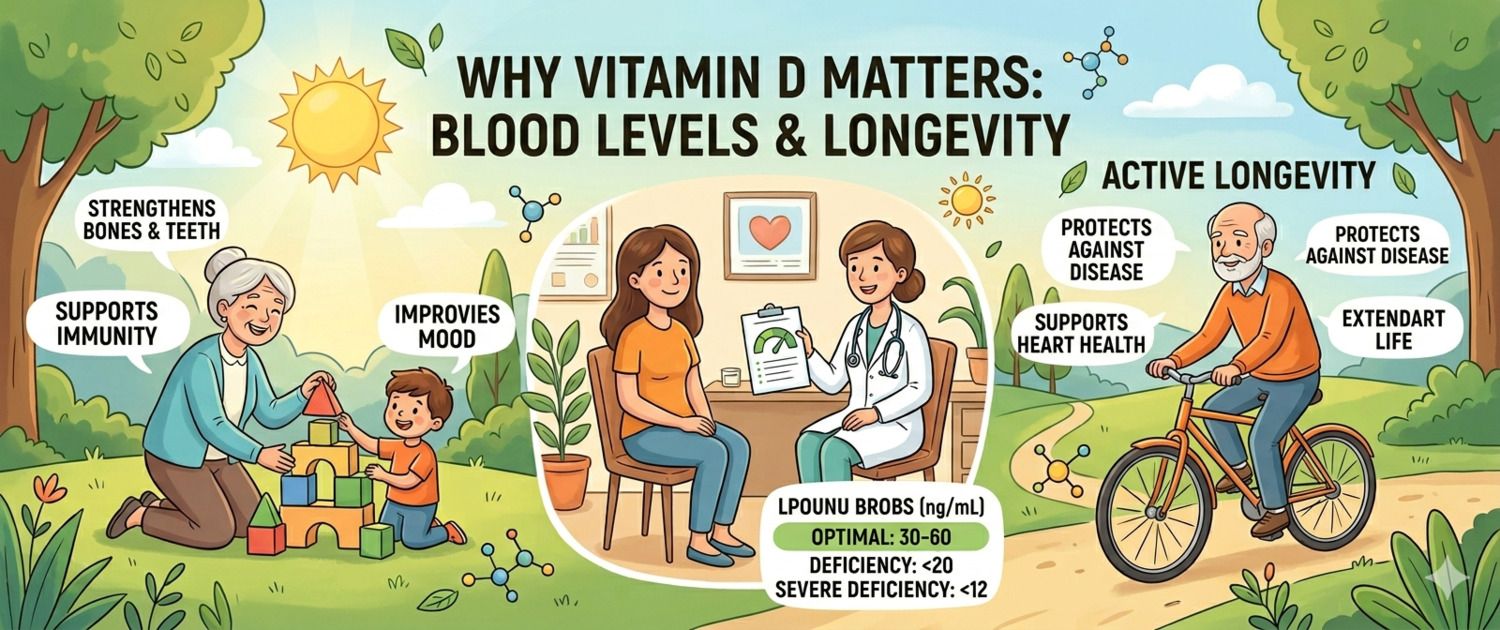
Vitamin D is the only nutrient the body synthesises itself under ultraviolet light — and yet deficiency is diagnosed in 40–80% of people in temperate climates. The reason: modern indoor life, clothing and SPF sunscreens reduce synthesis to almost nothing. Meanwhile, the role of vitamin D in the body extends far beyond bones: it is a signalling molecule with receptors in virtually every cell.
What Does Vitamin D Do: Key Functions in the Body
Vitamin D is a vitamin in name only — physiologically it is a steroid hormone. Its active form (calcitriol, 1,25-OH-D) interacts with nuclear VDR receptors found in immune cells, brain, heart, muscle, adipose tissue and reproductive organs. Vitamin D regulates the expression of more than 200 genes.
Calcium-phosphorus metabolism. The classical function: intestinal calcium and phosphorus absorption, bone remodelling. Vitamin D deficiency is a direct driver of osteoporosis and fractures in older adults.
Immune modulation. Vitamin D regulates both innate and adaptive immunity: enhances phagocytosis, stimulates production of antimicrobial peptides (cathelicidin, defensins), and reduces chronic inflammation. VDR receptors are present on all types of immune cells.
Endocrine regulation. VDR receptors are present in testicular Leydig cells (testosterone producers), pancreatic beta cells (insulin regulation) and adrenal cells. Vitamin D is one of the modulators of the entire endocrine axis.
Neuroprotection. Vitamin D regulates synthesis of neurotrophic factors (BDNF), protects neurons from oxidative stress, and participates in neurotransmitter synthesis. Low levels are associated with elevated risk of depression and cognitive decline.
Normal Vitamin D Blood Levels: Why 20 ng/mL Is Not Enough
The standard laboratory reference for vitamin D (25-OH-D3): above 20 ng/mL (50 nmol/L) is "normal"; below is deficiency. But this threshold reflects only the minimum required to prevent rickets and osteoporosis.
For full immune function, endocrine axis support and neuroprotection, epidemiological and clinical data consistently point to a substantially higher level:
| Category | 25-OH-D3 (ng/mL) | 25-OH-D3 (nmol/L) |
|---|---|---|
| Deficiency | < 20 | < 50 |
| Insufficiency | 20–30 | 50–75 |
| Laboratory normal | > 20 | > 50 |
| Functional optimum | 40–80 | 100–200 |
| Toxicity threshold | > 150 | > 375 |
Most people whose tests show "normal" vitamin D at 20–30 ng/mL are in practice in the insufficiency zone for immune and hormonal function — which explains why symptoms persist despite a "normal" result.
What Vitamin D Does for Men: Signs of Insufficiency
In men, vitamin D insufficiency presents differently than in women and is routinely attributed to stress, overwork or age. A typical profile: chronic unexplained fatigue; reduced immunity — recurrent respiratory infections; muscle weakness and poor exercise tolerance; low mood and apathy; reduced libido and erectile difficulties. The last two symptoms are often linked to vitamin D's role in testosterone synthesis — Leydig cell dysfunction from low vitamin D directly reduces testosterone output.
Detailed clinical signs and correction protocols are covered in the vitamin D deficiency guide.
Vitamin D and Immunity: The Molecular Mechanism
The immune-protective role of vitamin D is its best-studied function after calcium metabolism. The mechanism operates at multiple levels:
Innate immunity. Vitamin D stimulates macrophages and neutrophils to produce cathelicidin and defensins — antimicrobial peptides with broad-spectrum activity against bacteria, viruses and fungi. This explains the connection between vitamin D deficiency and increased susceptibility to upper respiratory infections.
Adaptive immunity. Vitamin D modulates the Th1/Th2 lymphocyte balance, reduces autoimmune reactivity and suppresses pro-inflammatory cytokines (IL-6, TNF-α) — the same cytokines that drive elevated C-reactive protein and chronic low-grade inflammation.
Antiviral protection. VDR receptors are expressed on respiratory epithelial cells — the first line of defence against viral infection. Vitamin D at 40–60 ng/mL is associated with a 2–3 fold reduction in respiratory infection frequency in cohort studies.
Vitamin D and Testosterone: The Male Hormone Connection
The link between vitamin D and testosterone is supported by both observational and interventional studies. The mechanism is direct: testicular Leydig cells express VDR receptors and vitamin D participates in testosterone synthesis via steroidogenesis regulation.
In observational studies, men with vitamin D below 20 ng/mL had on average 10–15% lower testosterone than men above 30 ng/mL. In supplementation trials, correcting deficiency raised testosterone by 20–25% over 12 months.
This is particularly relevant for men over 40, in whom both testosterone and vitamin D are declining simultaneously — each amplifying the other's negative effect. Monitoring both markers is discussed in the testosterone after 40 guide.
Vitamin D, Cardiovascular Health and Cancer Prevention
Cardiovascular system. VDR receptors are present in cardiomyocytes and vascular endothelium. Vitamin D regulates the renin-angiotensin-aldosterone system (lowering blood pressure), suppresses vascular wall inflammation and inhibits arterial calcification. Meta-analyses show: vitamin D below 20 ng/mL is associated with a 35–45% higher heart attack risk compared with levels above 40 ng/mL.
Cancer prevention. Vitamin D slows tumour cell proliferation, enhances apoptosis and reduces tumour angiogenesis. Evidence is strongest for colorectal, breast and prostate cancer. The 40–60 ng/mL range is associated with a 25–50% reduction in these cancer risks in large cohort studies.
Note: ferritin in the cancer prevention context works alongside vitamin D — excess iron accelerates oxidative stress that vitamin D partly counteracts.
Vitamin D for Longevity: Optimal Level vs Lab Reference
The laboratory norm of "above 20 ng/mL" is a minimum threshold to prevent severe deficiency states. For active cancer protection, immune function, neuroprotection and testosterone support, the level needed is substantially higher — 40–80 ng/mL (100–200 nmol/L).
This is consistent with data from blue zones — regions with the highest concentration of centenarians: Sardinia, Okinawa, the Nicoya Peninsula — all located in subtropical climates with high solar irradiance. Mean vitamin D in centenarians from these regions runs at 50–70 ng/mL.
How vitamin D relates to other biological age markers is covered in the biological age blood test guide.
How to Take Vitamin D and When to Test
Supplementation. For deficiency (below 20 ng/mL): starting dose 5,000–10,000 IU/day for 3–4 months under lab monitoring, then maintenance 2,000–4,000 IU/day. Take with a fat-containing meal (vitamin D is fat-soluble). Co-supplementation with vitamin K2 directs calcium to bones rather than blood vessels.
Testing schedule. Check 25-OH-D3 levels at least once a year — ideally twice: in September–October (after the summer peak) and in March–April (after the winter nadir). This reveals personal seasonal amplitude and allows dose adjustment.
Toxicity. Vitamin D is toxic only at very high levels (above 150 ng/mL): hypercalcaemia, nephrocalcinosis. At doses up to 10,000 IU/day with levels below 100 ng/mL, toxicity is essentially excluded. Overdose from sunlight is impossible. The role of vitamin D in the molecular mechanisms of ageing — telomeres, inflammation, mitochondrial function — is covered in the article ageing of the body: causes and mechanisms, and a complete longevity programme is in the article how to live long and healthy. The omega-3 index — another fat-soluble longevity marker synergistic with vitamin D — omega-3 index and longevity. Vitamin D's relationship with the chronic inflammation marker — hs-CRP and longevity. Annual monitoring frequency and target values — annual lab tests: longevity checklist.
This article is for informational purposes. Vitamin D dosage and supplementation protocol are determined by a doctor based on blood test results.
For informational purposes only
This article is for informational purposes only and does not constitute medical advice, diagnosis, or treatment. Please consult a healthcare professional for medical guidance.