Ferritin Blood Test: Normal Ranges and Interpretation
Reviewed by the LabReadAI medical team
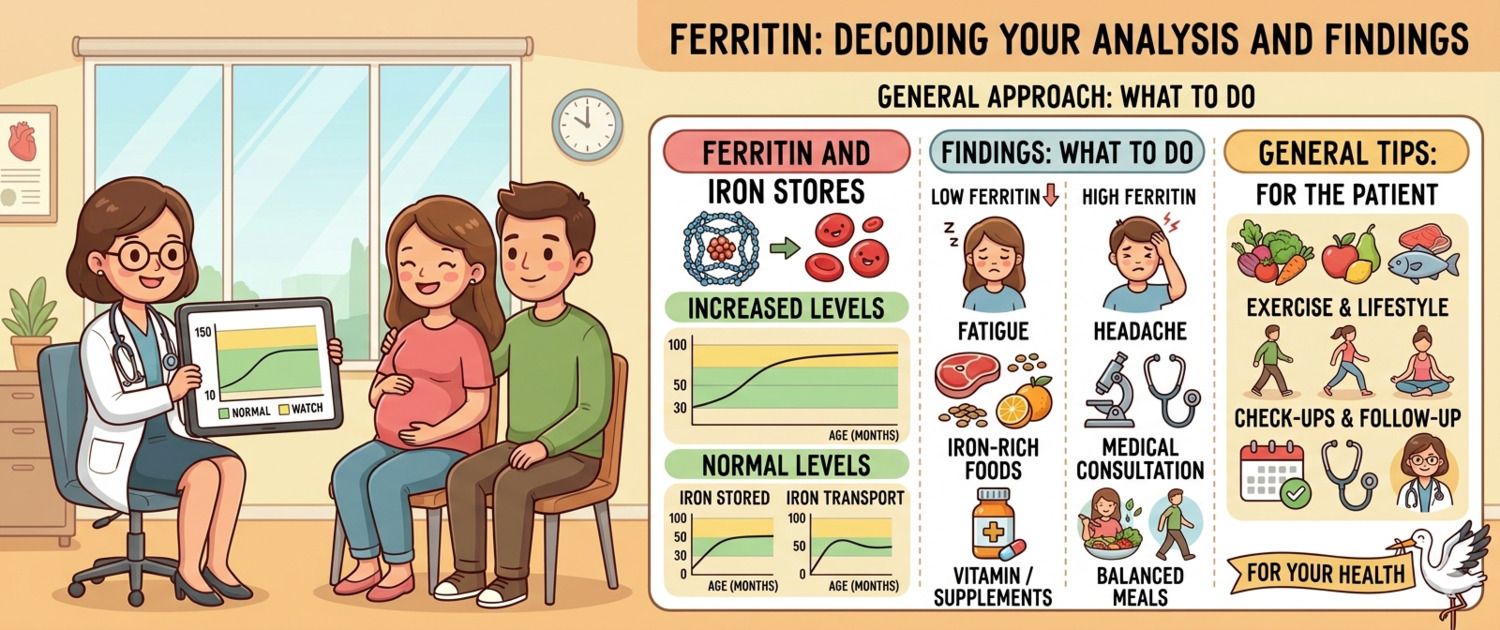
Ferritin is one of the most informative laboratory markers — and one of the most easily misread. "Normal ferritin" during chronic inflammation can conceal true iron deficiency. "High ferritin" in someone with fever and pain almost certainly reflects an acute-phase reaction, not an iron storage disease. Let's look at how to read this test correctly and when the result is misleading.
What Is Ferritin and Why It Matters More Than Haemoglobin for Diagnosing Iron Deficiency
Ferritin is the storage protein: it holds iron in liver cells, bone marrow, spleen, and muscle in an inactive, non-toxic form. A small amount of ferritin circulates in the blood — this is what we measure in the test.
Serum ferritin directly reflects the body's iron stores. This makes it a fundamentally earlier deficiency marker than haemoglobin: ferritin begins to fall weeks to months before haemoglobin drops and true iron deficiency anaemia develops.
The three-stage logic of iron depletion:
- Ferritin falls — iron stores are exhausted; haemoglobin still normal
- Serum iron and transferrin saturation fall — transport reserve depleted
- Haemoglobin falls, MCV decreases — iron deficiency anaemia
This is why normal haemoglobin does not exclude iron deficiency — ferritin must be checked.
Normal Ferritin Values
| Group | Normal ferritin (µg/L) |
|---|---|
| Women 18–45 years | 10–120 |
| Women over 45 years | 10–200 |
| Men | 20–250 |
| Children 1–5 years | 6–24 |
| Children 5–15 years | 10–55 |
| Pregnancy | ≥ 30 (target) |
Reference ranges vary between laboratories — always use the values on your specific report.
Three Clinically Important Ferritin Thresholds
Being formally "within range" is not always "sufficient." This is exactly why low ferritin with normal haemoglobin is one of the most common causes of scattered attention and brain fog: more in what steals your attention. Here are the thresholds that carry clinical weight:
Ferritin < 12–15 µg/L — overt iron deficiency. Stores are essentially exhausted; anaemia risk is high. Iron supplementation is indicated regardless of haemoglobin level.
Ferritin 12–30 µg/L — borderline zone. With symptoms (fatigue, hair loss, reduced stamina) — functional deficiency. In pregnancy this range already requires iron supplementation.
Ferritin < 30 µg/L in pregnancy — indication for iron supplementation, as demand rises sharply and stores are depleted quickly.
Ferritin 30–100 µg/L — optimal range for most adults. No deficiency, no toxicity.
Ferritin > 200–300 µg/L in women, > 300–400 µg/L in men — hyperferritinaemia requiring interpretation.
The Key Trap: Ferritin as an Acute-Phase Protein
This is the single most important thing to know about ferritin. Beyond its role as an iron storage protein, ferritin is an acute-phase reactant: during inflammation, infection, or tissue injury, its blood concentration rises sharply — independently of actual iron stores.
Practical implication: a patient with chronic inflammation (rheumatoid arthritis, chronic infection, malignancy) may have normal or even elevated ferritin while true iron stores are depleted. This is anaemia of chronic disease — one of the most diagnostically challenging forms of anaemia.
How to untangle this: always read ferritin alongside C-reactive protein (CRP):
- Low ferritin + normal CRP → true iron deficiency
- Normal/high ferritin + elevated CRP → inflammation masking possible deficiency; full iron panel needed (transferrin saturation < 16% indicates deficiency even with normal ferritin)
- Low ferritin + elevated CRP → iron deficiency coexisting with inflammation — both conditions are present
Causes of Low Ferritin
Low ferritin almost always means iron deficiency. The question is why:
Increased iron losses: heavy menstruation — the main cause in women of reproductive age; chronic gastrointestinal blood loss (ulcer, polyps, haemorrhoids, colorectal cancer — especially in men and postmenopausal women); regular blood donation.
Insufficient intake: strict vegetarianism and veganism without supplementation; restrictive diets.
Impaired absorption: coeliac disease, inflammatory bowel disease, atrophic gastritis, gastric surgery (including bariatric procedures).
Increased demand: pregnancy and breastfeeding, active growth in children and adolescents, intensive athletic training.
Causes of Elevated Ferritin (Hyperferritinaemia)
Elevated ferritin is not always a sign of iron excess. Causes must be distinguished:
Reactive elevation (acute phase): acute infections, inflammatory diseases, myocardial infarction, trauma, malignancy. Here ferritin is a marker of inflammation, not iron. As CRP normalises, ferritin follows.
Liver injury: acute hepatitis, cirrhosis — ferritin leaks from damaged cells. Liver function tests are also abnormal.
Chronic diseases: type 2 diabetes and metabolic syndrome — moderate hyperferritinaemia without iron excess; chronic kidney disease — ferritin accumulation from impaired clearance.
Hereditary haemochromatosis — genetic disorder of excess iron absorption. Ferritin > 300 µg/L in women and > 400 µg/L in men with transferrin saturation > 45–50% — the classic pattern. Requires confirmation by genetic testing (HFE mutation).
Macrophage activation syndrome (haemophagocytic lymphohistiocytosis) — rare but life-threatening. Ferritin is extremely high — often > 10 000 µg/L. Combined with fever, cytopenias, and abnormal liver function tests.
How to Prepare for a Ferritin Test
Ferritin does not require fasting — food intake has minimal effect on the result. Key recommendations:
- Draw blood in the morning under consistent conditions for serial monitoring
- Do not test during acute infections or active chronic disease flares — ferritin will be reactively elevated and will not reflect true stores
- When monitoring iron deficiency anaemia treatment — repeat after 3 months from haemoglobin normalisation, not sooner: this is how long it takes to replenish stores
Ferritin is part of the standard iron panel alongside serum iron, transferrin, and TIBC — a combined assessment is more accurate than ferritin alone.
When to Seek Urgent Medical Attention
Immediately: ferritin > 10 000 µg/L with fever, cytopenias, and organ dysfunction — possible macrophage activation syndrome.
Within a few days: ferritin < 10 µg/L in pregnancy; ferritin > 500 µg/L without an obvious cause (acute inflammation or trauma) — exclude haemochromatosis and liver pathology; rising ferritin on serial testing without treatment.
Summary
Ferritin is a two-faced marker. Low — almost always iron deficiency, cause to be found. High — must be distinguished: inflammation, liver injury, diabetes, or true iron excess. Reading ferritin without CRP and clinical context gives half the picture. Combined with a complete blood count and a full iron panel, ferritin delivers a complete view of iron metabolism.
This article is for informational purposes only. Interpretation of test results and treatment decisions are the responsibility of a physician.
For informational purposes only
This article is for informational purposes only and does not constitute medical advice, diagnosis, or treatment. Please consult a healthcare professional for medical guidance.