Low Hemoglobin: Causes of Anemia, Symptoms and Treatment
Reviewed by the LabReadAI medical team
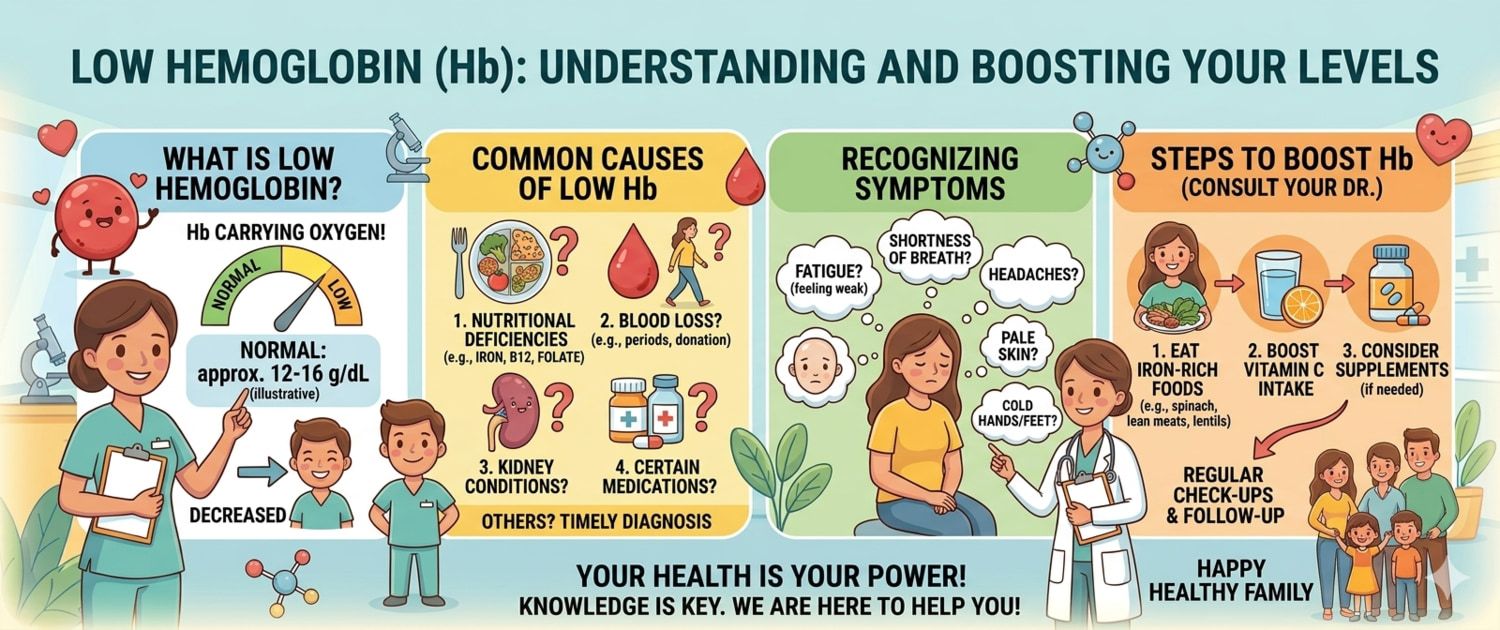
Fatigue that persists even after a full night of sleep, breathlessness climbing a single flight of stairs, pale skin, and a constant feeling of cold — these are the classic signs that tissues are not getting enough oxygen. Low hemoglobin is one of the most common abnormalities found on a complete blood count: anaemia affects one in four people worldwide. But "low hemoglobin" is not a diagnosis — it is a symptom. The conditions behind it vary enormously in nature and severity, and treatment differs fundamentally depending on the cause. This article covers why hemoglobin falls, how it presents, and what genuinely works to raise it.
What Low Hemoglobin Means and What the Normal Range Is
Hemoglobin is a protein in red blood cells that carries oxygen. When it falls below normal, the blood delivers less oxygen to tissues — anaemia develops.
Lower limits of normal (WHO criteria):
| Category | Anaemia defined as (g/L) |
|---|---|
| Men | < 130 |
| Non-pregnant women | < 120 |
| Pregnant women | < 110 (1st & 3rd trim.), < 105 (2nd trim.) |
| Children 6–59 months | < 110 |
| Children 5–11 years | < 115 |
| Children 12–14 years | < 120 |
Anaemia severity grades:
- Mild: 90 g/L – lower limit of normal. Often asymptomatic or mild fatigue only.
- Moderate: 70–89 g/L. Exertional breathlessness, palpitations, reduced capacity.
- Severe: < 70 g/L. Breathlessness at rest, tachycardia, dizziness, syncope.
- Critical: < 40–50 g/L. Risk of cardiac failure and death.
An important nuance: symptoms do not always correspond to the hemoglobin level. Chronic anaemia that has developed over years is tolerated far better than an acute haemorrhage to the same hemoglobin level — the body has had time to adapt.
Causes of Low Hemoglobin: Three Mechanisms
All causes of anaemia fit into three basic mechanisms: too little produced, too much lost, or destroyed too fast.
Insufficient Red Cell Production
Iron deficiency anaemia — the most common form worldwide, accounting for roughly 50% of all anaemias. Iron is an essential component of hemoglobin; without it, hemoglobin synthesis cannot proceed. Red cells come out small and pale (microcytic hypochromic anaemia). The earliest marker of deficiency is reduced ferritin — it falls before hemoglobin does. Full details on causes, diagnosis, and treatment: iron deficiency anaemia.
Causes of iron deficiency:
- Chronic blood loss: heavy menstruation, gastrointestinal bleeding (ulcer, polyps, haemorrhoids, colorectal cancer)
- Insufficient intake: vegetarian diet without supplementation, poor nutrition
- Increased demand: pregnancy, growth periods in children
- Impaired absorption: coeliac disease, Crohn's disease, post-gastrectomy, H. pylori infection
Vitamin B12 or folate deficiency — megaloblastic anaemia. Without these vitamins, DNA synthesis in red cell precursors is impaired; cells fail to divide normally and grow into large, immature forms. MCV is elevated (> 100 fL). Symptoms extend to neurological: tingling in the limbs, coordination problems.
Anaemia of chronic disease (ACD) — develops in chronic inflammation, malignancy, chronic kidney disease, and rheumatic conditions. Inflammatory cytokines suppress erythropoiesis and block iron release from storage. Ferritin is normal or elevated — unlike in iron deficiency. Treating the underlying disease improves the anaemia.
Aplastic anaemia — suppression of all bone marrow cell lines. Leukocytes and platelets fall simultaneously. Rare but serious, requiring inpatient haematology management.
Blood Loss
Acute blood loss — trauma, surgery, gastrointestinal haemorrhage. Hemoglobin falls rapidly; symptoms are acute — weakness, dizziness, tachycardia, falling blood pressure. An important caveat: in the first hours after acute bleeding, hemoglobin may appear "normal" — haemodilution occurs later.
Chronic blood loss — the most insidious variant. Small but constant losses (a few millilitres per day) deplete iron stores over months. The person gradually adjusts to weakness without noticing the worsening anaemia. Particularly dangerous in the context of gastrointestinal malignancy — colorectal cancer frequently presents as iron deficiency anaemia.
Accelerated Red Cell Destruction (Haemolysis)
In haemolytic anaemia, red cells are destroyed faster than the bone marrow can replace them. Signs: jaundice, dark urine, splenomegaly.
Causes:
- Autoimmune haemolysis — antibodies against the patient's own red cells
- Inherited haemolytic anaemias: sickle cell disease, thalassaemia, hereditary spherocytosis
- Infections: malaria — the classic cause in endemic areas
- Toxic haemolysis: venoms, certain medications
Symptoms of Low Hemoglobin
Symptoms are determined by two factors: the hemoglobin level and the speed of its decline. Chronic anaemia stays hidden longer — the body adapts by increasing heart rate and redistributing blood flow.
General tissue hypoxia symptoms:
- Persistent fatigue, weakness, reduced capacity for work
- Breathlessness with ordinary physical activity
- Rapid heartbeat (tachycardia)
- Dizziness, "floaters" before the eyes
- Headaches
- Impaired concentration and memory
Specific signs of iron deficiency (in addition to the above):
- Pale skin and mucous membranes
- Brittle nails with transverse ridging or spoon shape (koilonychia)
- Hair loss
- Dry skin and cracks at the corners of the mouth (angular cheilitis)
- Smooth, painful tongue (glossitis)
- Pica — craving chalk, earth, ice
- Taste for unusual smells: petrol, paint
Signs of B12 deficiency:
- Tingling and numbness in hands and feet
- Coordination problems, unsteady gait
- Cognitive impairment, depression — particularly in older adults
Diagnosis: Finding the Cause of Low Hemoglobin
Detecting anaemia is straightforward — a blood count suffices. Finding the cause takes more work. A doctor works through the differential systematically, guided by the morphology of red cells.
Key indicators for differential diagnosis:
- MCV: microcytosis (< 80 fL) — iron deficiency or thalassaemia; macrocytosis (> 100 fL) — B12 or folate deficiency; normocytosis — anaemia of chronic disease, haemolysis, acute blood loss
- Ferritin: reduced in iron deficiency; normal or elevated in ACD
- Reticulocytes: elevated in blood loss and haemolysis (bone marrow in overdrive); reduced in aplastic anaemia and vitamin deficiencies
- Bilirubin and LDH: elevated in haemolysis
When occult bleeding is suspected, a faecal occult blood test is ordered. Unexplained iron deficiency anaemia in an adult always mandates endoscopy — upper and lower gastrointestinal scope.
How to Raise Hemoglobin: Treatment by Cause
The fundamental rule: treat the cause, not the number. Iron tablets will not help B12-deficiency anaemia; B12 will not help iron deficiency.
Iron deficiency anaemia:
- Oral iron preparations (ferrous sulphate, fumarate, bisglycinate) — the cornerstone of treatment. Taken fasting or with vitamin C for better absorption. Treatment course 3–6 months: hemoglobin normalises in 4–8 weeks, then iron stores are replenished.
- Intravenous iron — for malabsorption, oral intolerance, or severe anaemia requiring rapid correction.
- Eliminating the source of blood loss — without this, any treatment is temporary.
- Diet: red meat, liver, offal, legumes. Vitamin C enhances non-haem iron absorption. Coffee, tea, and calcium reduce absorption — do not take with iron preparations.
B12 deficiency:
- When absorption is impaired (atrophic gastritis, pernicious anaemia) — intramuscular cyanocobalamin injections, lifelong.
- For dietary deficiency — high-dose oral B12.
Anaemia of chronic disease:
- Treating the underlying disease is primary.
- In chronic kidney disease — erythropoiesis-stimulating agents (epoetin).
- Red cell transfusion — only for severe symptomatic anaemia.
Haemolytic anaemia:
- Autoimmune — glucocorticoids, immunosuppression, splenectomy in severe cases.
- Inherited forms — supportive care; thalassaemia requires transfusions; some patients undergo bone marrow transplant.
When Low Hemoglobin Requires Urgent Medical Attention
Moderate chronic anaemia warrants a scheduled GP appointment. But several situations require immediate action:
- Hemoglobin below 70 g/L — regardless of symptoms
- Rapid hemoglobin drop alongside visible or occult blood loss
- Black tarry stools or blood in faeces — possible gastrointestinal haemorrhage
- Breathlessness at rest or heart rate above 100 bpm alongside anaemia
- Anaemia combined with simultaneous decline in leukocytes and platelets
- Anaemia in an infant under 1 year with hemoglobin below 90 g/L
- Anaemia in pregnancy with hemoglobin below 100 g/L
- No response to iron therapy after 4 weeks of correct treatment
The hemoglobin figure alone does not say which anaemia this is. The direction of the search is set by the calculated values of the red cell line — they place the anaemia in the microcytic, normocytic or macrocytic group before any further testing; how to read them is covered in red cell indices.
This content is for informational purposes only and does not replace professional medical advice.
For informational purposes only
This article is for informational purposes only and does not constitute medical advice, diagnosis, or treatment. Please consult a healthcare professional for medical guidance.