TSH Blood Test: Normal Range, Interpretation and Causes
Reviewed by the LabReadAI medical team
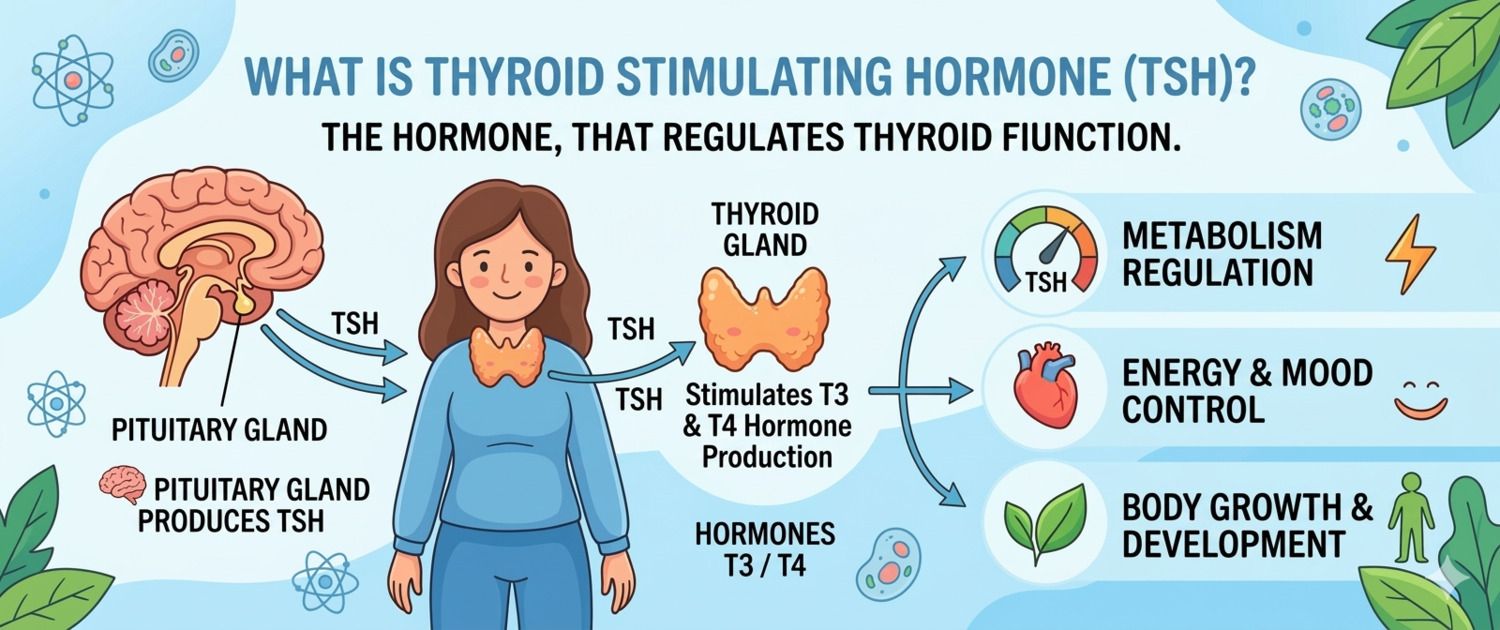
TSH is one of the most frequently ordered hormonal tests — and for good reason. A single marker can detect hidden hypothyroidism in a woman with unexplained fatigue or early hyperthyroidism in an elderly patient with atrial fibrillation. Yet TSH is also easily misinterpreted: in pregnant women, elderly patients, and those on therapy, the norms are fundamentally different. Let's look at how this hormone works and how to read its result in different clinical situations.
What Is Thyroid-Stimulating Hormone (TSH) and Why It Changes Before T4
TSH (thyroid-stimulating hormone) is a pituitary hormone that regulates thyroid gland activity. When thyroid hormone levels (T4 and T3) fall, the pituitary "detects" this and increases TSH output — stimulating the thyroid to work harder. When T4 and T3 are excessive, TSH is suppressed.
This relationship is non-linear (logarithmic). A small change in T4 causes a disproportionately large shift in TSH — the pituitary is roughly 100 times more sensitive to T4 fluctuations than standard T4 tests. This is why TSH becomes abnormal before T4 exits its reference range. Subclinical hypothyroidism is exactly this: TSH is already elevated but T4 is still normal — the pituitary detects the problem before it becomes clinically apparent.
This sensitivity makes TSH the best primary screening test. If TSH is normal, thyroid function is preserved and expanding the panel is unnecessary.
TSH Normal Range by Age, in Women and During Pregnancy
The standard adult reference range — 0.4–4.0 mIU/L — is not universal. Norms differ substantially across situations.
Normal Ranges by Age
| Age | TSH normal range (mIU/L) |
|---|---|
| Newborns (days 1–4) | 1.0–39.0 |
| Under 1 year | 0.7–8.4 |
| 1–6 years | 0.6–5.5 |
| 7–14 years | 0.4–4.5 |
| 15–18 years | 0.4–4.2 |
| Adults 18–60 years | 0.4–4.0 |
| Over 60 years | 0.4–6.0 |
In older adults the upper limit is higher — TSH physiologically shifts upward with age. Applying young-adult norms to a 75-year-old means over-diagnosing hypothyroidism.
Normal Ranges in Pregnancy
During pregnancy TSH norms are significantly stricter — especially in the first trimester, when hCG stimulates TSH receptors and physiologically lowers TSH.
| Trimester | TSH normal range (mIU/L) |
|---|---|
| 1st (weeks 1–12) | 0.1–2.5 |
| 2nd (weeks 13–26) | 0.2–3.0 |
| 3rd (weeks 27–40) | 0.3–3.0 |
Untreated hypothyroidism in pregnancy poses serious risks to fetal brain development. TSH is checked at the first obstetric visit.
Target Values During Levothyroxine Therapy
In hypothyroidism on therapy, the target is TSH in the range 0.5–2.5 mIU/L. In pregnancy — stricter: 0.1–2.5 mIU/L in the first trimester. In thyroid cancer after surgery — TSH is intentionally suppressed below 0.1 mIU/L.
TSH High: Causes, Hypothyroidism and Subclinical Hypothyroidism
TSH > 4.0 mIU/L (in adults 18–60) signals reduced thyroid function.
Subclinical hypothyroidism — TSH elevated (4–10 mIU/L) but free T4 still normal. Symptoms may be non-specific or absent. This is the most common finding on a thyroid panel.
Manifest (overt) hypothyroidism — TSH > 10 mIU/L + reduced free T4. Symptoms are pronounced: fatigue, weight gain, cold intolerance, slowed thinking, dry skin, bradycardia.
Other causes of high TSH: Hashimoto's autoimmune thyroiditis — the most common cause; thyroidectomy or radioiodine therapy; amiodarone, lithium; recovery phase after acute thyroiditis.
The TSH–lipid connection: in hypothyroidism, LDL and triglycerides often rise through impaired cholesterol clearance. This is why TSH is always checked when lipid panel abnormalities appear without an obvious cause.
TSH Low: Causes and Hyperthyroidism
TSH < 0.4 mIU/L — pituitary suppression from excess thyroid hormones or exogenous T4.
Subclinical hyperthyroidism — TSH suppressed, free T4 normal. Symptoms may be absent. Risks: atrial fibrillation (especially in the elderly), accelerated bone loss.
Manifest hyperthyroidism — TSH < 0.1 mIU/L + elevated free T4 or T3. Symptoms: tachycardia, weight loss, tremor, sweating, irritability, exophthalmos in Graves' disease.
Other causes of low TSH: Graves' disease — main cause in young women; toxic nodular goitre — more common in the elderly; excessive levothyroxine dose; acute destructive thyroiditis (temporary); first-trimester pregnancy — physiological hCG-mediated TSH suppression.
When to Test TSH: Diurnal Rhythm and Blood Test Interpretation
TSH has a pronounced diurnal rhythm: peak at night (2–4 am), nadir around noon. The difference between peak and nadir can reach 50–100%.
Practical rules:
- Draw blood in the morning, fasting (8–12 hours without food)
- For treatment monitoring — always at the same time of day
- For levothyroxine monitoring — draw blood before taking the morning tablet
Serial measurements at different times of day are not comparable. This is one of the most common sources of spurious "change" in TSH.
What Distorts TSH Results
Acute illness and stress — any severe illness can temporarily suppress TSH (euthyroid sick syndrome). Testing TSH during acute infection or hospitalisation is unreliable.
Biotin (vitamin B7) — high-dose biotin supplementation (> 5 mg/day, common in "hair and nails" products) causes false-low TSH results in immunoassays. Biotin must be stopped at least 72 hours before testing.
Medications: amiodarone raises TSH; corticosteroids, dopamine, and octreotide lower TSH; biotin-containing supplements interfere with immunoassay.
Heterophile antibodies — some people carry antibodies that interfere with immunochemical TSH measurement, producing spurious results. When TSH does not match the clinical picture — repeat at a different laboratory.
TSH and T4 Interpretation: Monitoring Levothyroxine Treatment
Free T4 — clarifies the degree of dysfunction. The algorithm: start with TSH; if abnormal, add free T4. More detail in the thyroid panel article.
Anti-TPO — when TSH is abnormal, confirms autoimmune cause. High anti-TPO predicts progression of subclinical to overt hypothyroidism.
Prolactin — often elevated in hypothyroidism. The pituitary simultaneously increases both TSH and prolactin output. In hyperprolactinaemia without an obvious cause — TSH is checked.
Estradiol — oestrogens affect thyroid hormone-binding proteins. In menstrual irregularities and low estradiol, TSH is one of the first tests ordered.
When to Seek Urgent Medical Attention
Immediately: TSH < 0.01 mIU/L with thyrotoxicosis symptoms (HR > 120, high fever, agitation) — possible thyroid storm; TSH > 20 mIU/L with severe hypothyroidism symptoms (stupor, hypothermia) — possible myxoedema coma.
Routine endocrinology referral: TSH > 4.0 mIU/L on repeat testing; TSH < 0.4 mIU/L without thyroid medication; any TSH abnormality in pregnancy; failure to reach target TSH after 6–8 weeks on a levothyroxine dose.
Summary
TSH is the best primary marker of thyroid function: sensitive, accessible, and earlier than T4. But it must be read in the context of age, pregnancy, medications, and time of day. Normal TSH rules out thyroid disease in most situations. An abnormal TSH is the trigger to add free T4, anti-TPO, and when needed — refer to an endocrinologist. For the full panel, see the thyroid panel article.
This article is for informational purposes only. Interpretation of test results and treatment decisions are the responsibility of a physician.
For informational purposes only
This article is for informational purposes only and does not constitute medical advice, diagnosis, or treatment. Please consult a healthcare professional for medical guidance.