How to Read TSH Results: Norms, Causes and Next Steps
Reviewed by the LabReadAI medical team
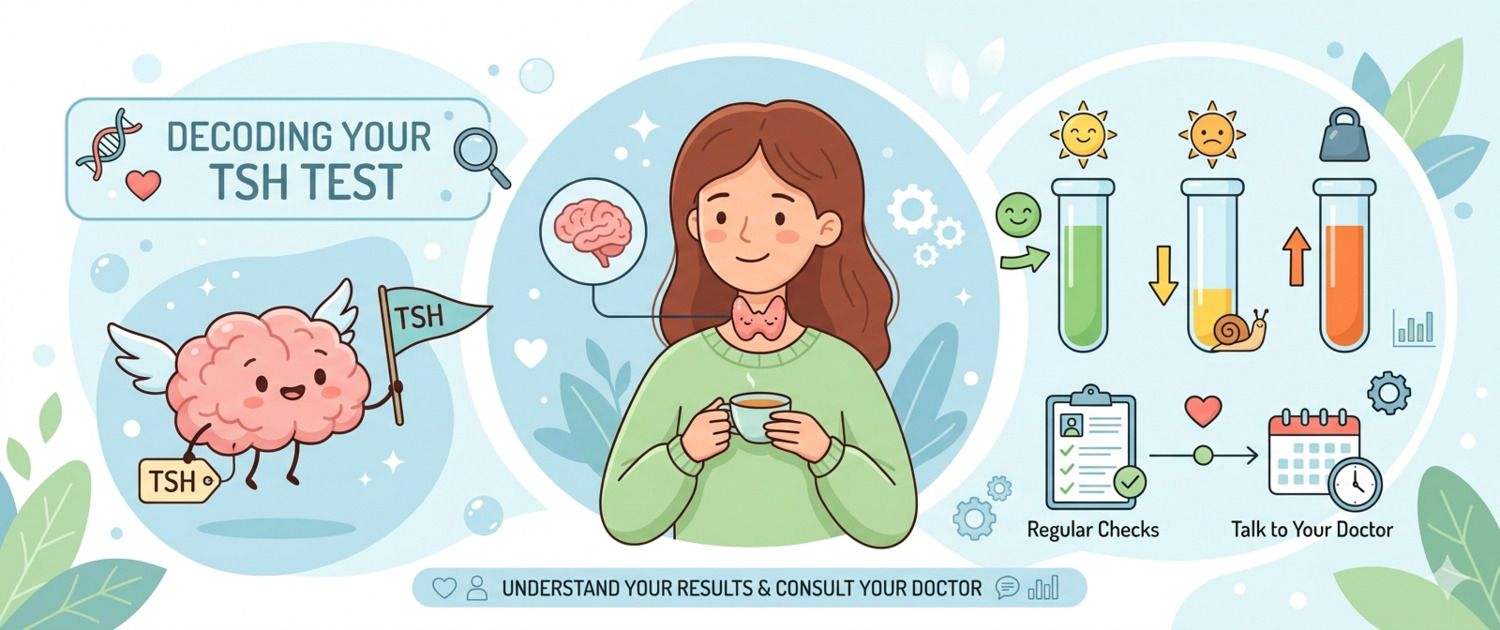
You received a TSH test result — and the number is either above or below the reference range on your lab report. Sometimes it's an incidental finding from a routine check-up; sometimes it finally explains months of fatigue, weight gain, or a racing heart. TSH is one of the most informative hormonal markers available, but reading it correctly requires understanding a few key principles. Let's go through it step by step.
What TSH Is and What It Measures
TSH — thyroid-stimulating hormone — is produced by the pituitary gland, a small structure at the base of the brain. Its sole function: to regulate the thyroid gland. When the thyroid produces too few hormones (T3 and T4), the pituitary increases TSH output — essentially pressing the accelerator. When thyroid hormones are excessive, TSH falls — releasing that pressure.
This makes TSH an exceptionally sensitive marker: it responds to changes in thyroid function before T3 and T4 themselves move outside the normal range. That's why TSH is the first and primary test for any suspected thyroid condition.
For a deeper look at how TSH regulates the thyroid and what happens during chronic deviation, see the article thyroid-stimulating hormone (TSH).
One important nuance: TSH does not directly measure how much thyroid hormone is currently in the blood — it reflects how the pituitary is evaluating that level. It's a "top-down view," not a direct measurement. For a complete picture, TSH is always read alongside the full thyroid panel.
TSH Normal Ranges by Age and During Pregnancy
Reference values for TSH vary significantly with age and physiological state. The same number can be entirely normal in an older adult and pathological in a pregnant woman.
| Group | TSH normal range (mIU/L) |
|---|---|
| Newborns (days 1–4) | 1.0–39.0 |
| Infants under 6 weeks | 1.7–9.1 |
| Infants 6 weeks – 14 months | 0.7–6.4 |
| Children 14 months – 5 years | 0.7–5.97 |
| Children 5–14 years | 0.6–4.84 |
| Adults 18–60 years | 0.4–4.0 |
| Adults over 60 years | 0.5–8.0 |
| Pregnancy — 1st trimester | 0.1–2.5 |
| Pregnancy — 2nd trimester | 0.2–3.0 |
| Pregnancy — 3rd trimester | 0.3–3.5 |
During pregnancy, TSH reference ranges are substantially lower than outside of it — this is not pathology, but a physiological effect: human chorionic gonadotropin (hCG) in the first trimester directly stimulates the thyroid, suppressing TSH.
Two practical rules when reading your report:
- Always check the reference range printed by your specific laboratory — it may differ slightly from the table above
- A minor deviation (0.1–0.2 units) without symptoms is not a cause for alarm, but it is reason for a repeat test in 3–6 months
How to Prepare for a TSH Test
TSH is one of the few hormones considered relatively stable throughout the day. Even so, several factors significantly affect the result.
- Fast or eat a light meal 3–4 hours before the draw
- Optimal timing: morning, between 8 and 11 AM — TSH concentration peaks at this time
- Avoid intense physical exercise and alcohol for 48 hours beforehand
- Minimize acute stress before testing — it can transiently suppress TSH
- Keep conditions consistent for follow-up tests: if the first draw was done fasting in the morning, repeat all subsequent tests the same way
If you take thyroid hormone medication (levothyroxine): the standard recommendation is to draw blood before taking your morning dose. Otherwise the result will reflect the drug's peak level, not the true background TSH.
Oral contraceptives, glucocorticoids, amiodarone, and lithium all significantly influence TSH — always inform your doctor about these medications.
High TSH: What It Means and Common Causes
A high TSH means the pituitary is sending strong signals for the thyroid to work harder — indicating that the thyroid is underperforming or struggling to keep up.
Hypothyroidism is the most common cause. In overt hypothyroidism, TSH is markedly elevated (typically > 10 mIU/L) and free T4 is low. Symptoms include fatigue, drowsiness, weight gain, cold intolerance, dry skin, constipation, and slowed thinking and speech. For full details on diagnosis and treatment, see hypothyroidism.
Subclinical hypothyroidism — TSH is elevated (usually 4–10 mIU/L) but free T4 remains within normal range. Symptoms may be absent or very mild. This is a borderline state requiring monitoring: some cases progress to overt hypothyroidism; others normalize spontaneously.
Hashimoto's thyroiditis — autoimmune inflammation of the thyroid. The most common cause of hypothyroidism in iodine-sufficient regions. TSH rises gradually as thyroid tissue is progressively destroyed.
Other causes: recovery phase after thyrotoxicosis, TSH-secreting pituitary adenomas, adrenal insufficiency, recovery from severe systemic illness, and certain medications (amiodarone, lithium, some antipsychotics).
Transient TSH elevation can follow severe stress, surgery, or acute illness — in such cases a repeat test 4–6 weeks later typically normalizes without treatment.
Low TSH: What It Means and Common Causes
A low TSH means the pituitary has gone quiet — the thyroid is either overproducing hormones or receiving stimulation that bypasses normal pituitary control.
Hyperthyroidism (thyrotoxicosis) — the thyroid produces excess hormones. TSH is suppressed or undetectable (< 0.01 mIU/L) and free T4 is elevated. Symptoms include palpitations, hand tremor, weight loss despite normal appetite, sweating, insomnia, and irritability. All clinical details and treatment are covered in hyperthyroidism.
Subclinical thyrotoxicosis — TSH is low (< 0.4 mIU/L) but T3 and T4 are normal. Symptoms are minimal or absent. In older patients, this condition increases the risk of atrial fibrillation and osteoporosis even without overt symptoms.
Graves' disease (diffuse toxic goiter) — an autoimmune condition in which antibodies mimic TSH, driving autonomous thyroid activity. One of the most common causes of persistently low TSH in young women.
Toxic nodular goiter — individual thyroid nodules begin secreting hormones autonomously, independent of TSH. More common after age 50.
Levothyroxine overdose — when hypothyroidism is treated with too high a dose. Requires dose adjustment, not discontinuation of therapy.
Other causes: central hypothyroidism from pituitary damage (paradoxically: low TSH with low T3/T4), euthyroid sick syndrome in systemic illness, and the first trimester of pregnancy (physiological).
TSH, T3, and T4: Reading the Tests Together
An isolated TSH is a good screening tool, but understanding the cause of any deviation requires looking at free T4 (and sometimes free T3). Here is how the combinations work:
| TSH | Free T4 | Interpretation |
|---|---|---|
| High | Low | Overt hypothyroidism |
| High | Normal | Subclinical hypothyroidism |
| Low | High | Overt hyperthyroidism (thyrotoxicosis) |
| Low | Normal | Subclinical thyrotoxicosis |
| Normal | Normal | Euthyroidism — thyroid function is normal |
| Low | Low | Central hypothyroidism (pituitary pathology) |
| High | High | Thyroid hormone resistance (rare) |
Central hypothyroidism is a rare but deceptive condition: TSH is low (or "normal" but functionally inactive) while T4 is also low. Without awareness of this pattern, the diagnosis is easily missed.
Anti-TPO (thyroid peroxidase) and anti-thyroglobulin antibodies are added to the workup when TSH is elevated, to confirm or rule out an autoimmune cause — this matters for prognosis and management decisions.
When a TSH Deviation Requires Treatment and Who to See
Not every abnormal TSH result requires immediate treatment. The approach depends on the degree of deviation, whether symptoms are present, and what T3/T4 show.
For elevated TSH:
- TSH 4–10 mIU/L, T4 normal, no symptoms → monitoring, repeat test in 3–6 months
- TSH > 10 mIU/L or symptoms of hypothyroidism → endocrinologist referral; levothyroxine therapy is likely
- Pregnancy with TSH > 2.5 mIU/L in the first trimester → endocrinologist urgently
For low TSH:
- TSH 0.1–0.4 mIU/L, T4 normal, no symptoms → monitoring, repeat test in 3–6 months
- TSH < 0.1 mIU/L or symptoms of thyrotoxicosis → endocrinologist within days
- Any TSH suppression during pregnancy → endocrinologist immediately
Seek urgent care if you have TSH abnormality combined with: rapid palpitations or arrhythmia, high fever with neck pain (possible thyroiditis), or altered consciousness and marked lethargy (possible myxedema coma in severe undiagnosed hypothyroidism).
This article is for informational purposes only and does not replace professional medical advice. TSH interpretation should be performed by an endocrinologist or GP in the context of the full clinical picture.
For informational purposes only
This article is for informational purposes only and does not constitute medical advice, diagnosis, or treatment. Please consult a healthcare professional for medical guidance.