Triglycerides in Blood: Normal Levels, Causes and Treatment
Reviewed by the LabReadAI medical team
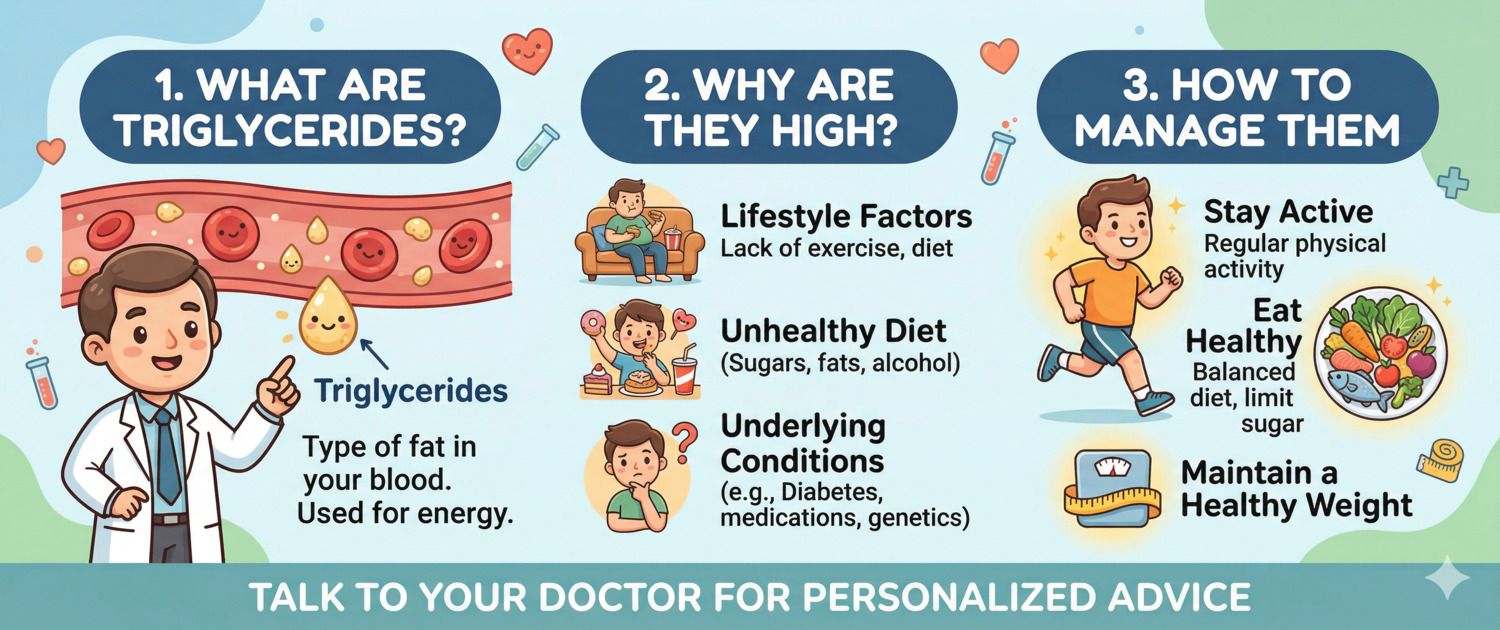
If cholesterol is the headline villain of cardiovascular risk conversations, triglycerides tend to stay in its shadow. Yet elevated triglycerides are an independent risk factor for both myocardial infarction and acute pancreatitis — and they are among the most responsive of all lipid markers to lifestyle change: the right interventions can reduce triglycerides by 30–50% without a single medication. Let's break down what triglycerides are, why they rise, and what to do about it.
What Triglycerides Are and How They Form
Triglycerides (TG) are esters of glycerol and three fatty acid chains. They are the primary form of fat storage in the body: triglycerides fill adipocytes (fat cells) and represent the body's main caloric reserve.
Triglycerides enter the blood via two routes. The first is from the intestine after dietary fat absorption: they are packaged into chylomicrons and transported through lymph into circulation. The second is synthesized in the liver from carbohydrates and free fatty acids and secreted as very-low-density lipoproteins (VLDL).
This second pathway explains a paradox that surprises many patients: triglycerides rise not only from fatty food but also from excess sugar and simple carbohydrates — the liver converts surplus carbohydrate into fat. This is precisely why a lipid panel must be drawn strictly fasting: even a light snack sharply elevates postprandial triglycerides.
Once in the blood, triglycerides within VLDL are hydrolyzed by lipoprotein lipase in muscle and adipose capillaries, releasing fatty acids for energy or storage. VLDL remnants are converted to LDL — and here the direct link between triglyceride levels and the atherogenic potential of the blood becomes clear.
Normal Triglyceride Levels by Age
Reference values for triglycerides are largely sex-independent in adults but vary modestly with age. Risk-based threshold values are uniform for all adults.
| Age | Normal range (mmol/L) |
|---|---|
| Children under 10 | 0.34–1.13 |
| Children 10–19 years | 0.36–1.48 |
| Adults 20–29 years | 0.45–2.27 |
| Adults 30–39 years | 0.45–2.60 |
| Adults 40–49 years | 0.45–2.71 |
| Adults over 50 | 0.45–2.83 |
Clinically relevant thresholds for adults:
| TG level (mmol/L) | Interpretation |
|---|---|
| < 1.7 | Desirable |
| 1.7–2.2 | Borderline high |
| 2.3–5.6 | High — lifestyle modification mandatory |
| > 5.6 | Very high — acute pancreatitis risk |
| > 11.3 | Severe hypertriglyceridemia — emergency treatment |
During pregnancy, triglycerides physiologically rise 2–3-fold — this is normal and does not require treatment.
How to Prepare for a Triglyceride Test
Triglycerides are among the most unstable markers in the lipid profile. Preparation errors produce far greater result distortion than for cholesterol or glucose.
- Strictly fasting: minimum 12 hours without food — optimally 12–14 hours. Even a small snack 4–6 hours before the draw can elevate results by 1.5–2-fold
- No alcohol for 72 hours: alcohol acutely stimulates hepatic VLDL synthesis
- Limit physical exercise the day before: intense training transiently lowers triglycerides — the result will be falsely low
- Stable diet: do not radically change eating habits in the 2–3 weeks before testing — results should reflect typical levels, not a dietary intervention
- Body position: draw blood seated after 5–10 minutes of rest — lying down reduces TG by approximately 5–10%
When triglycerides are first found elevated — especially above 5.6 mmol/L — repeat the test under identical conditions 2–4 weeks later before making any therapeutic decisions.
Causes of High Triglycerides
Hypertriglyceridemia is one of the most multifaceted lipid abnormalities: the causes range from dietary habits and systemic disease to genetics and medications.
| Cause | Mechanism | Characteristic features |
|---|---|---|
| Excess simple carbohydrates and alcohol | Enhanced hepatic VLDL synthesis | Isolated TG elevation; falls with diet change |
| Obesity, especially abdominal | Excess free fatty acids from visceral fat | Combined with low HDL |
| Type 2 diabetes and insulin resistance | Reduced lipoprotein lipase activity | Diabetic dyslipidemia: TG↑, HDL↓, small dense LDL |
| Hypothyroidism | Reduced VLDL clearance | Combined with elevated LDL and low HDL |
| Chronic kidney disease | Impaired VLDL catabolism | Often combined with low HDL |
| Familial hypertriglyceridemia | Genetic defect in TG synthesis or catabolism | Often marked elevation; family history |
| Medications | Oral estrogens, beta-blockers, retinoids, antipsychotics, tacrolimus | Rise linked to specific drug |
| Pregnancy | Physiological increase in VLDL synthesis | 2–3× elevation; normal in 3rd trimester |
The combination of high triglycerides with low HDL is the classic fingerprint of metabolic syndrome and insulin resistance. This "atherogenic duo" poses substantially greater cardiovascular risk than either marker alone.
Causes of Low Triglycerides
Low triglycerides (< 0.45 mmol/L) are less common but carry clinical significance.
Main causes: hyperthyroidism — accelerated lipoprotein catabolism; malabsorption syndromes (celiac disease, Crohn's) — impaired dietary fat absorption; severe fasting or cachexia — depletion of fat stores; hypobetalipoproteinemia — a rare genetic defect in apo-B-containing lipoprotein synthesis.
Isolated low triglycerides in a young, healthy person eating well are generally not pathological.
Triglycerides, HDL and LDL: How They Are Connected
Triglycerides cannot be interpreted in isolation — they are linked to the other lipid fractions through shared metabolic pathways.
Triglycerides and HDL — a reciprocal relationship. HDL ("good" cholesterol) exchanges components with VLDL particles: high triglyceride levels "consume" HDL, depleting its concentration. This is why reducing triglycerides almost always raises HDL — and vice versa. A patient with TG > 2.3 mmol/L and HDL < 1.0 mmol/L needs immediate lifestyle intervention.
Triglycerides and LDL. Elevated TG promotes the formation of small dense LDL (sdLDL) — the most atherogenic LDL subfraction. These particles penetrate the vessel wall more easily and circulate longer. This is why high triglycerides are a risk factor for atherosclerosis even when total LDL appears "normal."
Friedewald equation (calculated LDL): LDL = Total cholesterol − HDL − TG/2.2. When TG exceeds 4.5 mmol/L, this formula becomes unreliable and direct LDL measurement is required.
How to Lower Triglycerides and When to See a Doctor
Triglycerides are uniquely responsive to non-pharmacological interventions — more so than most other lipid markers.
Diet — the primary lever:
- Sharp reduction in simple carbohydrates and added sugar: replacing white bread, sweets, juices, and soft drinks with complex carbohydrates and fiber reduces TG by 20–30%
- Complete elimination or strict minimization of alcohol: even moderate intake sustains hypertriglyceridemia
- Increased omega-3 fatty acids: fatty fish (salmon, mackerel, sardines) 2–3 times per week reduces TG by 15–30%; for significantly elevated levels — prescription-grade omega-3 at high doses (2–4 g/day of EPA+DHA)
- Replacing saturated fats with monounsaturated fats (olive oil) provides modest TG reduction
Physical activity: moderate-intensity aerobic exercise for 30 minutes five times per week reduces triglycerides by 20–30% through activation of lipoprotein lipase in muscles.
Weight loss: each kilogram of abdominal fat lost reduces TG by approximately 2%; losing 5–10% of body weight in obesity reduces TG by 20–30%.
Drug treatment is indicated when TG > 5.6 mmol/L or when lifestyle changes are insufficient in the context of high cardiovascular risk:
- Fibrates (fenofibrate, bezafibrate) — first-line agents for severe hypertriglyceridemia; reduce TG by 30–50%
- High-dose omega-3 — in combination with statins
- Statins — modestly reduce TG (by 10–20%) and remain the foundation of therapy in high cardiovascular risk
- Niacin — effective but rarely used due to side effect profile
See a doctor if triglycerides exceed 2.3 mmol/L on repeat testing, and seek urgent evaluation at TG > 5.6 mmol/L — the risk of acute pancreatitis at levels above 11 mmol/L is very high and requires inpatient treatment.
For triglycerides in the extended lipid profile framework, their link to metabolic syndrome and longevity, see the article extended lipid profile and longevity.
This article is for informational purposes only and does not replace professional medical advice. Consult a GP or cardiologist for any triglyceride abnormality.
For informational purposes only
This article is for informational purposes only and does not constitute medical advice, diagnosis, or treatment. Please consult a healthcare professional for medical guidance.