How to Increase Testosterone in Men: Causes and Methods
Reviewed by the LabReadAI medical team
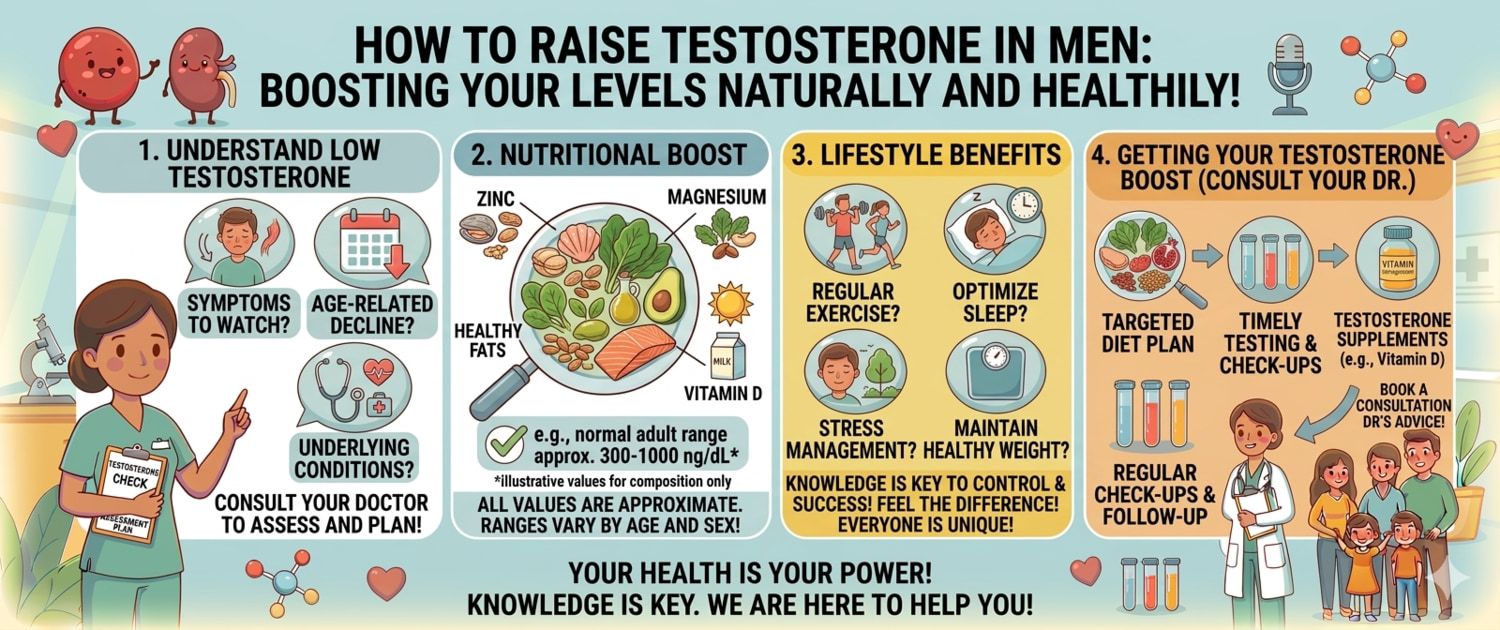
Fatigue that a full night's sleep doesn't resolve, diminishing interest in sex, muscles that won't grow despite consistent training, and stubborn abdominal fat that won't respond to diet. Men often attribute these symptoms to age or stress — and miss the specific hormonal cause. There are proven methods to address this deficiency, both lifestyle-based and medical. Testosterone deficiency affects roughly one in four men over 45, and it's appearing earlier in life than it used to. Let's examine why it develops, how to identify it, and what genuinely works to restore it.
Why Testosterone Declines in Men
Testosterone is produced by Leydig cells in the testes under the direction of luteinizing hormone (LH) from the pituitary gland. This forms a classic axis: hypothalamus → pituitary → testes. A disruption at any level produces testosterone deficiency.
Age-related decline is the most common cause. After the age of 30, total testosterone falls by approximately 1–2% per year. By age 50, some men reach clinically significant deficiency — referred to as late-onset hypogonadism.
Obesity is the second most frequent factor. Adipose tissue contains aromatase, an enzyme that converts testosterone to estradiol. The more visceral fat, the more active this conversion. A self-reinforcing cycle forms: low testosterone promotes fat accumulation, and excess fat further suppresses testosterone.
Chronic stress and sleep deprivation. Testosterone is produced primarily at night, during deep sleep phases. With consistent undersleeping (under 6 hours), levels fall by 10–15% within a single week. Chronically elevated cortisol directly suppresses LH and testosterone secretion.
Primary hypogonadism — damage to the testes themselves: Klinefelter syndrome, cryptorchidism, trauma, orchitis after mumps, toxic exposures, and radiation.
Secondary hypogonadism — disruption at the pituitary or hypothalamic level: tumors, hyperprolactinemia, hemochromatosis, and prior anabolic steroid use (which suppresses endogenous LH production).
Comorbid conditions: type 2 diabetes, metabolic syndrome, chronic kidney and liver disease, and HIV all reliably lower testosterone — and low testosterone in turn worsens the course of these conditions.
Symptoms of Low Testosterone in Men
Testosterone deficiency acts systemically and develops gradually — which is precisely why it is easily mistaken for normal aging or burnout.
| Domain | Symptoms of testosterone deficiency |
|---|---|
| Sexual function | Reduced libido, erectile dysfunction, decreased ejaculate volume |
| Body composition | Loss of muscle mass and strength; increased fat (especially abdominal) |
| Energy and mood | Chronic fatigue, apathy, reduced motivation, irritability |
| Cognitive function | Poor concentration, memory decline, "brain fog" |
| Sleep | Sleep disturbances, night sweats |
| Bone | Reduced bone density, elevated fracture risk |
| Physical signs | Reduced shaving frequency, decreased testicular volume, gynecomastia |
None of these symptoms is specific to testosterone deficiency in isolation. Diagnosis is only valid when the clinical picture is confirmed by laboratory testing — there is no other way.
Diagnosis: Which Tests to Order
Before attempting to raise testosterone, it is essential to establish the actual level and identify the underlying cause of any reduction.
Total and free testosterone — the baseline markers. Total testosterone provides screening; free (bioavailable) testosterone is a more precise assessment, particularly important in obese men and older patients, where sex hormone-binding globulin (SHBG) is elevated and binds a larger fraction.
Blood must be drawn in the morning (8:00–10:00 AM) — this is when testosterone is at its daily peak. Fasting or 2–3 hours after a light breakfast. A diagnosis of hypogonadism requires confirmation by two separate measurements on different days.
LH and FSH — distinguish primary hypogonadism (high LH with low testosterone: the testes are not responding to the signal) from secondary (low LH with low testosterone: the signal is not being sent).
SHBG — determines how much testosterone is biologically available. It is reduced in obesity and elevated in cirrhosis.
Complete blood count — to assess hematocrit and hemoglobin. Testosterone stimulates erythropoiesis; its deficiency is often accompanied by anemia.
Prolactin — to rule out hyperprolactinemia as a cause of secondary hypogonadism. Estradiol — especially when gynecomastia or obesity is present.
How to Boost Testosterone Without Medication: Lifestyle
For functional testosterone decline — without organic pathology — lifestyle methods produce significant and measurable results. These are not generic health recommendations but interventions with documented impact on the hypothalamic–pituitary–gonadal axis, each shown to increase testosterone through a specific mechanism.
Sleep is the foundation of testosterone. Approximately 70% of daily testosterone production occurs at night, concentrated in slow-wave sleep phases. The target is 7–9 hours with a consistent wake time. In one controlled experiment, healthy young men who slept five hours per night for one week had testosterone levels drop by 10–15% — equivalent to the effect of 10–15 years of aging.
Resistance training. Compound strength exercises are the most effective non-pharmacological testosterone stimulus. Working at 70–85% of maximum load (3–5 sets of 5–8 reps), with multi-joint movements (squats, deadlifts, bench press), produces the greatest hormonal response. Moderate aerobic exercise is also beneficial but raises testosterone to a lesser degree.
Weight loss. A 10–15% reduction in body weight in obese men increases testosterone by 15–30% — driven by reduced aromatase activity in adipose tissue. This is one of the most effective medication-free approaches available.
Stress management and cortisol reduction. Chronically elevated cortisol suppresses GnRH (gonadotropin-releasing hormone) — the starting signal of the entire reproductive axis. Reducing psychological load, practicing stress management techniques, and normalizing sleep all work on testosterone specifically through this mechanism.
Eliminating toxins. Chronic heavy alcohol use is directly toxic to Leydig cells. Even moderate regular intake (> 2–3 units per day) reduces testosterone by 6–23%. Tobacco, prior anabolic steroid use, and exposure to endocrine disruptors (bisphenol A from plastics, phthalates) are additional suppressive factors.
Nutrition and Low Testosterone
Testosterone is a steroid hormone, and cholesterol is required for its synthesis. Severely restricting dietary fat when testosterone is already low is counterproductive.
Key nutrients:
Vitamin D functions as a prohormone and directly regulates the testosterone synthesis gene in Leydig cells. Men with sufficient vitamin D have measurably higher testosterone than those who are deficient. Sources: sunlight, fatty fish, egg yolks; supplementation under blood level monitoring when deficient.
Zinc — a cofactor of the enzyme involved in testosterone synthesis. Zinc deficiency directly lowers LH and testosterone. Sources: oysters (by far the richest source), red meat, pumpkin seeds, legumes. In men without deficiency, zinc supplements do not raise testosterone further — they only correct a deficit.
Magnesium — influences testosterone bioavailability by reducing SHBG binding. Sources: nuts, spinach, buckwheat.
Adequate fat intake. Optimal fat consumption is 20–35% of total calories, with emphasis on monounsaturated fats (olive oil, avocado) and moderate animal saturated fats.
What lowers testosterone through diet: chronic caloric excess and obesity, excess sugar and refined carbohydrates (drive insulin resistance and aromatase activity), large habitual soy intake (contains phytoestrogens), and extreme caloric restriction below 1,500–1,800 kcal per day.
Testosterone and Other Hormones: Systemic Connections
Testosterone does not operate in isolation — its level is woven into the broader hormonal context.
Testosterone and insulin resistance. Low testosterone amplifies insulin resistance; insulin resistance lowers testosterone. This mutually reinforcing cycle is one of the mechanisms linking androgen deficiency to type 2 diabetes. Improving insulin sensitivity is a legitimate therapeutic target in hypogonadism associated with metabolic syndrome.
Testosterone and estradiol. A portion of testosterone is normally converted to estradiol by aromatase — and this is physiologically necessary: estradiol protects bone, cardiovascular function, and cognition in men. In obesity, conversion becomes excessive, which manifests as gynecomastia and progressive suppression of the pituitary–testicular axis.
Testosterone and prolactin. Hyperprolactinemia is one of the most common endocrine causes of secondary hypogonadism in men under 40. Elevated prolactin suppresses GnRH, reducing LH and testosterone. Excluding this cause is a mandatory step in the diagnostic workup.
Testosterone and the thyroid. Hypothyroidism lowers SHBG and disrupts the gonadal axis, producing reduced libido and erectile dysfunction with a technically normal testosterone level. When androgen deficiency symptoms are present, thyroid function assessment is part of the standard evaluation.
Medical Treatment and When to See a Doctor
Lifestyle and nutritional methods work for functional testosterone decline. In organic hypogonadism — primary or secondary — they address aggravating factors but medical methods are needed to resolve the underlying problem.
Testosterone replacement therapy (TRT) is prescribed for confirmed hypogonadism with symptoms. Delivery forms: daily gels, injections (every 1–12 weeks depending on the preparation), patches, and subcutaneous pellets. The choice of form is a joint decision between patient and endocrinologist based on lifestyle, preferences, and comorbidities.
Key contraindications to TRT: prostate or male breast cancer, high hematocrit (> 54%), uncontrolled heart failure, and desire to preserve fertility (TRT suppresses spermatogenesis).
Alternatives for secondary hypogonadism when fertility is desired: human chorionic gonadotropin (hCG) and clomiphene citrate — both stimulate endogenous testosterone production through the pituitary–testicular axis.
Consult an endocrinologist or urologist-andrologist if you have:
- Testosterone below 12 nmol/L combined with symptoms
- Erectile dysfunction with no other clear cause
- Gynecomastia at any age
- Couple infertility with a normal semen analysis from the female partner
- Suspected primary hypogonadism (reduced testicular volume, elevated LH)
Seek urgent care if pituitary adenoma symptoms develop: progressive headache, visual field defects, or simultaneous decline in multiple pituitary hormones.
This article is for informational purposes only and does not replace professional medical advice. Diagnosis and treatment of hypogonadism should be managed by an endocrinologist or urologist-andrologist.
For informational purposes only
This article is for informational purposes only and does not constitute medical advice, diagnosis, or treatment. Please consult a healthcare professional for medical guidance.