Anxiety: Which Lab Tests to Take to Rule Out Hormonal Causes
Reviewed by the LabReadAI medical team
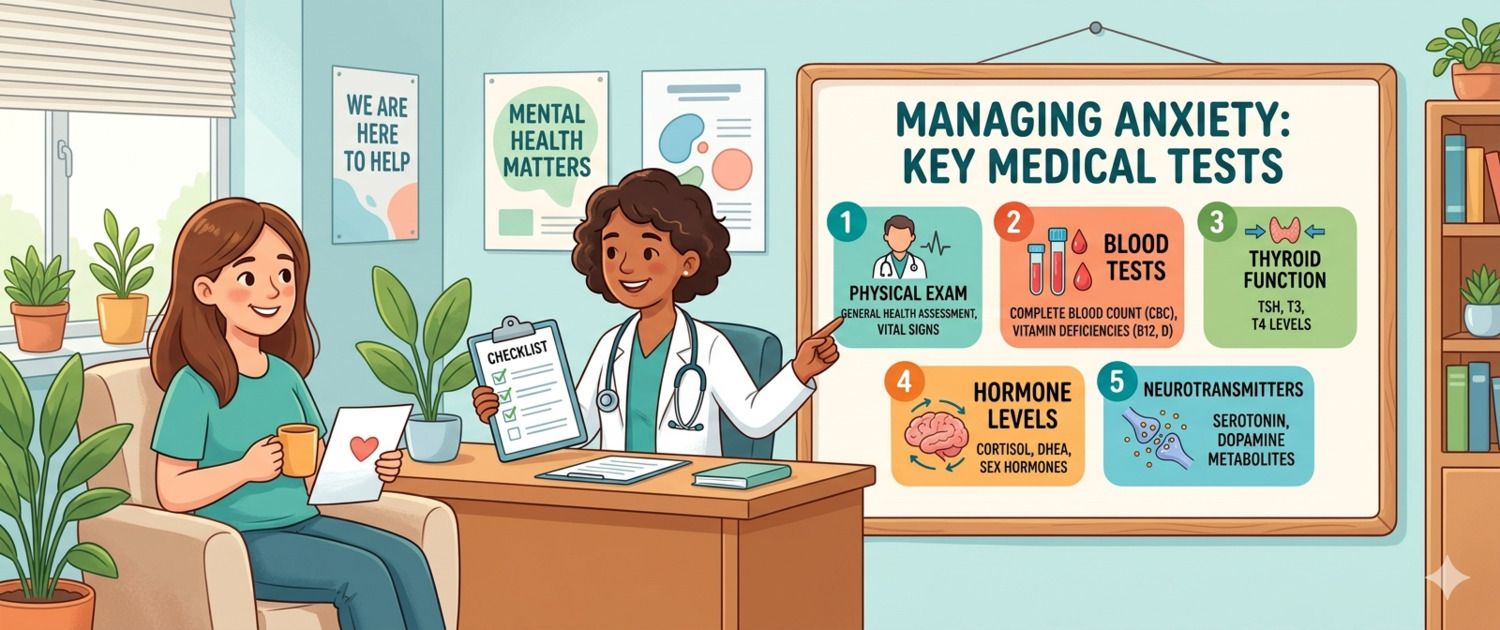
Anxiety has a long list of possible causes, and not all of them are "psychological." Chronic HPA-axis activation, hidden hyperthyroidism, iron deficiency, low vitamin D, chronic inflammation, and hormonal fluctuations in women — each of these can cause or amplify anxiety. Before treating anxiety as "just anxiety," it makes sense to rule out a set of laboratory causes once. This won't turn psychotherapy into a blood test, but it will save months of treating anxiety that has a biochemical basis.
When Anxiety Warrants Lab Testing
Not every "I'm nervous" needs a blood test. Lab workup for anxiety is meaningful when:
- Anxiety appeared relatively recently (1–6 months) and without an obvious trigger
- Anxious episodes come with physical symptoms: palpitations, tremor, sweating, shaking
- Anxiety coexists with weight loss or gain
- Sleep is disturbed regardless of daily stress level
- There are concurrent hair loss, dry skin, cycle changes, erectile dysfunction
- Anxiety doesn't respond to "ordinary" measures (psychotherapy, sleep, exercise)
- Family history of thyroid disease, autoimmunity, or pheochromocytoma
If anxiety has a clear psychological context (job loss, divorce, relocation) and is accompanied by sadness, apathy, intrusive thoughts — psychotherapy is the priority and lab testing runs in parallel.
Which Hormones and Markers to Check
The base set for anxiety lab workup:
Thyroid hormones: TSH + free T4. Hyperthyroidism is a frequent and easily missed cause of "new" anxiety. The symptoms overlap: palpitations, sweating, tremor, insomnia. Target TSH for well-being — 1.0–2.5 mIU/L.
Morning cortisol (8:00–10:00) and evening cortisol (4:00–6:00 PM). Cortisol is usually elevated in chronic anxiety; an evening rise explains the "mind that won't switch off" pattern.
Ferritin — low iron reduces dopamine and GABA system synthesis. Target for emotional well-being is > 50 ng/mL; in anxiety it is often lower.
Vitamin D (25-OH) — receptors are present in the hypothalamus and emotion-regulation centers. Deficiency < 30 ng/mL is linked to higher anxiety in predisposed people.
Vitamin B12 and folate — critical for serotonin, dopamine, and GABA synthesis. Their deficiency often masquerades as "anxious-depressive disorder."
Magnesium — a GABA synthesis cofactor — the principal inhibitory neurotransmitter. Magnesium deficiency is a known driver of anxiety.
Fasting glucose + insulin — frequent hypoglycemias activate the adrenaline system and mimic panic attacks.
For prominent physical anxiety symptoms: 24-hour urinary catecholamines and metanephrines (to exclude pheochromocytoma — rare but dangerous).
The stress block is conveniently drawn as one adrenal stress panel, the thyroid block as a thyroid panel, and the sleep block as a sleep disorders panel.
Anxiety and the Thyroid
Hyperthyroidism is the #1 miss in "new anxiety." Excess thyroid hormones make the nervous system hyperreactive: heart "jumps," hands shake, sleep is poor, weight drops, sweating increases. Because of the resemblance to anxiety disorder, patients are often treated with psychotherapy for months without anyone checking TSH.
Useful clinical distinctions:
- Overt hyperthyroidism — TSH suppressed (< 0.1), T4/T3 elevated: clear clinical picture, endocrinologist required
- Subclinical hyperthyroidism — TSH suppressed, T4/T3 normal: milder symptoms but real arrhythmia and osteoporosis risks
- Autoimmune thyroiditis in thyrotoxic phase — anti-TPO elevated, transient inflammatory hormone release
Hypothyroidism usually presents differently — apathy, slowing, depression — but in some patients with hypothyroidism anxiety develops alongside subclinical TSH fluctuations. So: with TSH > 4.0 and anxiety, an endocrinology consult is warranted.
Anxiety and Cortisol
Cortisol and anxiety are bidirectionally linked. Chronic anxiety activates the HPA axis and raises cortisol; elevated cortisol in turn sustains the anxious background by amplifying amygdala activity and impairing the prefrontal cortex.
Typical lab patterns in anxiety:
- Morning cortisol upper-normal or modestly elevated
- Evening cortisol elevated (flattened circadian rhythm)
- DHEA-S reduced or normal — cortisol/DHEA-S ratio shifted toward cortisol
- Prolactin may be modestly elevated (stress-induced)
This is functional hypercortisolism — well responsive to non-pharmacological strategies: sleep, nutrition, caffeine restriction, basic adaptogens. For more, see how to lower cortisol.
Anxiety and Neurotransmitters (Serotonin, GABA, Dopamine)
The neurotransmitter hypothesis of anxiety is simplified but workable. It is worth holding separately in mind that scattered attention and "I can't gather myself" in anxiety are easily confused with ADHD: how they are told apart is covered in ADHD or burnout, anxiety, depression. Three key systems:
- Serotonin — mood stabilization, anxiety inhibition. SSRIs raise synaptic serotonin. A blood serotonin test gives a limited picture — mainly reflecting gut, not brain, synthesis. For more on this, see serotonin: what it is.
- GABA — the main inhibitory neurotransmitter. Benzodiazepines potentiate GABA receptors. Direct GABA testing is clinically uninformative; deficiency is inferred indirectly via low magnesium and B6.
- Dopamine — motivation, pleasure; paradoxically, its deficiency also increases anxiety through depletion of motivational systems and is linked to iron deficiency.
Laboratory evaluation of this triad is indirect: through synthesis cofactors (magnesium, B6, B12, folate, ferritin) and adjacent hormonal systems (cortisol, TSH). Properly checking these hormonal pathways is what separates "anxiety with no obvious causes" from anxiety with treatable hormonal causes.
Deficiencies That Mimic Anxiety
Part of "anxiety" is actually the clinical face of nutrient deficiency.
Low ferritin (< 30 ng/mL) — produces irritability, anxiety, insomnia, palpitations; women of reproductive age are the most common scenario.
Vitamin D deficiency (< 30 ng/mL) — associated with elevated anxiety and impaired serotonergic function; replacement often delivers a noticeable benefit.
Magnesium deficiency — linked to neuromuscular hyperexcitability, tremor, anxiety, and sleep disturbance.
B12 and folate deficiency — linked to depressive-anxious symptoms, particularly in vegetarians and people over 50.
Hypoglycemia (unstable glucose) — repeated sugar drops activate the adrenaline-cortisol response, subjectively felt as anxiety or panic.
Replacing deficiencies is not "supplement therapy" but the first line of objective intervention. Doses and forms are best chosen by a clinician with follow-up testing.
Interpretation: Typical Patterns in Anxiety
"Pure" functional anxiety. TSH normal, cortisol elevated (especially evening), ferritin may be low, vitamin D at the lower bound. Response — psychotherapy, sleep, baseline anti-stress measures, deficiency replacement.
Anxiety with a thyroid component. TSH suppressed (< 0.4), free T4 normal or elevated. Response — endocrinology and, if needed, antithyroid therapy.
Anxiety on a burnout background. Evening cortisol elevated, DHEA-S reduced 30–50% below age norm, ferritin low, TSH closer to 4. Response — comprehensive: load reduction, sleep, deficiency replacement, psychotherapy.
"Deficiency" anxiety. Hormones normal but low ferritin (< 30), low vitamin D and B12, low magnesium. Response — replacement, and anxiety often resolves without specific psychotherapeutic intervention.
Pheochromocytoma (rare). Episodic sharp BP rises, palpitations, sweating, fear of death; elevated urinary catecholamines and metanephrines. Response — urgent endocrinology and adrenal CT.
Psychotherapist or Endocrinologist: Where to Start
To a psychotherapist first:
- Anxiety is tied to a specific psychotraumatic event
- The ruminative, intrusive component dominates
- Lab values are normal
- Symptoms persist after deficiency correction and hormone normalization
To an endocrinologist first:
- Concurrent physical symptoms (weight, sweating, palpitations, cycle changes)
- Suppressed or elevated TSH
- Morning cortisol > 690 nmol/L
- Episodic hypertensive crises with tachycardia
To a primary care doctor:
- Iron, B12, vitamin D, folate deficiencies
- Changes on basic blood work (low hemoglobin, elevated CRP)
Ideally — a combined approach. Lab testing and psychotherapy are not alternatives but parallel tools.
This article is for informational purposes only and does not replace professional medical advice. Anxiety states require individual evaluation by a qualified clinician.
For informational purposes only
This article is for informational purposes only and does not constitute medical advice, diagnosis, or treatment. Please consult a healthcare professional for medical guidance.