Glycated Hemoglobin (HbA1c): Normal Levels and Interpretation
Reviewed by the LabReadAI medical team
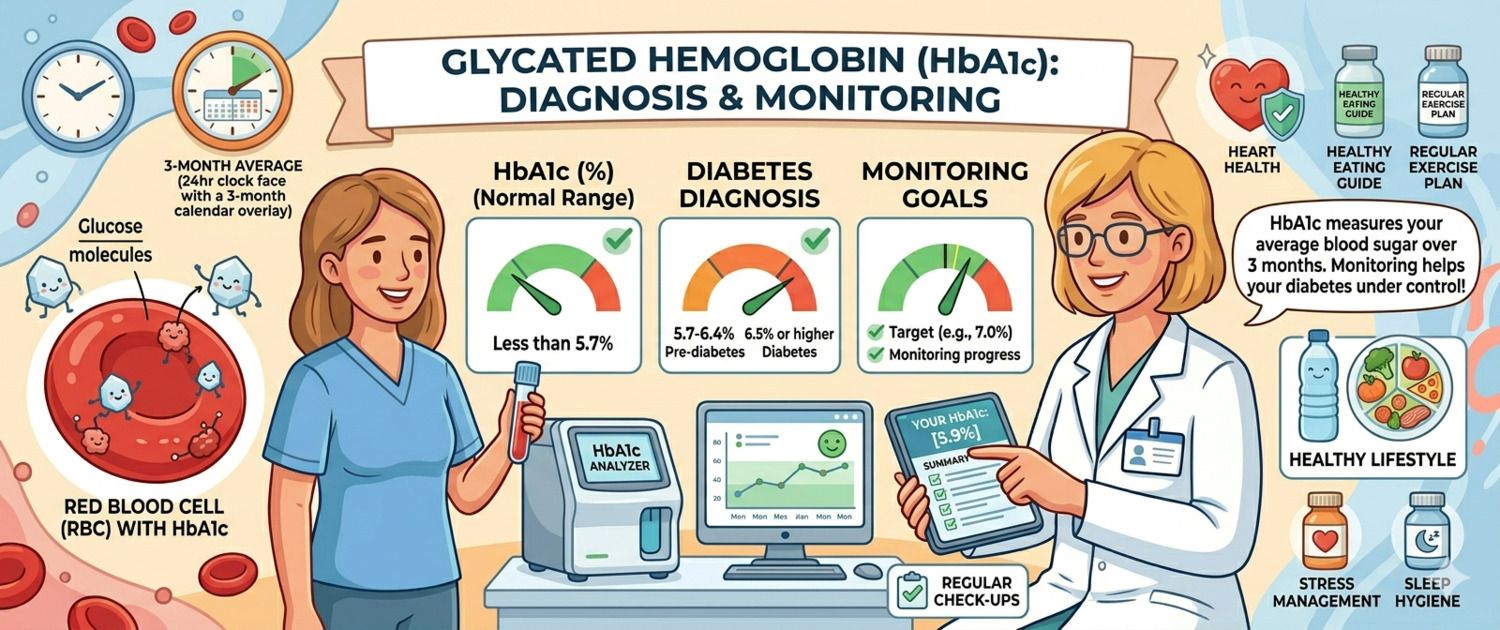
A standard blood glucose test is a snapshot: it captures your sugar level at the precise moment of the draw. Glycated hemoglobin is a fundamentally different tool — it is a three-month recording. It tells the physician what blood glucose actually looked like in daily life, not just on the morning of a clinic visit. For diagnosing and monitoring diabetes, HbA1c is irreplaceable.
What Glycated Hemoglobin Is and How It Forms
Glycated hemoglobin (HbA1c) is hemoglobin that has had a glucose molecule irreversibly attached to it. This process — glycation — occurs spontaneously: the higher the glucose concentration in the blood, the more actively it binds to hemoglobin inside red blood cells.
A red blood cell lives approximately 90–120 days. During that time, a certain percentage of its hemoglobin becomes glycated — directly proportional to the average glucose concentration over that period. When the red cell is destroyed, the "counter" resets: new cells start glycating from scratch.
This is why HbA1c reflects average glycemia over the preceding 2–3 months — not the past week, not a single day. It is resistant to situational fluctuations: a slice of cake the night before has no impact. What matters is the sustained pattern of diet and lifestyle — over months.
Normal HbA1c Levels
Reference values for HbA1c are largely independent of age and sex in healthy adults. However, they differ meaningfully depending on the clinical situation.
| Group | HbA1c (%) | HbA1c (mmol/mol) | Interpretation |
|---|---|---|---|
| Healthy adults | < 5.7 | < 39 | Normal |
| Prediabetes | 5.7–6.4 | 39–46 | Elevated diabetes risk |
| Diabetes — diagnostic threshold | ≥ 6.5 | ≥ 48 | Diabetes (requires confirmation) |
| Target in diabetes (most patients) | < 7.0 | < 53 | Good control |
| Target in diabetes (elderly, high hypoglycemia risk) | < 8.0 | < 64 | Acceptable control |
| Target in pregnancy with diabetes | < 6.0–6.5 | < 42–48 | Tight control |
Approximate HbA1c-to-glucose conversion: 6% ≈ 7.0 mmol/L; 7% ≈ 8.6 mmol/L; 8% ≈ 10.2 mmol/L; 9% ≈ 11.8 mmol/L.
How to Prepare for an HbA1c Test
One of HbA1c's main advantages over standard glucose testing is the simplicity of preparation. The test does not require fasting — it can be done at any time of day, regardless of recent meals.
Key caveats:
- Acute illness, blood transfusion, or blood loss in the preceding 2–3 months can distort the result
- Inform your doctor about medications that affect red cell turnover (erythropoietin, iron supplementation)
- For primary diabetes diagnosis, two confirmatory measurements on separate days are required
- For serial monitoring, use the same laboratory and method each time
HbA1c is not used for diabetes diagnosis in hemolytic anemia, sickle cell anemia, or certain rare hemoglobinopathies.
Interpreting Your Result
Clinical context is everything: the same number means different things for a healthy person, someone with prediabetes, and someone with established diabetes.
| HbA1c | Clinical meaning | Recommended action |
|---|---|---|
| < 5.7% | Normal | Recheck every 3 years without risk factors |
| 5.7–6.4% | Prediabetes | Lifestyle modification; annual monitoring |
| ≥ 6.5% (confirmed twice) | Diabetes mellitus | Endocrinology referral; start treatment |
| < 7.0% (in diabetes) | Good glycemic control | Continue current treatment plan |
| 7.0–8.0% (in diabetes) | Suboptimal control | Adjust treatment or lifestyle |
| > 8.0% (in diabetes) | Poor control | Urgent treatment revision; high complication risk |
| > 10% (in diabetes) | Decompensation | Hospitalization or emergency intervention |
Each 1% reduction in HbA1c measurably reduces the risk of diabetic complications: retinopathy by 35%, nephropathy by 25%, neuropathy by 25%.
HbA1c in Type 1 and Type 2 Diabetes: Targets and Monitoring
Glycated hemoglobin is the primary marker of diabetes management quality. Treatment targets are individualized and depend on patient age, diabetes duration, presence of complications, and hypoglycemia risk.
In type 2 diabetes, the target for most patients is HbA1c < 7.0%. In older adults or those with frequent hypoglycemia, the target is relaxed to < 8.0%. In young patients without complications, a tighter goal of < 6.5% is sometimes appropriate.
In type 1 diabetes, targeting HbA1c < 7.0% carries hypoglycemia risk with aggressive management. Continuous glucose monitoring (CGM) systems complement HbA1c with "time in range" (TIR) — capturing intraday variability that HbA1c cannot reflect.
In gestational diabetes and pre-existing diabetes during pregnancy, the target is most stringent — HbA1c < 6.0–6.5% to minimise fetal risk. Monitoring frequency increases to every 4–6 weeks.
When HbA1c Can Be Misleading: Sources of Error
Falsely elevated HbA1c:
- Iron deficiency anemia — reduced ferritin slows red cell turnover; longer-lived cells accumulate more glycated hemoglobin. HbA1c can be falsely elevated by 0.5–1.5% despite adequate glucose control
- Vitamin B12 and folate deficiency — same mechanism
- Chronic kidney disease with hemoglobin carbamylation — interferes with certain measurement methods
- Chronic heavy alcohol use
Falsely reduced HbA1c:
- Hemolytic anemia — accelerated red cell destruction shortens average cell lifespan
- Blood transfusion in the preceding 2–3 months — donor cells dilute the patient's own
- Sickle cell anemia, thalassemia — abnormal hemoglobin variants are measured differently
- Recently initiated iron therapy or erythropoietin
When a false result is suspected, alternative markers are used: fructosamine (reflects glycemia over 2–3 weeks) or 1,5-anhydroglucitol.
A complete blood count is an essential companion to HbA1c at initial interpretation: red cell indices, hemoglobin, and MCV immediately reveal conditions that could distort the result.
When an HbA1c Result Requires Action
See a doctor within the next few days if:
- HbA1c ≥ 6.5% is found for the first time — full diagnostic workup and treatment initiation are needed
- HbA1c > 9% in a patient with known diabetes — high risk of ketoacidosis or hyperosmolar state
- HbA1c is rising visit-to-visit despite treatment — the current regimen is failing
- HbA1c has dropped sharply to < 5.0% in an insulin-treated patient — frequent nocturnal hypoglycemia may be occurring
Seek urgent care if decompensation symptoms appear: intense thirst, frequent urination, weakness, nausea, acetone breath — possible ketoacidosis regardless of the current HbA1c value.
For people without diabetes, HbA1c is informative as a biological age marker: a value above 5.5% with normal blood sugar indicates accumulating glycation damage and is a driver of accelerated ageing. For more on the role of glycation in the mechanisms of ageing, see the article ageing of the body: causes and mechanisms, and for optimal HbA1c values in the context of longevity — how to live long and healthy. For HbA1c interpretation and its link to insulin resistance, see glycated hemoglobin and longevity. For optimal fasting insulin and HOMA-IR targets, see fasting insulin and HOMA-IR. And how to compute the index yourself is in HOMA-IR index.
This article is for informational purposes only and does not replace professional medical advice. HbA1c interpretation and target-setting should be performed by an endocrinologist or GP.
For informational purposes only
This article is for informational purposes only and does not constitute medical advice, diagnosis, or treatment. Please consult a healthcare professional for medical guidance.