Sodium in Blood: Normal Levels, Causes and Treatment
Reviewed by the LabReadAI medical team
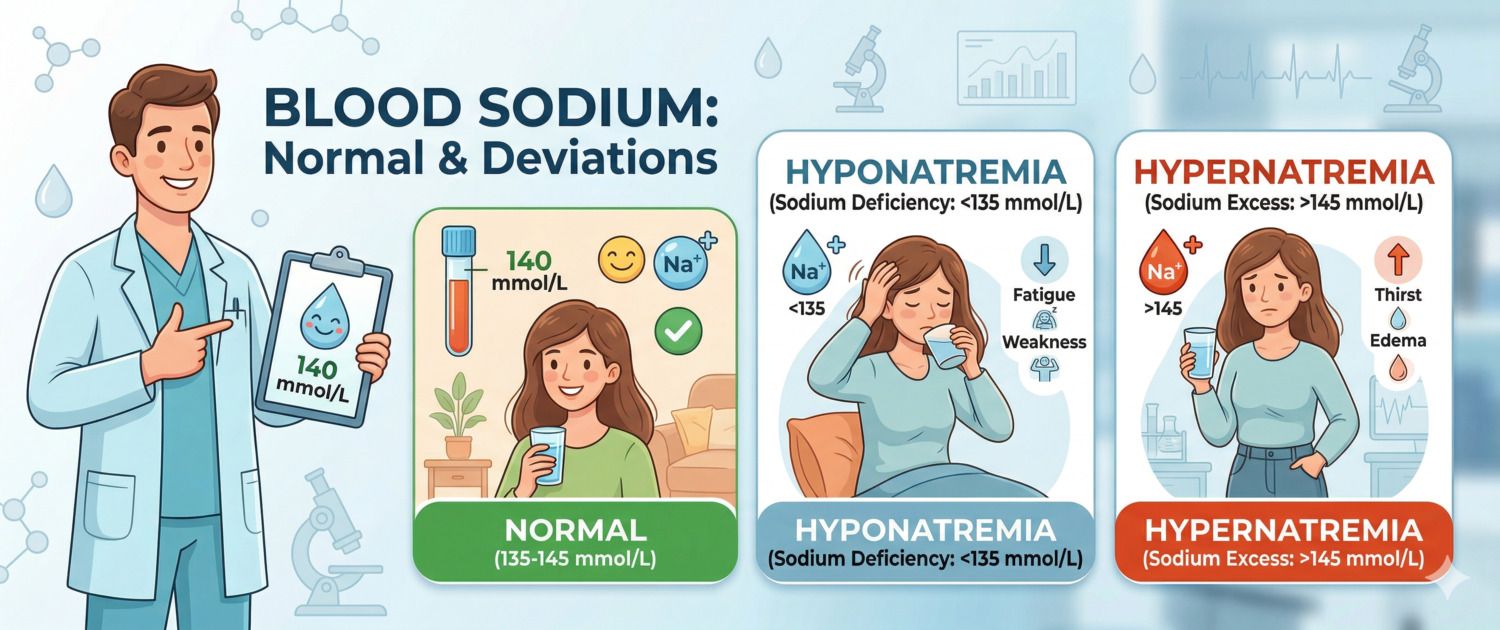
Sodium is the most abundant cation in extracellular fluid and the principal regulator of blood osmolarity. Its level determines how much water is retained in the vascular space, how nerves and muscles function, and how stable blood pressure remains. Deviations in either direction — both deficit and excess — can lead to severe neurological complications within hours. Let's break down what controls sodium in the body, why it falls out of range, and when that becomes dangerous.
What Sodium Does and Why It Matters
Sodium is an electrolyte with approximately 90% of the body's supply located outside cells: in blood plasma, interstitial fluid, and lymph. Inside cells, sodium concentration is 10–15 times lower — a gradient maintained by the Na⁺/K⁺-ATPase, the "sodium-potassium pump" embedded in every cell membrane.
Sodium serves several critical functions. First, it determines extracellular fluid osmolarity: sodium concentration decides how water moves between cells and blood. When sodium rises, water shifts out of cells into plasma; when it falls, water enters cells. Second, the sodium gradient enables action potentials in nerve and muscle cells — without it, neither thought nor movement is possible. Third, sodium reabsorption in the kidneys governs circulating blood volume and blood pressure.
Several systems regulate sodium. Aldosterone (adrenal cortex hormone) promotes sodium retention in the kidneys. ADH (antidiuretic hormone, vasopressin) regulates water reabsorption — indirectly influencing sodium concentration. Atrial natriuretic peptide (ANP) promotes sodium excretion during volume overload. This is a three-tier, continuously active control system.
Sodium disturbances are among the most common electrolyte disorders in clinical practice. A complete electrolyte panel always includes sodium as a mandatory component.
Normal Sodium Levels in Blood
Reference values for sodium in adults are stable and largely sex-independent. The range is slightly wider in newborns and young children.
| Group | Normal sodium (mmol/L) |
|---|---|
| Newborns | 133–146 |
| Infants under 1 year | 134–145 |
| Children 1–14 years | 136–145 |
| Adults | 136–145 |
| Elderly over 65 years | 132–146 |
Clinically relevant thresholds:
| Na⁺ level (mmol/L) | Condition |
|---|---|
| > 150 | Hypernatremia — requires treatment |
| 145–150 | Borderline high — monitor |
| 136–145 | Normal |
| 130–135 | Mild hyponatremia |
| 125–129 | Moderate hyponatremia |
| < 125 | Severe hyponatremia — cerebral edema risk |
| < 120 | Critical — emergency care |
The rate of change is no less important than the absolute value: an acute drop to 125 mmol/L over a few hours is far more dangerous than a chronic decline to 120 mmol/L developing over weeks.
How to Prepare for a Sodium Blood Test
Sodium is measured in serum or plasma. No special preparation is required for most patients, but several factors influence the result.
- The test does not need to be strictly fasting — normal food and water intake does not significantly affect sodium in a healthy person
- Inform the physician about diuretics, corticosteroids, NSAIDs, and SSRI antidepressants — all of these affect sodium metabolism
- For serial monitoring: use the same laboratory, preferably at the same time of day
- Pseudohyponatremia: in significant hyperlipidemia or hyperproteinemia (multiple myeloma), some older methods produce a falsely low sodium — modern ion-selective electrode analyzers do not have this problem
Sodium is always interpreted alongside potassium, creatinine, and the clinical picture — an isolated number tells very little without context: osmolarity, fluid volume status, and kidney function.
Causes of High Sodium (Hypernatremia)
Hypernatremia — sodium above 145 mmol/L — means a relative deficit of water relative to sodium. Simply put: either too little water, or too much sodium.
| Cause | Mechanism | Characteristic features |
|---|---|---|
| Dehydration (insufficient water intake) | Loss of free water without Na⁺ loss | Thirst, dark urine, reduced skin turgor |
| Diabetes insipidus (central or nephrogenic) | ADH deficiency or renal ADH resistance | Polyuria, polydipsia, low urine specific gravity |
| Insensible losses (skin, lungs) | Evaporative loss during fever, high temperature | Hypernatremia with reduced circulating volume |
| Diarrhea and vomiting in infants | Loss of hypotonic fluid | Rapid onset in infants and young children |
| Primary hyperaldosteronism | Excess renal Na⁺ retention | Hypertension, hypokalemia |
| Glucocorticoid excess (Cushing's syndrome) | Mineralocorticoid effect of cortisol | Combined with hypertension and hypokalemia |
| Iatrogenic (hypertonic saline infusion) | Direct Na⁺ administration | In hospital or intensive care settings |
Hypernatremia develops faster and is more severe in older adults and infants: older adults have a diminished thirst response; infants have a high body surface area-to-volume ratio. Even moderate dehydration can rapidly produce clinically significant hypernatremia in these groups.
Causes of Low Sodium (Hyponatremia)
Hyponatremia — sodium below 136 mmol/L — is the most common electrolyte disorder in clinical practice. It occurs in 15–30% of hospitalized patients. It can arise from fundamentally different mechanisms, and treatment differs radically depending on the cause.
The first step in differential diagnosis is assessing extracellular fluid volume:
Hypovolemic hyponatremia (reduced volume):
- GI losses: vomiting, diarrhea, fistulas
- Skin losses: excessive sweating, burns
- Renal losses: diuretics (especially thiazides), adrenal insufficiency, salt-wasting nephropathy
Euvolemic hyponatremia (normal volume) — the most common form:
- Syndrome of inappropriate ADH secretion (SIADH) — the key cause: ADH is produced excessively in tumors, pneumonia, traumatic brain injury, SSRI use, and certain anticonvulsants
- Hypothyroidism — reduced renal blood flow
- Primary polydipsia — excessive water intake overwhelming renal excretion capacity
Hypervolemic hyponatremia (increased volume):
- Chronic kidney disease — impaired free water excretion
- Heart failure — reduced effective circulating volume stimulates ADH
- Liver cirrhosis — same mechanism via portal hypertension
In chronic hyponatremia, the brain adapts by extruding osmolytes from cells, reducing edema. This explains why a patient with sodium of 120 mmol/L over several weeks may be asymptomatic — and why excessively rapid correction is lethal (osmotic demyelination syndrome).
Symptoms of Sodium Disturbances
The clinical picture of sodium disorders is driven by two factors: the absolute value and the rate of change.
Hyponatremia symptoms — from mild to critical:
- Mild (130–135 mmol/L): nausea, headache, reduced concentration, malaise
- Moderate (125–129 mmol/L): progressive weakness, confusion, emotional lability
- Severe (< 125 mmol/L): disorientation, seizures, impaired consciousness
- Critical (< 120 mmol/L, acute): cerebral edema, coma, respiratory arrest
Hypernatremia symptoms — reflecting cellular dehydration:
- Mild (145–150 mmol/L): thirst, dry mucous membranes, reduced urine output
- Moderate (150–160 mmol/L): weakness, irritability, altered consciousness
- Severe (> 160 mmol/L): agitation or stupor, muscle twitching, seizures
- Critical (> 170 mmol/L): risk of cerebral vein rupture and subdural hemorrhage from brain shrinkage
In older adults, hyponatremia symptoms frequently masquerade as "cognitive decline" or "dementia" and are not recognized in time.
When Sodium Abnormalities Require Medical Attention
Any sodium value outside the reference range warrants medical evaluation. The urgency depends on the value and the presence of symptoms.
Scheduled visit to a doctor when:
- Sodium 130–135 mmol/L without symptoms — identify the cause, particularly in patients on diuretics or SSRIs
- Sodium 146–150 mmol/L without symptoms — assess hydration status and kidney function
See a doctor within hours when:
- Sodium < 130 mmol/L or > 150 mmol/L in any condition
- Moderate deviation combined with symptoms: confusion, weakness, nausea
Call emergency services immediately when:
- Sodium < 120 mmol/L or > 160 mmol/L
- Seizures, loss of consciousness, or acute disorientation in the context of a known electrolyte disorder
- Rapidly worsening symptoms in a child with diarrhea or vomiting
Important: self-correcting sodium — taking saline solutions or restricting water intake without medical supervision — is dangerous. The rate of sodium correction in both directions is strictly regulated: no more than 8–10 mmol/L per 24 hours for chronic disturbances.
This article is for informational purposes only and does not replace professional medical advice. Consult a GP or nephrologist if your blood sodium is outside the normal range.
For informational purposes only
This article is for informational purposes only and does not constitute medical advice, diagnosis, or treatment. Please consult a healthcare professional for medical guidance.