Troponin in Blood: Normal Levels, Causes and Significance
Reviewed by the LabReadAI medical team
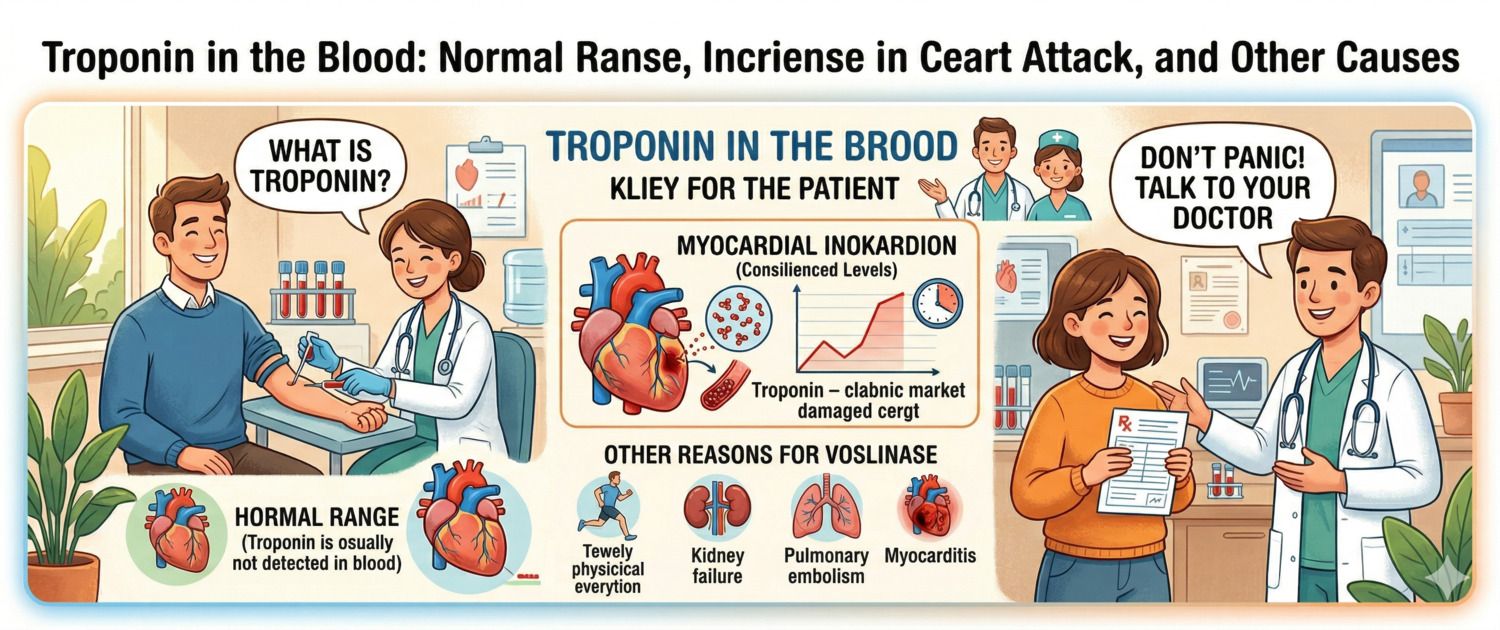
Troponin is a protein that in healthy people exists exclusively inside cardiomyocytes. When heart muscle cells die, troponin is released into the bloodstream — and its presence there is essentially direct evidence of myocardial injury. This is why troponin has become the central biomarker in heart attack diagnosis, replacing older and less specific markers. But elevated troponin is not always a heart attack — and understanding that distinction is critically important.
What Troponin Is and Why It Is Heart-Specific
Troponin is a regulatory protein complex that controls the interaction between actin and myosin during muscle contraction. It consists of three subunits: troponin C (TnC), troponin I (TnI), and troponin T (TnT).
Two types are clinically relevant:
Cardiac troponin I (cTnI) — expressed exclusively in cardiomyocytes. Skeletal muscle contains a different TnI isoform that is not detected by cardiac-specific antibodies. This makes cTnI a highly specific marker of cardiac injury.
Cardiac troponin T (cTnT) — also cardiac-specific, though present in trace amounts in regenerating skeletal muscle. Modern fourth- and fifth-generation assays (high-sensitivity troponin T, hsTnT) are sufficiently selective.
In healthy individuals, troponin barely enters the blood: cardiomyocytes do not turn over the way blood cells do. Any significant elevation signals either necrosis or reversible myocardial injury with disrupted cell membrane integrity. This is why troponin is the cornerstone of myocardial infarction diagnosis in contemporary clinical guidelines.
Troponin Normal Ranges: Standard and High-Sensitivity Assays
Reference values depend substantially on the assay platform and specific analyzer. Always use the reference range printed by the specific laboratory — not a generic table.
| Assay / marker | Normal (99th percentile) | Notes |
|---|---|---|
| Standard TnI (4th generation) | < 0.04–0.10 ng/mL (assay-dependent) | Less sensitive; rises later |
| Standard TnT (4th generation) | < 0.01–0.03 ng/mL | Standard before hsTnT adoption |
| High-sensitivity hsTnI | < 16–52 ng/L (sex- and assay-dependent) | Male threshold higher than female |
| High-sensitivity hsTnT | < 14–19 ng/L | Unified thresholds for both sexes in most assays |
Diagnostically relevant thresholds with high-sensitivity assays:
| hsTn level | Probability of acute MI |
|---|---|
| Below normal | Acute MI extremely unlikely (NPV > 99%) |
| Within normal but > 20% rise over 1–2 hours | High probability of acute MI |
| Above normal, moderate dynamics | Requires differential diagnosis |
| Markedly elevated (> 5× ULN) | Acute MI, chronic disease, or multi-organ injury |
Important: female reference values for hsTnI are 40–50% lower than male values on average. Applying a "male" threshold to women reduces the sensitivity of MI diagnosis in this group.
How to Test Troponin and Why Serial Measurement Matters
Troponin is not a one-time measurement — it is a dynamic assay. A single value is almost never sufficient to diagnose or rule out acute myocardial infarction.
Troponin kinetics in acute MI:
- Onset of rise: 2–4 hours after onset of necrosis
- Peak: 12–24 hours (earlier with successful reperfusion)
- Normalization: 7–14 days (TnI), 10–14 days (TnT)
Standard protocol for suspected acute coronary syndrome:
- Blood draw at presentation (0 hours)
- Repeat at 1–2 hours (0/1h or 0/2h protocol with high-sensitivity assays)
- Additional measurement at 3–6 hours if needed
The diagnostically significant finding is a rise or fall (delta) in troponin on serial measurement — the hallmark of an acute, dynamically evolving process. A persistently elevated troponin without significant delta more often reflects chronic myocardial injury (chronic heart failure, renal failure) rather than acute infarction.
No special preparation is required. The test can be drawn at any time, fasting or not — neither affects troponin levels.
Causes of Elevated Troponin: Cardiac and Non-Cardiac
Elevated troponin means myocardial injury — but not necessarily infarction. This is a fundamental distinction.
Acute cardiac causes:
| Condition | Pattern of elevation |
|---|---|
| Acute myocardial infarction | Acute rise with delta, often marked |
| Unstable angina | Minimal rise or normal |
| Myocarditis | Moderate elevation, slow dynamics |
| Tachyarrhythmia (AF, VT) | Mild elevation during prolonged episode |
| Hypertensive crisis | Moderate elevation with target organ damage |
| Acute heart failure | Proportional to severity |
Acute non-cardiac causes:
- Pulmonary embolism — acute right ventricular pressure overload causes subendocardial ischemia and troponin elevation in 30–50% of patients with massive PE
- Sepsis and critical illness — systemic inflammation and microcirculatory failure injure cardiomyocytes
- Acute stroke — neurogenic myocardial injury, particularly in subarachnoid hemorrhage
- Rhabdomyolysis — massive skeletal muscle breakdown can affect the myocardium
Chronic causes of stably elevated troponin:
- Chronic heart failure
- Chronic kidney disease — impaired troponin clearance and accumulation
- Hypertrophic cardiomyopathy
- Chemotherapy and cardiotoxic agents
- Severe diabetes with cardiac autonomic neuropathy
In chronic troponin elevation, C-reactive protein and a complete blood count help assess systemic inflammation and exclude infectious causes of myocardial damage — myocarditis and endocarditis.
High-Sensitivity Troponin: What Changed in Diagnosis
The transition to high-sensitivity assays (hsTn, 5th generation) is one of the most important advances in cardiac diagnostics of the past decade.
What high-sensitivity assays deliver:
- Detection of troponin in blood of 50–90% of healthy individuals (previously < 5%): it became clear that "undetectable" troponin was a measurement limit, not a biological reality
- Shorter diagnostic protocols: acute MI can be excluded within 1–2 hours rather than 6–12 with standard assays
- Identification of "chronically elevated" troponin as an independent cardiovascular risk marker
- Detection of small infarctions previously missed due to insufficient assay sensitivity
The trade-off for sensitivity: reduced specificity. High-sensitivity troponin is more frequently elevated in non-cardiac conditions — renal failure, sepsis, PE — requiring careful clinical contextualization.
CK-MB retains its role in diagnosing reinfarction: it normalizes within 48–72 hours (faster than troponin), so a new CK-MB rise against a background of already-elevated troponin confirms reinfarction.
False Results: When Troponin Can Mislead
Despite its specificity, troponin is not without analytical pitfalls.
Falsely elevated troponin:
- Heterophilic antibodies — a rare but documented phenomenon: antibodies in the patient's serum cross-react with assay reagents, producing a false-positive. Characteristic pattern: very high level with no clinical symptoms and no delta on repeat testing with a different assay platform
- High-dose biotin — like HbA1c, interferes with certain immunoassay formats
- Rheumatoid factor — occasionally produces a technical artifact with hsTnT in rare cases
Falsely normal troponin (missed infarction):
- Blood draw too early (< 2 hours from symptom onset) — troponin has not yet risen
- Using a standard rather than high-sensitivity assay for a small infarction
- Pre-analytical errors: prolonged storage at room temperature, wrong collection tube
When a false result is suspected: repeat measurement 1–3 hours later with a different assay platform or at a different laboratory.
When Elevated Troponin Requires Emergency Action
Troponin is not a routine screening test — it is measured for specific clinical indications. Any troponin elevation requires medical evaluation, but the urgency depends on the clinical picture.
Call emergency services immediately if troponin elevation is accompanied by:
- Chest pain, breathlessness, or loss of consciousness — regardless of the level
- Rapid rising dynamics on serial measurement
- ECG changes (ST elevation or depression, new left bundle branch block)
- Hemodynamic instability: falling blood pressure, acute pulmonary edema
Scheduled outpatient evaluation for stable patients with mildly and stably elevated troponin — to clarify the chronic underlying cause (heart failure, renal disease, cardiomyopathy).
Troponin is not a preventive screening test for asymptomatic people. An unexpectedly elevated troponin discovered incidentally during testing for another reason is always a reason to discuss the finding with a cardiologist or GP.
This article is for informational purposes only and does not replace professional medical advice. Call emergency services immediately if you experience chest pain or suspect a heart attack.
For informational purposes only
This article is for informational purposes only and does not constitute medical advice, diagnosis, or treatment. Please consult a healthcare professional for medical guidance.