Heart Failure: Symptoms, Causes and Treatment Guide
Reviewed by the LabReadAI medical team
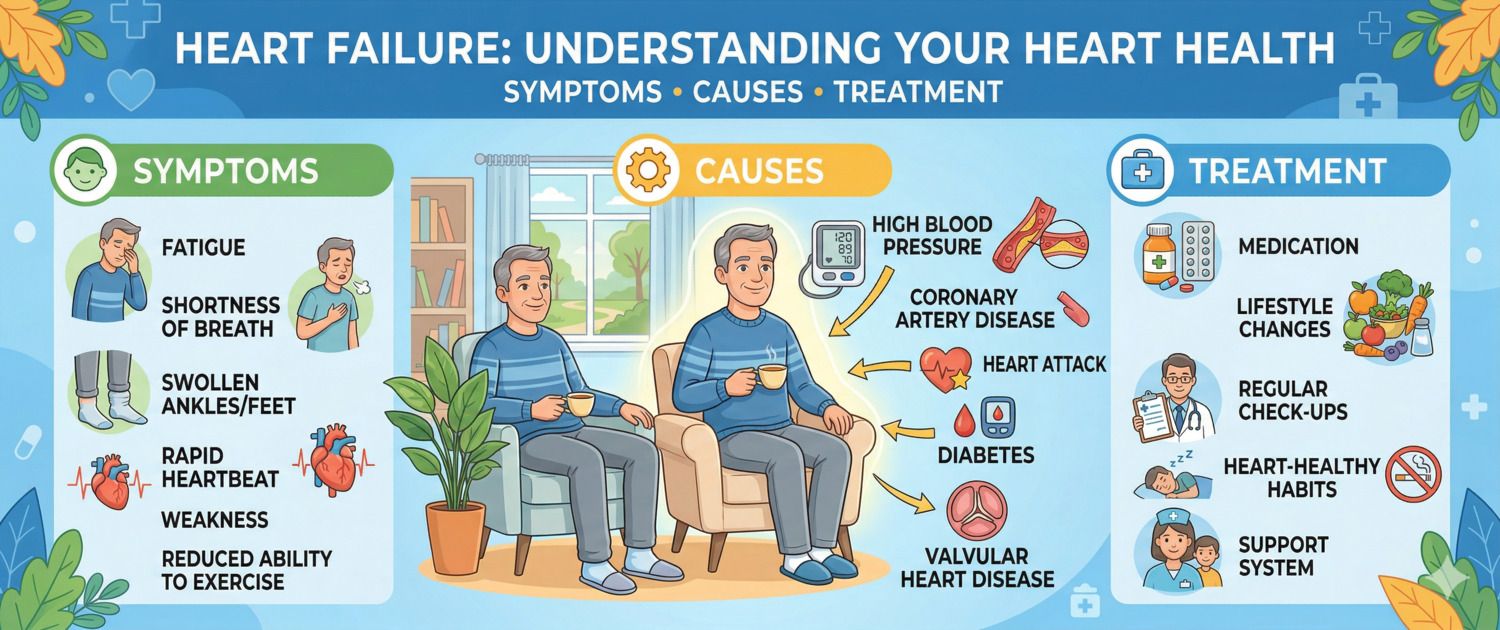
Breathlessness climbing a single flight of stairs when it was never an issue before. Ankles so swollen by evening that shoes no longer fit. Needing two pillows to sleep because lying flat makes breathing impossible. These complaints may seem ordinary, but they are the hallmark of heart failure — a condition in which the heart can no longer meet the body's demand for blood flow. More than 64 million people worldwide live with it, and the number continues to rise.
What Is Heart Failure and How Does It Develop
Heart failure is a clinical syndrome in which the heart cannot supply organs and tissues with sufficient blood to meet their metabolic needs, or can only do so at the cost of abnormally elevated filling pressures. It is not a disease in its own right but the final common pathway of many cardiovascular conditions.
The mechanism can be described as a vicious cycle: the myocardium is damaged or overloaded → contractility or filling is reduced → cardiac output falls → the kidneys perceive reduced perfusion and retain sodium and water → blood volume expands → the load on the weakened heart increases further. Without treatment this cycle accelerates.
The key biomarker of this process is BNP (B-type natriuretic peptide). Overloaded ventricular walls release BNP and its precursor NT-proBNP as a "distress signal". This is why measuring BNP has become the standard laboratory test for heart failure: it rises in proportion to the severity of volume overload and is an independent predictor of hospitalisation and death.
Types of Heart Failure
Classification by left ventricular ejection fraction (LVEF) underpins modern management, because different phenotypes respond differently to therapy.
HFrEF — heart failure with reduced ejection fraction (< 40%). The myocardium contracts weakly — classic "systolic" failure. More common in men, typically following myocardial infarction. Most evidence-based treatments have been proven in this phenotype.
HFpEF — heart failure with preserved ejection fraction (≥ 50%). The heart contracts normally but has become stiff and relaxes poorly — "diastolic" failure. More common in older women with hypertension and obesity. Harder to treat: specific therapies were lacking for years.
HFmrEF — mildly reduced ejection fraction (41–49%). A "grey zone" that in characteristics and outcomes sits between the two.
By course, heart failure is classified as acute or chronic. Acute failure develops over hours — for example, during myocardial infarction or a severe arrhythmia — and requires immediate hospitalisation. Chronic failure develops over months and years, cycling through periods of compensation and decompensation.
Causes of Heart Failure
Any condition that chronically damages or overloads the myocardium can lead to heart failure.
Coronary artery disease and myocardial infarction — the leading cause in most countries. After a myocardial infarction, the necrotic zone is replaced by scar tissue that does not contribute to contraction. The larger the scar, the worse the function.
Arterial hypertension — chronic pressure overload forces the left ventricle to hypertrophy, then to "fatigue". Hypertension is the leading cause of HFpEF.
Valvular heart disease — mitral or aortic regurgitation or stenosis creates volume or pressure overload on cardiac chambers.
Cardiomyopathies — dilated (stretched, weak ventricle), hypertrophic (thickened, stiff), restrictive (myocardial infiltration in amyloidosis, sarcoidosis). Some cases are genetically determined.
Atherosclerosis — chronic coronary artery disease leads to ischaemic myocardial remodelling even without overt myocardial infarction.
Arrhythmias — prolonged tachycardia (particularly fast atrial fibrillation) gradually exhausts the myocardium ("tachycardiomyopathy").
Other causes: toxic damage (alcohol, chemotherapy, cocaine), viral myocarditis, endocrine disorders (hypothyroidism, thyrotoxicosis), severe anaemia.
Symptoms of Heart Failure
Symptoms fall into two groups: congestive features (fluid accumulation) and low-output features.
Congestive features — the most frequent complaints:
- Breathlessness — the dominant symptom. Initially on exertion, later at rest. Orthopnoea is characteristic — breathlessness when lying flat, relieved by sitting up on pillows (due to fluid redistributing into the lungs). Paroxysmal nocturnal dyspnoea — sudden suffocating breathlessness that literally wakes the patient at 2–4 am.
- Leg oedema — symmetrical, worsening in the evening, soft, pit-forming on pressure. In severe failure it extends to the thighs, abdomen (ascites), and scrotum.
- Rapid weight gain from fluid retention — often the first sign of impending decompensation. An increase of 2 kg over 2–3 days is an alarm signal.
- Bibasal crackles on lung auscultation.
- Distended neck veins — sign of elevated right-sided filling pressure.
Low-output features:
- profound fatigue and reduced exercise tolerance;
- dizziness and near-syncope;
- cold extremities;
- confusion in elderly patients — from reduced cerebral perfusion.
Symptom severity is graded by the NYHA classification (class I–IV): from symptoms only with significant exertion (I) to symptoms at rest (IV).
Diagnosis: Which Tests Are Ordered for Heart Failure
Diagnosis rests on the combination of symptoms, echocardiography, and biomarkers.
Key biomarkers:
- BNP / NT-proBNP — the primary laboratory test when heart failure is suspected. A normal BNP virtually excludes the diagnosis in a breathless patient. NT-proBNP > 125 pg/mL in chronic patients or > 300 pg/mL in acute breathlessness marks the threshold for further workup.
- Troponin — elevated in acute myocardial injury; detectable even in chronic HF reflecting ongoing micro-injury. A high troponin during decompensation points to an ischaemic aetiology or acute myocarditis.
- Creatinine and eGFR — kidneys suffer from reduced perfusion in heart failure; worsening acute kidney injury during treatment (cardiorenal syndrome) is a common clinical challenge.
- Serum sodium — hyponatraemia in heart failure reflects neurohormonal activation and is associated with a poor prognosis.
- LDH — non-specific marker of tissue damage; elevated in decompensated HF due to hepatic hypoperfusion and congestive hepatopathy.
- Kidney function test — comprehensive assessment before prescribing diuretics and RAAS inhibitors.
Echocardiography — the indispensable imaging test: measures ejection fraction, chamber dimensions, valve morphology, and wall motion abnormalities. Heart failure cannot be formally confirmed without echo.
ECG — detects arrhythmias, signs of previous myocardial infarction, and ventricular hypertrophy. A normal ECG makes systolic failure unlikely.
Treatment of Heart Failure
Treatment of HFrEF (reduced EF) is one of the most evidence-based areas in cardiology. Four drug classes reduce mortality — the "fantastic four":
- ACE inhibitors / ARBs / ARNIs — reduce neurohormonal activation, limit ventricular remodelling. Sacubitril/valsartan (ARNI) is preferred over standard ACE inhibitors based on recent evidence.
- Beta-blockers — lower heart rate, reduce myocardial oxygen demand, reduce mortality.
- Mineralocorticoid receptor antagonists (spironolactone, eplerenone) — block excess sodium retention and myocardial fibrosis.
- SGLT2 inhibitors (dapagliflozin, empagliflozin) — originally developed as glucose-lowering agents, they proved powerful in HF regardless of diabetes status.
Loop diuretics (furosemide, torasemide) — relieve congestive symptoms. They do not improve prognosis but restore quality of life; daily weight monitoring and dose self-titration are key skills for the patient.
Devices: implantable cardioverter-defibrillators (ICD) reduce sudden death risk when EF < 35%; cardiac resynchronisation therapy (CRT) improves contractile synchrony in conduction abnormalities.
In HFpEF the evidence base is narrower; SGLT2 inhibitors are currently the only class with proven reduction in hospitalisation.
Non-pharmacological: salt restriction to 2–3 g/day, daily morning weight monitoring, fluid restriction in severe oedema, cardiac rehabilitation — moderate-intensity aerobic exercise improves prognosis and quality of life.
Complications of Chronic Heart Failure
Heart failure is a systemic disease that affects virtually every organ.
Cardiorenal syndrome — mutual worsening of cardiac and renal function. Reduced cardiac output impairs renal perfusion; venous congestion elevates renal venous pressure — both mechanisms reduce glomerular filtration. Paradoxically, diuretics required for fluid relief can themselves worsen renal function.
Arrhythmias — atrial fibrillation occurs in 30–40% of HF patients and worsens prognosis bidirectionally. Ventricular arrhythmias are the leading cause of sudden cardiac death.
Cardiac cachexia — in severe long-standing HF, progressive loss of muscle and fat mass develops from chronic inflammation, malabsorption, and anorexia. Cachexia dramatically worsens prognosis.
Depression — present in 20–30% of patients, reduces medication adherence, and independently increases mortality.
When to Seek Emergency Care
Call emergency services immediately if:
- sudden severe breathlessness or suffocation develops at rest;
- pink frothy sputum appears — a sign of acute pulmonary oedema;
- blood pressure falls below 90/60 mmHg with dizziness;
- weight increases sharply (> 2 kg in one day) alongside worsening breathlessness;
- palpitations or irregular heartbeat accompany a deterioration in symptoms.
Decompensation can develop rapidly even in "stable" HF — most often triggered by dietary indiscretion, missed medications, intercurrent infection, or arrhythmia. Early hospitalisation at the first sign of worsening improves outcomes. Do not manage deterioration on your own — contact your doctor or call emergency services.
For informational purposes only
This article is for informational purposes only and does not constitute medical advice, diagnosis, or treatment. Please consult a healthcare professional for medical guidance.