High Blood Pressure: Symptoms, Causes and Treatment Guide
Reviewed by the LabReadAI medical team
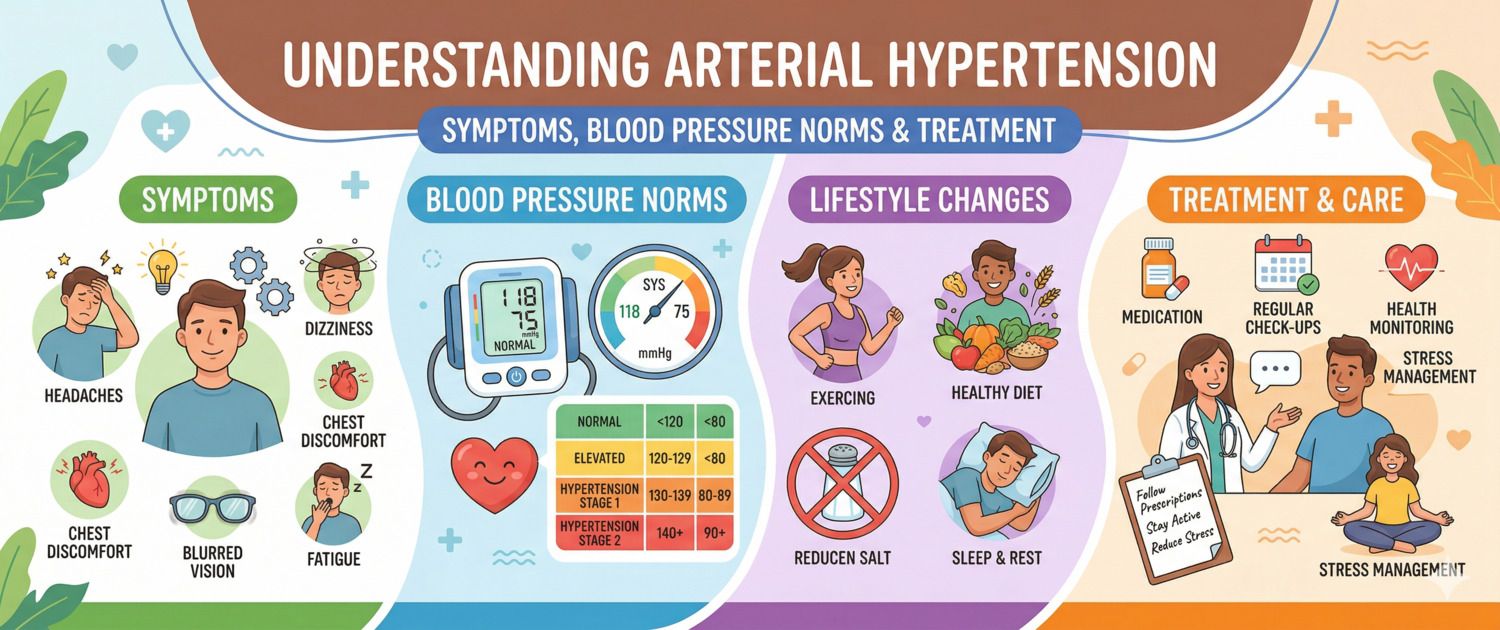
High blood pressure has earned the name "silent killer" for good reason: in most patients, hypertension runs for years without a single symptom, quietly damaging blood vessels, the heart, and kidneys. According to the WHO, one in three adults worldwide has arterial hypertension — and nearly half of them have no idea. This article covers what blood pressure levels mean, why pressure rises, and what to do about it.
What Is Arterial Hypertension and Blood Pressure Norms
Blood pressure is the force exerted by blood against vessel walls. It is expressed as two numbers: systolic (upper) — pressure during cardiac contraction; diastolic (lower) — pressure during relaxation.
| Category | Systolic | Diastolic |
|---|---|---|
| Optimal | < 120 | < 80 |
| Normal | 120–129 | 80–84 |
| High normal | 130–139 | 85–89 |
| Grade 1 hypertension | 140–159 | 90–99 |
| Grade 2 hypertension | 160–179 | 100–109 |
| Grade 3 hypertension | ≥ 180 | ≥ 110 |
A diagnosis of hypertension requires systolic pressure ≥140 mmHg and/or diastolic ≥90 mmHg on two or more separate visits. A single elevated reading is not a diagnosis.
An important note: in older patients, systolic pressure carries greater prognostic weight than diastolic. Isolated systolic hypertension (systolic ≥140, diastolic < 90) is the most common form in people over 60 and carries the same vascular risk as classical hypertension.
Causes of Hypertension: Primary and Secondary Forms
Primary (essential) hypertension accounts for 90–95% of all cases. There is no single identifiable cause — it is a combination of genetic predisposition and lifestyle factors: excess weight, high salt intake, physical inactivity, chronic stress, smoking, excessive alcohol, and age. In people with a family history of hypertension, all these factors hit harder.
Secondary hypertension — 5–10% of cases — has a specific, potentially reversible cause:
- Kidney disease — the most common cause of secondary hypertension. In chronic kidney disease, sodium and water regulation is disrupted and the renin-angiotensin-aldosterone system becomes chronically activated.
- Primary aldosteronism — an adrenal tumour secreting excess aldosterone, causing sodium and water retention. It should be suspected in hypertension with low blood potassium and poor response to standard medications.
- Phaeochromocytoma — a rare catecholamine-secreting adrenal tumour: the classic picture is episodic sudden pressure spikes with palpitations, sweating, and headache.
- Cushing's syndrome — excess cortisol causes sodium retention, characteristic fat redistribution, and hypertension.
- Sleep apnoea — nocturnal hypoxia activates the sympathetic nervous system and renin-angiotensin axis; hypertension in these patients is often uncontrollable until the apnoea is treated.
- Medications — oral contraceptives, NSAIDs, decongestants, and some antidepressants can raise blood pressure.
Secondary causes are always ruled out in young patients (under 40) with newly diagnosed hypertension, and in anyone with hypertension that fails to respond to three medications.
Symptoms of Hypertension and Hypertensive Crisis
The great deception of hypertension is its prolonged asymptomatic course. "No headache means my pressure is fine" is a dangerous misconception. Many patients with a pressure of 160/100 feel perfectly well because the body adapts to chronically elevated pressure.
When symptoms do appear, the most common are:
- occipital headache, especially in the morning;
- ringing in the ears, visual disturbances ("spots" before the eyes);
- dizziness on sudden standing;
- nosebleeds;
- a heavy sensation in the chest on exertion.
Hypertensive crisis — acute severe elevation, usually above 180/120 mmHg — divides into two critically different scenarios:
- Uncomplicated crisis — severely elevated pressure without signs of end-organ damage. The patient feels unwell, but there is no immediate threat to an organ. Pressure is reduced gradually over several hours.
- Complicated crisis (hypertensive emergency) — severely elevated pressure plus signs of acute organ damage: escalating chest pain (myocardial infarction), neurological deficits (stroke), sudden vision loss, progressive breathlessness (pulmonary oedema). This is a medical emergency.
Which Tests Are Ordered for Hypertension
The workup for hypertension serves three goals: assess end-organ damage, find a possible secondary cause, and identify co-existing cardiovascular risk factors.
Standard minimum panel:
- Creatinine and estimated GFR — the kidneys are the first target of chronic high pressure and can simultaneously be its cause. Rising creatinine signals hypertensive nephropathy.
- Kidney function test — comprehensive assessment: urea, electrolytes, eGFR.
- Lipid panel — LDL cholesterol combined with hypertension multiplies cardiovascular risk several-fold.
- Fasting glucose and HbA1c — hypertension and type 2 diabetes frequently co-exist; their combination dramatically elevates stroke and myocardial infarction risk.
- Urinalysis — microalbuminuria is an early marker of renal end-organ damage.
- ECG — left ventricular hypertrophy as evidence of chronic pressure overload.
- Serum potassium — hypokalaemia in hypertension triggers a search for primary aldosteronism.
If workup reveals secondary hypertension or end-organ damage disproportionate to the measured pressure, the investigation is extended: renal and adrenal ultrasound, ambulatory blood pressure monitoring (ABPM), and specific hormonal tests.
End-Organ Damage in Chronic Hypertension
Hypertension destroys vessels gradually through mechanical stress and vascular wall inflammation. Organs with abundant small vessels are most vulnerable.
Heart. The left ventricle works constantly against elevated resistance — its walls thicken (hypertrophy), then lose elasticity. The result: first diastolic dysfunction, then heart failure. Hypertension is the leading cause of heart failure with preserved ejection fraction.
Blood vessels. Chronic pressure accelerates atherosclerosis: plaques grow faster, and the risk of plaque rupture triggering myocardial infarction or stroke is higher. Large arteries lose elasticity — arterial stiffness itself becomes an additional source of pressure elevation.
Kidneys. Narrowing and thickening of intrarenal vessels reduces glomerular filtration; over time hypertensive nephropathy leads to chronic kidney disease — which in turn maintains high pressure, creating a vicious cycle.
Brain. Chronic hypertension is the leading modifiable risk factor for both ischaemic and haemorrhagic stroke, as well as vascular dementia. Small brain arteries are especially vulnerable.
Retina. Long-standing hypertension produces hypertensive retinopathy — vascular changes visible on fundoscopy. In severe cases, haemorrhages and vision loss develop.
The combination of hypertension with insulin resistance and obesity within the metabolic syndrome sharply accelerates all these risks — target organs are damaged much faster.
Treatment of Arterial Hypertension
The goal of treatment is to lower pressure to target values (for most patients < 140/90 mmHg; in younger patients and high-risk cases < 130/80) and reduce the risk of complications.
Non-pharmacological treatment — the foundation that works at every stage of hypertension:
- Reducing salt intake to < 5 g/day (systolic pressure falls 5–7 mmHg)
- Weight loss in obesity — every 5 kg lost reduces systolic pressure by approximately 4–5 mmHg
- Aerobic exercise 30–45 minutes five times per week
- Limiting alcohol to ≤14 units per week for men, ≤8 for women
- Stopping smoking — pressure change is modest, but cardiovascular risk falls sharply
Pharmacological treatment. Five first-line drug classes: ACE inhibitors (or ARBs), calcium antagonists, thiazide-like diuretics, and beta-blockers. Current guidelines favour two-drug combination therapy from the start when pressure is ≥160/100 — monotherapy rarely achieves targets.
In secondary hypertension, treating the underlying cause often normalises pressure without lifelong medication: surgery for phaeochromocytoma, treatment of sleep apnoea, correction of aldosteronism.
When to Seek Emergency Care
Call emergency services immediately if high blood pressure is accompanied by any of the following:
- sudden severe headache unlike anything before ("the worst headache of your life");
- weakness or numbness in an arm or leg, facial drooping, speech difficulties;
- acute chest pain radiating to the left arm or jaw;
- sudden vision loss or double vision;
- rapidly worsening breathlessness that is worse when lying down;
- pressure above 180/120 mmHg with headache, nausea, or visual disturbance.
Pressure above 180/120 without symptoms warrants a same-day or urgent medical review — do not attempt to self-treat. Dropping blood pressure too rapidly without medical supervision can trigger stroke or myocardial infarction.
Hypertension is a chronic condition requiring lifelong management. Properly guided therapy reduces stroke risk by 35–40% and myocardial infarction risk by 20–25%. Do not interpret blood pressure readings in isolation — see a doctor who can select treatment tailored to your full risk profile.
For informational purposes only
This article is for informational purposes only and does not constitute medical advice, diagnosis, or treatment. Please consult a healthcare professional for medical guidance.