Primary Hyperaldosteronism: Symptoms, Diagnosis and Treatment
Reviewed by the LabReadAI medical team
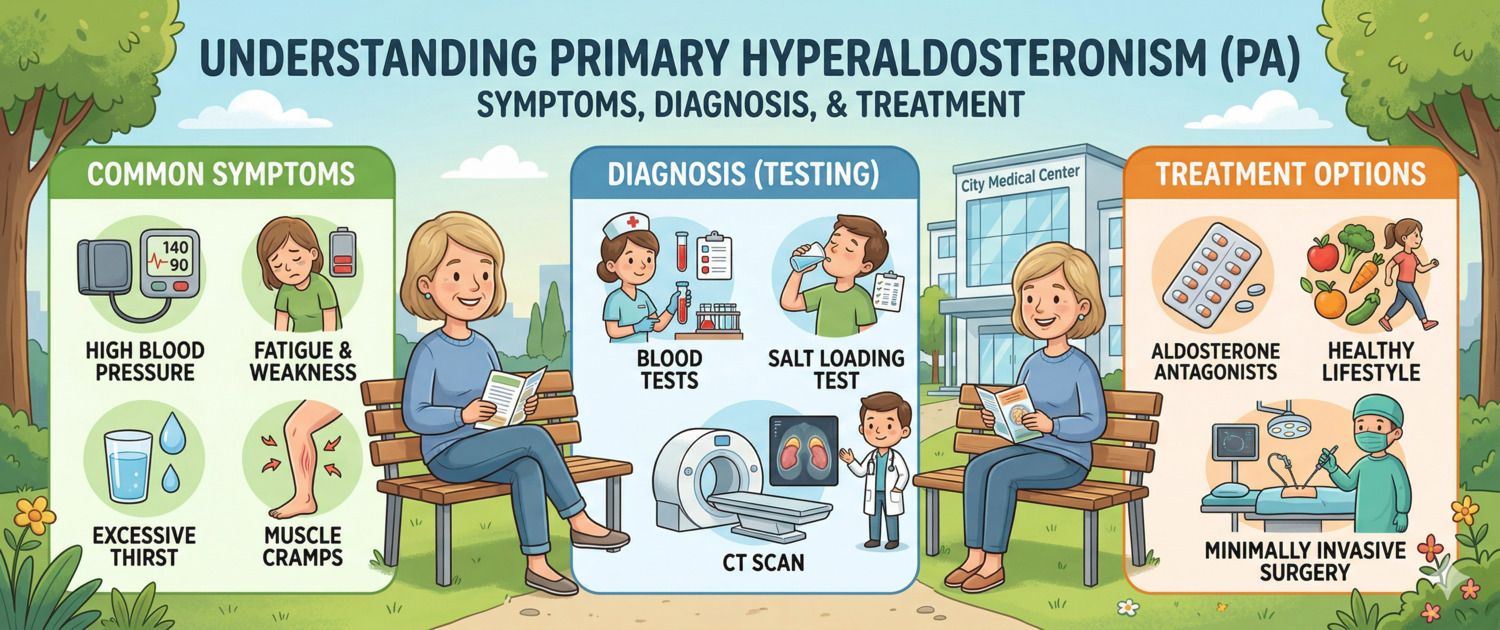
Blood pressure stays elevated despite three different medications at full doses. Potassium keeps falling with no obvious explanation. Muscle weakness, nocturnal cramps and persistent thirst have become the background of daily life. Behind this picture, in 5–20% of cases, lies primary hyperaldosteronism — one of the most common yet most underdiagnosed causes of secondary hypertension.
What Is Primary Hyperaldosteronism
Primary hyperaldosteronism (Conn's syndrome) is an endocrine condition in which one or both adrenal glands produce excessive aldosterone autonomously — independently of normal physiological regulatory signals. Under normal conditions, aldosterone production is governed by the renin-angiotensin-aldosterone system: pressure falls → renin rises → aldosterone rises → pressure is restored. In primary hyperaldosteronism this chain is broken: the adrenal gland secretes aldosterone regardless of renin, and blood pressure stays persistently elevated.
Excess aldosterone acts as a dam on two channels simultaneously: it retains sodium — and water — in the body while driving potassium out through the urine. The result is an expanding blood volume that presses against vessel walls, while falling potassium triggers a cascade of muscular and cardiac disturbances.
Historically, Conn's syndrome was described as a rare condition with a classic triad: hypertension — hypokalaemia — adrenal adenoma. Modern screening programmes have overturned this picture: hypokalaemia is present in only 40–50% of patients, and the syndrome is now identified in 5–10% of all hypertensive patients and in one in five with resistant hypertension.
Causes: Adrenal Adenoma or Hyperplasia
Two main morphological variants exist, and distinguishing between them is fundamental to treatment planning.
Aldosterone-producing adenoma (aldosteronoma) — a benign tumour of one adrenal gland, typically small (0.5–2 cm), responsible for 60–65% of cases. Most common in women aged 30–50. The adenoma functions entirely autonomously: renin is suppressed, aldosterone is elevated, and sodium loading fails to suppress its secretion. This is the surgically curable form.
Bilateral idiopathic adrenal hyperplasia — diffuse or nodular growth of aldosterone-producing cells in both adrenal glands. Accounts for 30–35% of cases. Unlike an adenoma, aldosterone secretion in this form retains partial dependence on the renin-angiotensin system. Removing one adrenal gland is largely ineffective — medical therapy is the mainstay of treatment.
Rare forms include unilateral adrenal hyperplasia (< 2%), familial hyperaldosteronism types I–IV (< 1%), and adrenocortical carcinoma (< 1%). Malignant aldosteronomas are typically larger (> 4–5 cm) and show features of invasion or metastasis.
Symptoms of Primary Hyperaldosteronism
The clinical picture of Conn's syndrome consists of two components: the consequences of chronically elevated blood pressure and the consequences of hypokalaemia. Patients often spend years being treated for "ordinary" hypertension without the underlying cause ever being suspected.
Hypertension is present in 95–100% of patients. Features that distinguish it from essential hypertension:
- resistance to standard therapy — three medications at full doses without effect;
- diastolic pressure frequently exceeds 110 mmHg;
- absence of the normal nocturnal blood pressure dip on ambulatory monitoring ("non-dipper" pattern).
Hypokalaemia is present in 40–50% of patients. It manifests as muscle weakness (especially in the legs), rapid fatigue, nocturnal cramps, polyuria (frequent urination, particularly at night) and polydipsia (persistent thirst). Severe hypokalaemia can cause life-threatening cardiac arrhythmias.
Other features: headaches, impaired concentration, heightened anxiety. Oedema is uncommon: despite sodium retention, the aldosterone "escape" phenomenon partially compensates for fluid accumulation in chronic disease.
Approximately 25% of patients with Conn's syndrome have no symptoms at all — hypertension is found incidentally and potassium is normal. This is particularly characteristic of bilateral hyperplasia, where the clinical presentation is milder.
Diagnosis: Renin, Aldosterone and Confirmatory Tests
The diagnostic algorithm comprises three sequential stages: screening → confirmation → localisation (identifying the source).
Stage 1 — Screening: renin-to-aldosterone ratio (RAR)
Simultaneous sampling of aldosterone and renin is the first-line test whenever primary hyperaldosteronism is suspected. RAR above 30 combined with aldosterone above 150 pg/mL constitutes a positive screening result. Interpreting the RAR without knowing the absolute aldosterone value is invalid: low renin with normal aldosterone is not hyperaldosteronism.
Stage 2 — Confirmatory tests
A positive screen requires confirmation by one of four methods:
- IV saline infusion test: 2 litres of normal saline over 4 hours — in primary hyperaldosteronism aldosterone remains > 10 ng/dL; autonomous secretion is not suppressed;
- Fludrocortisone suppression test: 4 days of the drug with salt loading — aldosterone > 6 ng/dL on day 4 confirms the diagnosis;
- Captopril challenge test: blockade of angiotensin I → II conversion; aldosterone fails to fall in Conn's syndrome;
- Oral salt loading: 3 days of high-sodium diet — urinary aldosterone excretion > 12–14 µg/24 h confirms autonomous secretion.
Stage 3 — Localisation
CT of the adrenal glands is performed only after biochemical confirmation of the diagnosis. Crucially, CT findings alone do not determine management: a small adenoma may be missed, and a nodule on CT may prove to be a non-functioning incidentaloma.
The gold standard for patients planning surgery is adrenal vein sampling (AVS) — bilateral selective catheterisation with separate aldosterone measurement from each side. AVS reliably distinguishes unilateral from bilateral secretion and thereby determines whether surgery or medical therapy is appropriate.
Blood Tests Ordered in Conn's Syndrome
The standard diagnostic workup when primary hyperaldosteronism is suspected covers several test groups.
Mandatory minimum:
- Aldosterone + renin simultaneously — for RAR calculation
- Electrolyte panel — potassium, sodium, chloride: hypokalaemia and sodium excess corroborate the clinical picture
- Kidney function tests — creatinine, eGFR: chronic hypokalaemia is nephrotoxic and long-standing hypertension in Conn's syndrome accelerates eGFR decline
Additional when an adrenal tumour is found:
- Cortisol — to exclude concomitant cortisol overproduction (Cushing's syndrome or subclinical hypercortisolism)
- Plasma or urinary metanephrines — phaeochromocytoma must be excluded before any invasive procedures
- ECG — assessment for hypokalaemia signs: T-wave flattening, U waves, prolonged QT interval
Treatment: Surgery or Aldosterone Antagonists
The choice of treatment depends entirely on the form of the disease established at localisation.
Surgery is indicated for unilateral aldosteronoma or unilateral hyperplasia. Laparoscopic adrenalectomy is the procedure of choice. Outcomes:
- hypokalaemia resolves in 98–100% of patients;
- arterial hypertension is completely cured in 30–60% of operated patients;
- in the remainder, blood pressure decreases and requires fewer medications.
Predictors of complete blood pressure normalisation after surgery: short duration of hypertension, younger age, no target organ damage, no family history of hypertension.
Medical treatment is indicated for bilateral adrenal hyperplasia, contraindications to surgery, or patient refusal of the operation.
Mineralocorticoid receptor antagonists form the cornerstone of pharmacotherapy:
- Spironolactone — the most studied and effective agent: blocks aldosterone receptors, normalises blood pressure and potassium. The main drawback is anti-androgenic side effects (gynaecomastia in men, menstrual irregularities in women) with long-term use;
- Eplerenone — a selective antagonist without androgenic side effects, somewhat less potent in lowering blood pressure.
Target potassium during medical treatment: 4.0–4.5 mmol/L. Thiazide and loop diuretics should not be used as the basis of antihypertensive therapy in Conn's syndrome — they worsen hypokalaemia.
When to See a Doctor
Primary hyperaldosteronism raises the risk of cardiovascular events independently of blood pressure level. In patients with untreated Conn's syndrome, the risk of myocardial infarction, stroke, atrial fibrillation and kidney stones (via chronic hypokalaemia and hypercalciuria) is significantly higher than in patients with essential hypertension at the same blood pressure.
Consult an endocrinologist when any of the following apply:
- blood pressure uncontrolled on three medications at full doses;
- potassium below 3.5 mmol/L without diuretic use;
- incidentally discovered adrenal mass on CT or MRI;
- hypertension diagnosed before age 40;
- family history of Conn's syndrome or stroke at a young age.
Early diagnosis in Conn's syndrome is not merely about lowering blood pressure. When an adrenal adenoma is the cause, timely surgery offers the chance of complete cure. The shorter the interval between hypertension onset and surgery, the greater the likelihood of full blood pressure normalisation. Do not postpone the evaluation.
This content is for informational purposes only and does not replace professional medical advice.
For informational purposes only
This article is for informational purposes only and does not constitute medical advice, diagnosis, or treatment. Please consult a healthcare professional for medical guidance.