Renin Blood Test: Normal Levels, High and Low Results
Reviewed by the LabReadAI medical team
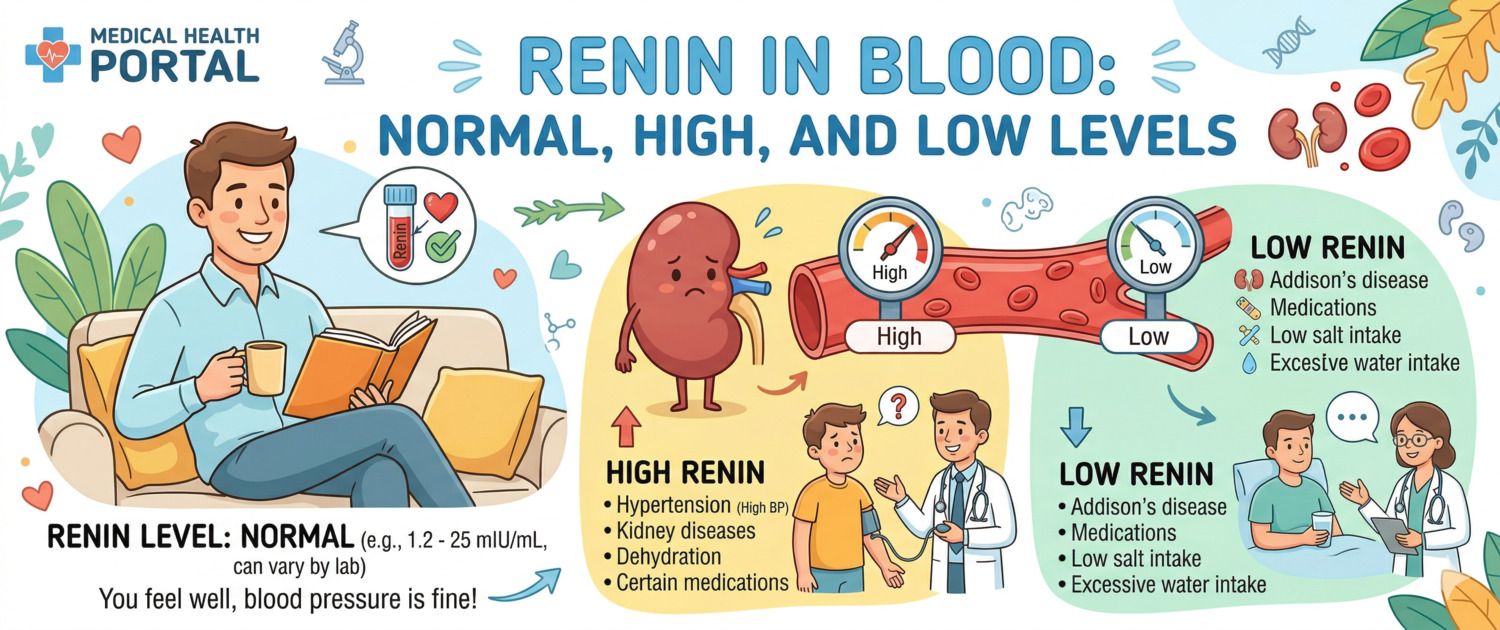
Blood pressure refuses to respond to standard medications. Potassium is low for no obvious reason. The doctor orders renin and aldosterone simultaneously — but it is unclear why this particular test is needed and what the results mean. Renin is not a routine blood marker; its value is correctly read only alongside aldosterone and in clinical context.
What Renin Is and Its Role in the RAAS
Renin is a proteolytic enzyme (aspartyl protease) synthesised by the juxtaglomerular cells of the renal afferent arterioles. Its principal biological function is to initiate the renin-angiotensin-aldosterone system (RAAS) — the central regulator of blood pressure and fluid-electrolyte balance.
The RAAS cascade works as follows. When the kidneys detect a fall in afferent arteriolar pressure, reduced sodium delivery to the tubules, or sympathetic nervous system activation, the juxtaglomerular cells release renin into the bloodstream. Renin cleaves angiotensinogen (a protein made by the liver) to angiotensin I. Angiotensin-converting enzyme (ACE) in the pulmonary and vascular endothelium converts angiotensin I to angiotensin II — a potent vasoconstrictor that narrows blood vessels and simultaneously stimulates the adrenal cortex to produce aldosterone, which retains sodium and water in the kidneys, further raising blood pressure.
This is a closed-loop negative feedback system: once pressure and blood volume normalise, renin secretion is suppressed. Understanding this cascade is essential for interpreting the test: the renin level reveals where the signal to raise aldosterone is coming from — from the adrenal gland itself (in which case renin is suppressed) or from a systemic pressure or volume disturbance (in which case renin is elevated).
Renin is measured in two formats:
- Plasma renin activity (PRA) — a functional assay measuring the rate of angiotensin I generation in vitro: result in ng/mL/h
- Direct renin concentration (DRC) — an immunological measurement of renin molecule count: result in µIU/mL or pg/mL
Both formats are used for renin-to-aldosterone ratio (RAR) calculation, but reference ranges and threshold values differ. Always confirm which method your laboratory uses.
Normal Renin Blood Levels
Reference values depend critically on body position at the time of collection and on the measurement method. Approximate ranges for plasma renin activity:
| Body position | PRA (ng/mL/h) |
|---|---|
| Supine (recumbent) | 0.2–1.6 |
| Standing (upright) | 0.7–3.3 |
For direct renin concentration: 2–35 µIU/mL supine, 4–46 µIU/mL standing. Always compare against the reference ranges on your own laboratory report.
Key physiological factors affecting renin levels:
Posture: transitioning from supine to standing raises PRA two- to threefold within 30–60 minutes. This is why the standard protocol strictly specifies position and duration before blood collection.
Diet: a low-sodium diet stimulates renin (reduced circulating volume); a high-sodium diet suppresses it. Non-standard dietary intake in the week before the test substantially shifts the result.
Age: renin physiologically declines with age — normal values in older adults are lower than in younger individuals.
Pregnancy: the RAAS is physiologically activated; renin and aldosterone are elevated two- to threefold — this is normal, not pathological.
Menstrual cycle phase: renin is modestly higher in the luteal phase.
How to Prepare for a Renin Blood Test
Renin is among the most condition-sensitive hormonal tests in clinical practice. Inadequate preparation renders the result uninterpretable.
Diet and lifestyle:
- For 2 weeks: maintain usual salt intake — neither restrict nor increase it
- The day before: avoid heavy meals, alcohol and intense physical exertion
- On the day of the test: morning blood draw before 10:00 a.m.
Body position — critical:
- Recumbent sample: at least 30 minutes lying flat before collection
- Upright sample: 2 hours of standing or sitting with legs down before collection; used as a supplementary test when primary hyperaldosteronism is suspected
Medication washout — only under medical supervision, as stopping antihypertensives may be unsafe:
- ACE inhibitors and angiotensin receptor blockers: raise renin → false-positive elevation; stop 2 weeks before
- Beta-blockers: lower renin → false-negative results; stop 2 weeks before
- Spironolactone and eplerenone: markedly raise renin after washout; stop 4–6 weeks before
- Thiazide and loop diuretics: raise renin; stop 2 weeks before
- NSAIDs: lower renin; stop 1 week before
Renin and aldosterone must always be drawn simultaneously under identical conditions — a time gap between the two collections invalidates the RAR calculation. Baseline electrolyte panel assessment is mandatory alongside renin: the potassium level affects both renin and aldosterone and is essential for interpretation.
Causes of High Renin
Elevated renin means the RAAS is receiving a signal that blood volume or pressure is insufficient and is actively trying to restore it. This may reflect true reduced perfusion or pathological volume loss.
Secondary hyperaldosteronism — the most common cause of high renin:
- Heart failure: reduced cardiac output → the kidneys perceive inadequate perfusion → RAAS activation
- Liver cirrhosis with ascites: fluid redistribution into the peritoneal cavity reduces effective circulating volume
- Nephrotic syndrome: protein loss lowers oncotic pressure
- Renal artery stenosis: renal ischaemia is a direct stimulus for juxtaglomerular renin release; the classic cause of renovascular hypertension resistant to treatment
- Diuretic use, low-sodium diet, blood loss, dehydration
Renovascular hypertension — an important specific form: atherosclerotic stenosis or fibromuscular dysplasia of the renal artery. Renin is markedly elevated, aldosterone is reactively elevated. Suspect this in treatment-resistant hypertension in a young woman, or when renal asymmetry is found on ultrasound.
Renin-secreting tumour (reninoma) — rare: a juxtaglomerular cell tumour autonomously secretes renin → extremely high renin, high aldosterone, severe hypertension and hypokalaemia in a young patient. Distinguished from primary hyperaldosteronism by markedly elevated rather than suppressed renin.
Acute kidney injury and end-stage renal disease: renal parenchymal ischaemia activates the juxtaglomerular apparatus.
Hypothyroidism and Addison's disease (adrenal insufficiency): sodium wasting activates the RAAS.
Causes of Low Renin
Suppressed renin indicates autonomous secretion of aldosterone or other mineralocorticoids independent of blood pressure and volume status.
Primary hyperaldosteronism — the most clinically important cause of suppressed renin. An adrenal adenoma (aldosteronoma) or bilateral adrenal hyperplasia autonomously secretes aldosterone, raising pressure "from within" → the RAAS shuts off via negative feedback → renin is suppressed. The combination of low renin and high aldosterone is the diagnostic key.
Essential hypertension with low renin ("low-renin hypertension"): a subset of patients with ordinary hypertension have chronically suppressed renin — probably through subclinical sodium retention. This form responds particularly well to thiazide diuretics and aldosterone antagonists.
Cushing's syndrome: excess cortisol exerts weak mineralocorticoid activity, retains sodium and suppresses renin.
Congenital adrenal hyperplasia (11β-hydroxylase or 17α-hydroxylase defects): accumulation of intermediate steroids with mineralocorticoid activity suppresses renin.
Liddle's syndrome: a rare genetic condition in which epithelial sodium channels (ENaC) are constitutively activated → sodium retention without aldosterone → both renin and aldosterone are suppressed in the presence of hypertension and hypokalaemia.
NSAIDs, beta-blockers, ciclosporin: pharmacological suppression of renin synthesis.
The Renin-to-Aldosterone Ratio
The renin-to-aldosterone ratio (RAR) is a calculated index that distinguishes primary from secondary hyperaldosteronism. It is the number-one screening tool for resistant hypertension.
Formula: RAR = aldosterone (pg/mL or ng/dL) ÷ plasma renin activity (ng/mL/h)
Interpretation:
| Pattern | Conclusion |
|---|---|
| Aldosterone ↑ + Renin ↓ → RAR > 30 | Primary hyperaldosteronism |
| Aldosterone ↑ + Renin ↑ → RAR < 10 | Secondary hyperaldosteronism |
| Aldosterone normal + Renin ↓ → RAR elevated | Low-renin essential hypertension |
| Aldosterone ↓ + Renin ↓ | Liddle's syndrome, exogenous glucocorticoids |
Important limitations of the RAR: the ratio cannot be interpreted without the absolute aldosterone value. Low renin with normal aldosterone produces an elevated RAR — this is a calculation artefact, not primary hyperaldosteronism. A positive RAR (> 30 with aldosterone > 150 pg/mL) requires confirmatory functional testing before any diagnosis is made.
Simultaneous measurement of electrolytes (hypokalaemia supports the diagnosis) and kidney function is mandatory: eGFR affects both renin secretion and the interpretation of results in patients with chronic kidney disease.
When to See a Doctor
The renin test is ordered by an endocrinologist or cardiologist for specific clinical indications — it is not a routine blood marker.
Testing for renin is warranted when one or more of the following apply:
- blood pressure uncontrolled on three or more medications at full doses;
- hypokalaemia (potassium below 3.5 mmol/L) without an obvious cause on a normal diet;
- severe hypertension in a young patient without a family history of essential hypertension;
- incidentally discovered adrenal tumour on CT or MRI;
- suspected renovascular hypertension (renal size asymmetry, systolic bruit over the renal arteries);
- monitoring of a patient with established primary or secondary hyperaldosteronism.
Renin is analytically and preanalytically complex. An isolated result without aldosterone, electrolytes and knowledge of current medications cannot be interpreted. Do not draw independent conclusions — this test is always read in clinical context by an endocrinologist.
This content is for informational purposes only and does not replace professional medical advice.
For informational purposes only
This article is for informational purposes only and does not constitute medical advice, diagnosis, or treatment. Please consult a healthcare professional for medical guidance.