Aldosterone Blood Test: Normal Levels, High and Low Results
Reviewed by the LabReadAI medical team
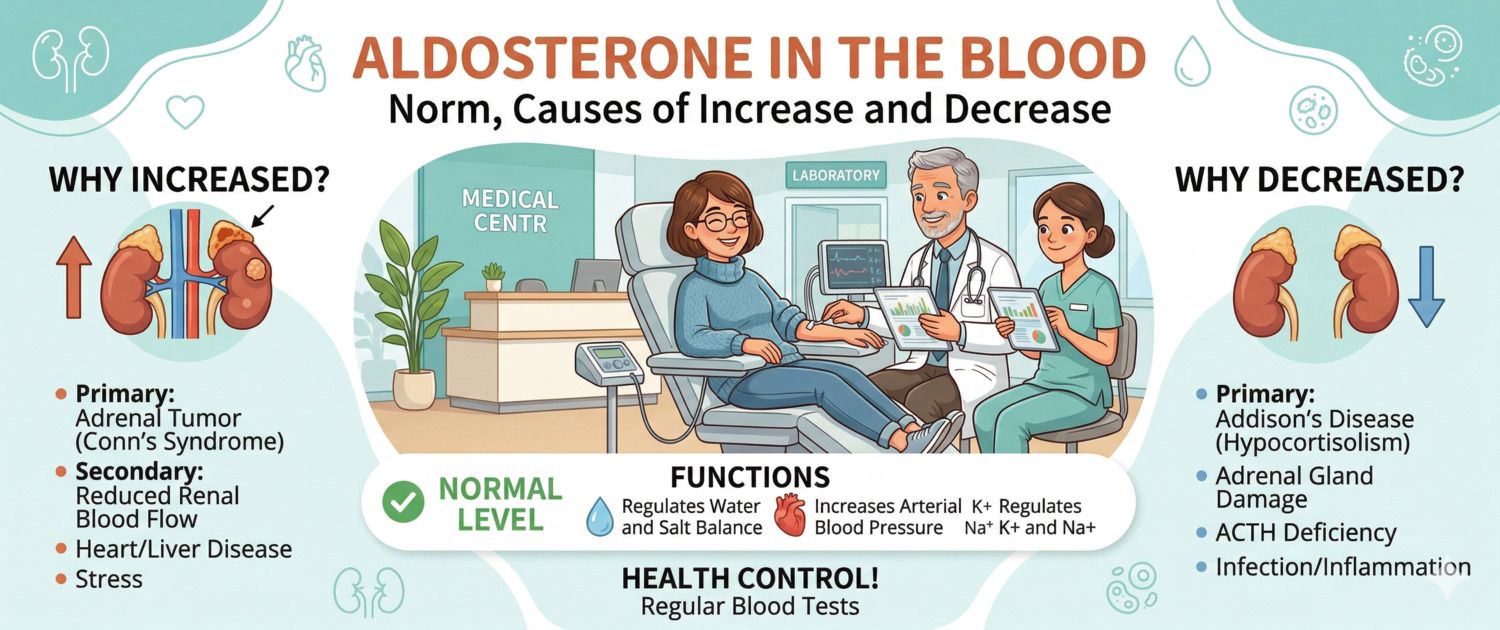
Blood pressure stays high despite three medications, potassium keeps dropping for no clear reason, and muscle weakness lingers — often, one hormone is behind all of it. Aldosterone in the blood quietly governs blood pressure and electrolyte balance until its level moves outside the normal range.
Aldosterone is a steroid hormone produced by the zona glomerulosa of the adrenal cortex. It belongs to the mineralocorticoid class and carries out one central function: in the renal tubules, it promotes reabsorption of sodium and excretion of potassium. Retaining sodium means retaining water, which raises blood volume and blood pressure. This is a normal physiological mechanism. Problems arise when the hormone is produced in excess or falls short.
How the Adrenal Hormone Aldosterone Regulates Blood Pressure
Think of aldosterone as a pressure-regulating valve: open too wide and pressure climbs while potassium falls; close it off and pressure drops while potassium accumulates. Three main signals govern its secretion.
The most important is the renin-angiotensin-aldosterone system (RAAS). When blood pressure or blood volume falls, the kidneys release renin → a cascade follows: renin → angiotensin I → angiotensin II → stimulation of the adrenal zona glomerulosa → aldosterone rises → the kidneys retain sodium and water → pressure is restored. The system runs in reverse: high pressure suppresses renin → aldosterone declines.
The second regulator is blood potassium. A rise of just 0.1–0.2 mmol/L directly stimulates aldosterone secretion — a fast emergency mechanism against dangerous hyperkalaemia.
The third is ACTH (adrenocorticotropic hormone). Its influence on aldosterone is far weaker than on cortisol and becomes relevant mainly in acute stress or pituitary disease.
Normal Aldosterone Levels
The normal range for aldosterone depends critically on body position at the time of blood collection — this is why the result must always note whether it was drawn supine or standing.
| Body position | Normal range (pg/mL) | Normal range (pmol/L) |
|---|---|---|
| Supine (recumbent sample) | 15–100 | 40–280 |
| Standing (upright sample) | 40–300 | 110–830 |
Reference ranges vary considerably between laboratories — always compare with your own laboratory's values printed on the report. An isolated result without renin is almost uninterpretable: the same number points to primary hyperaldosteronism when renin is suppressed, but to a normal compensatory response when renin is elevated.
In children, ranges are higher than in adults. During pregnancy, aldosterone physiologically rises two- to fourfold — this is normal, not pathological: the placenta activates the RAAS and the body appropriately retains more fluid.
How to Prepare for an Aldosterone Blood Test
Aldosterone is among the most condition-sensitive hormonal tests in clinical practice. Inadequate preparation can double or halve the result and lead to false conclusions.
Diet: for two weeks before the test, maintain your usual salt intake — neither restrict nor increase it. A low-sodium diet falsely elevates aldosterone; excess salt falsely suppresses it.
Position and timing: the standard protocol is a morning sample (before 10:00 a.m.) after at least 30 minutes lying down (recumbent sample). When primary hyperaldosteronism is suspected, a second draw is added after two hours standing or walking — the upright sample is more sensitive for this diagnosis.
Medication washout — only under medical supervision:
- spironolactone, eplerenone — 4–6 weeks before the test;
- ACE inhibitors, ARBs, beta-blockers, thiazide diuretics — 2 weeks;
- NSAIDs — 1 week.
On the day of the test: no smoking for 2 hours beforehand; avoid physical exertion in the morning.
Causes of High Aldosterone
Elevated aldosterone — hyperaldosteronism — is either primary or secondary. The distinction is impossible without measuring renin.
Primary hyperaldosteronism (Conn's syndrome) — the adrenal gland secretes aldosterone autonomously, independently of renin. Renin is suppressed (low), aldosterone is high. This is the most common endocrine cause of secondary hypertension — primary hyperaldosteronism is identified in 5–10% of all hypertensive patients and in up to 20% with resistant hypertension.
Causes:
- adrenal adenoma (aldosteronoma) — 60–65% of cases;
- bilateral idiopathic adrenal hyperplasia — 30–35%;
- adrenocortical carcinoma — rare (< 1%).
Clinical picture: arterial hypertension (often resistant — three medications without effect), hypokalaemia (muscle weakness, cramps, polyuria, thirst), and metabolic alkalosis. Hypokalaemia is present in only 40–50% of patients — its absence does not exclude the diagnosis.
Secondary hyperaldosteronism — renin is elevated → aldosterone responds physiologically:
- heart failure — reduced cardiac output activates the RAAS;
- liver cirrhosis with ascites — reduced effective circulating volume;
- renal artery stenosis — renal ischaemia drives renin release;
- nephrotic syndrome — protein loss reduces oncotic pressure → RAAS activation;
- prolonged diuretic use or a low-sodium diet.
Causes of Low Aldosterone
Aldosterone deficiency — hypoaldosteronism — presents with hypotension, hyperkalaemia and urinary sodium wasting.
Adrenal insufficiency (Addison's disease) — destruction of the adrenal cortex by autoimmune, tuberculous or other processes simultaneously depletes both cortisol and aldosterone. In an acute Addisonian crisis, life-threatening hyperkalaemia and hypotension can develop within hours.
Hyporeninemic hypoaldosteronism (type IV renal tubular acidosis) — common in diabetic nephropathy: the kidneys produce insufficient renin → aldosterone falls → hyperkalaemia develops that is disproportionate to the degree of GFR reduction.
Iatrogenic causes: ACE inhibitors, ARBs and direct renin inhibitors reduce angiotensin II → aldosterone falls. Prolonged heparin use directly suppresses adrenal aldosterone synthesis.
Cushing's syndrome with exogenous glucocorticoids — chronic ACTH suppression reduces adrenal stimulation and aldosterone consequently declines.
Renin-to-Aldosterone Ratio
The renin-to-aldosterone ratio (RAR) is the primary screening tool for primary hyperaldosteronism. The principle is straightforward: if aldosterone is high while renin is suppressed, the adrenal gland itself is the autonomous source — not the signalling cascade responding to a physiological need.
RAR = aldosterone (pg/mL) ÷ plasma renin activity (ng/mL·h)
An RAR above 30 combined with aldosterone above 150 pg/mL is highly suspicious for Conn's syndrome and triggers confirmatory testing (salt loading, fludrocortisone suppression test, postural test). The ratio alone, without the absolute aldosterone value, can yield false-positives when renin is suppressed for other reasons — interpretation is always clinical.
For an accurate RAR, both tests must be drawn simultaneously under identical preparation conditions. A baseline electrolyte panel is mandatory: the initial potassium and sodium levels influence both the RAR value and its interpretation.
When to See a Doctor About Aldosterone Test Results
Aldosterone testing is warranted when one or more of the following apply:
- blood pressure that cannot be controlled with three or more medications at full doses;
- hypokalaemia (potassium below 3.5 mmol/L) without a clear cause, particularly in the absence of diuretic use;
- incidentally discovered adrenal tumour (incidentaloma) on CT or ultrasound;
- hypertension diagnosed before age 40;
- family history of primary hyperaldosteronism or stroke at a young age;
- hypotension combined with hyperkalaemia and profound weakness without another explanation.
Aldosterone is not a routine test. It is ordered when hypertension is unexplained, the electrolyte balance is disrupted, or adrenal pathology is suspected. A standalone number without renin, electrolytes and clinical context cannot be interpreted — do not draw conclusions independently; consult an endocrinologist.
This content is for informational purposes only and does not replace professional medical advice.
For informational purposes only
This article is for informational purposes only and does not constitute medical advice, diagnosis, or treatment. Please consult a healthcare professional for medical guidance.