Acute Kidney Injury (AKI): Causes, Stages and Treatment
Reviewed by the LabReadAI medical team
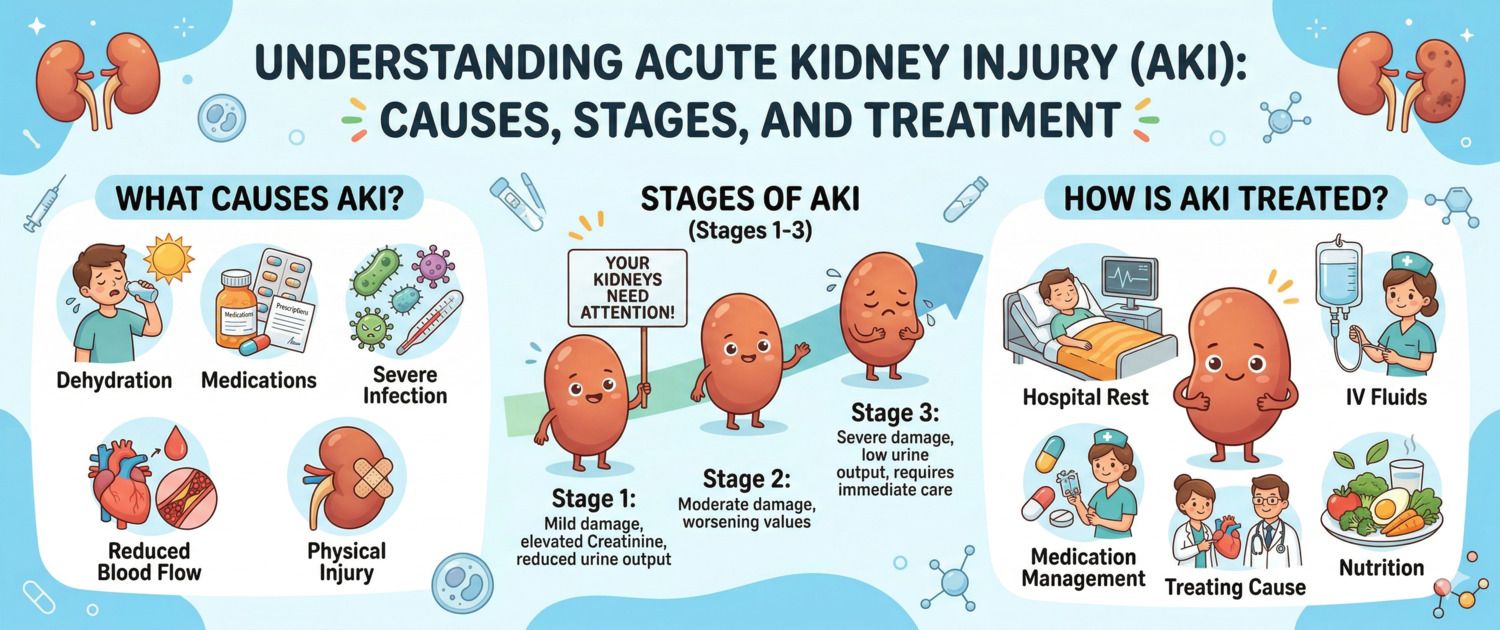
Acute kidney injury is one of the few conditions in nephrology where time is measured in hours. The kidneys can lose a significant portion of their filtration capacity within a day, and how quickly the cause is identified and treatment started directly determines whether function recovers fully or the patient progresses to chronic kidney disease. This is why AKI is not simply a diagnosis — it is an alarm signal.
What AKI Is and How It Differs from Chronic Kidney Disease
Acute kidney injury (AKI) is a syndrome of rapid decline in kidney function developing over hours or days. The defining word is "acute": unlike chronic kidney disease, which evolves over months and years, AKI is a sudden event.
KDIGO diagnostic criteria (2012): AKI is diagnosed when at least one of the following is present:
- Rise in creatinine ≥ 26.5 µmol/L within 48 hours
- Rise in creatinine ≥ 1.5-fold from baseline within 7 days
- Urine output < 0.5 mL/kg/hour for ≥ 6 hours
AKI stages (KDIGO):
| Stage | Creatinine | Urine output |
|---|---|---|
| 1 | ×1.5–1.9 from baseline or +26.5 µmol/L | < 0.5 mL/kg/h ≥ 6 h |
| 2 | ×2.0–2.9 from baseline | < 0.5 mL/kg/h ≥ 12 h |
| 3 | ×3.0 or > 353.6 µmol/L or dialysis initiation | < 0.3 mL/kg/h ≥ 24 h or anuria ≥ 12 h |
The critical distinction from CKD: AKI is potentially reversible with timely treatment. Outcome depends on cause, stage, and speed of intervention.
Causes of AKI: Prerenal, Renal, Postrenal
Classification by mechanism is the key to treatment: different causes require fundamentally different approaches.
Prerenal (reduced renal blood flow) — 55–60% of all AKI
The kidneys themselves are intact but receive insufficient blood flow. Filtration falls as a compensatory response to hypovolaemia or reduced cardiac output. Reversible with rapid restoration of perfusion.
- Dehydration — vomiting, diarrhoea, haemorrhage, burns, excessive sweating
- Heart failure, cardiogenic shock — impaired pump function
- Sepsis — peripheral vasodilation with normal or reduced cardiac output
- Cirrhosis with hepatorenal syndrome
- Excessive diuretic therapy
- NSAIDs — block prostaglandin-dependent afferent vasodilation in glomeruli
Laboratory marker of prerenal AKI: urea rises disproportionately fast — urea/creatinine ratio > 80 (BUN/Cr > 20 in mg/dL). Urine is concentrated; oliguria is present.
Renal (intrinsic kidney parenchyma damage) — 35–40%
Direct injury to nephron structures. The most common form: acute tubular necrosis (ATN).
Ischaemic ATN — develops when prerenal AKI is prolonged: the kidneys "tolerated" reduced blood flow until tubular epithelium began to die. The transition from prerenal to renal AKI is the critical inflection point, after which volume restoration alone no longer normalises function immediately.
Nephrotoxic ATN — direct toxic tubular injury:
- Aminoglycoside antibiotics (gentamicin, amikacin)
- Radiocontrast agents — especially dangerous in patients with pre-existing reduced GFR
- Rhabdomyolysis — myoglobin from destroyed muscle is nephrotoxic
- Chemotherapy agents (cisplatin)
- Intravascular haemolysis
Other renal causes:
- Acute glomerulonephritis — immune glomerular injury
- Acute interstitial nephritis — commonly drug-induced (NSAIDs, antibiotics, proton pump inhibitors)
- Thrombotic microangiopathy (HUS, TTP)
- Renal artery atheroemboli
Postrenal (obstructed urine outflow) — 5–10%
Urine is produced but cannot exit. Pressure builds in the tubules, filtration falls. Reversible upon relief of obstruction.
- Urolithiasis with bilateral obstruction or obstruction of a solitary kidney
- Benign prostatic hyperplasia or prostate cancer
- Pelvic tumours with external ureteral compression
- Neurogenic bladder
Acute Renal Failure Symptoms: Oliguria, Uraemia and Electrolyte Crisis
The clinical picture of AKI comprises symptoms of reduced filtration and symptoms of the underlying causative condition.
Changes in urine output:
- Oliguria (< 400 mL/day) — the most common sign; anuria (< 50 mL/day) indicates a critical state
- Paradoxically: some AKI forms (contrast-induced nephropathy, some nephrotoxic injuries) occur without oliguria — "non-oliguric AKI"
Uraemic symptoms (from toxin accumulation): Nausea, vomiting, reduced appetite, metallic taste, ammonia breath odour. As severity increases — confusion, seizures.
Fluid and electrolyte disturbances:
- Fluid overload — oedema, dyspnoea, hypertension
- Hyperkalaemia — the most dangerous acute complication of AKI. At potassium > 6.0–6.5 mmol/L — risk of fatal arrhythmia. Requires emergency management
- Hyponatraemia, hyperphosphataemia, hypocalcaemia
Metabolic acidosis — the kidneys cannot excrete acid; worsens with severe AKI.
Creatinine and Other Lab Tests in AKI: What Changes and How
Blood:
- Creatinine — the primary marker: rapid rise over hours to days. In stage 3 AKI may exceed 350–500 µmol/L
- Urea — rises in parallel, but faster in catabolic states
- Potassium — hyperkalaemia in AKI is life-threatening; check every 4–6 hours in severe AKI
- Sodium — hyponatraemia with fluid overload
- Phosphorus — hyperphosphataemia
- Bicarbonate / pH — metabolic acidosis
- CBC: haemoglobin — falls in haemolysis or as part of anaemia of renal disease
Urine:
- Osmolality > 500 mOsm/kg — concentrated urine in prerenal AKI
- Osmolality < 300 mOsm/kg — impaired concentration in renal AKI
- Casts in sediment: granular, epithelial — markers of tubular necrosis
- Myoglobinuria (dark "tea-coloured" or "cola-coloured" urine) — in rhabdomyolysis
Imaging: Renal ultrasound — mandatory in all AKI: dilated pelvicalyceal system indicates postrenal obstruction.
Treatment of AKI
The approach is determined by cause and stage.
Eliminate the cause — top priority:
- Prerenal AKI: volume restoration with crystalloid fluids; inotropes for cardiogenic shock; discontinue NSAIDs and other nephrotoxins
- Postrenal AKI: urgent drainage — bladder catheterisation, nephrostomy, ureteral stents
- Renal AKI: aetiology-directed treatment (immunosuppression for glomerulonephritis, steroids for interstitial nephritis); remove nephrotoxins
Supportive care:
- Fluid balance management: avoid both hypovolaemia and volume overload
- Hyperkalaemia — emergency treatment: calcium gluconate (membrane stabilisation), insulin + glucose + bicarbonate (intracellular K⁺ shift), ion exchange resins or dialysis
- Blood pressure control
- Nutritional support: adequate protein intake; restricting protein in AKI is an outdated concept harmful in catabolic states
- Infection prevention (AKI is a risk factor for nosocomial infections)
Renal replacement therapy (dialysis): Indications for emergency dialysis in AKI:
- Refractory hyperkalaemia (K⁺ > 6.5 mmol/L)
- Severe metabolic acidosis (pH < 7.15)
- Uraemic symptoms (encephalopathy, pericarditis)
- Volume overload with refractory pulmonary oedema
- The absolute creatinine level is not a dialysis indication — clinical status governs the decision
With timely management, most patients with prerenal and postrenal AKI recover kidney function fully. With renal AKI (especially ischaemic ATN), recovery takes 1–3 weeks; in some patients, function does not fully recover and CKD develops.
When to Seek Urgent Medical Attention
- Sudden sharp reduction in urine output or complete cessation — anuria always requires emergency assessment
- Creatinine rise > 26 µmol/L within 48 hours on lab results — urgent nephrology consultation
- Weakness, arrhythmia, or numbness — possible hyperkalaemia; call emergency services
- Dark tea-coloured urine after intense exercise or trauma — rule out rhabdomyolysis
- Confusion in a patient with known kidney disease — possible uraemic encephalopathy
Telling prerenal injury from intrinsic renal damage often rests not on an absolute figure but on a proportion: with dehydration and falling perfusion the nitrogen waste product rises faster than creatinine, and the ratio between them climbs. What stands behind high urea (BUN), and which extrarenal causes push it up, is set out in a separate article.
This article is for informational purposes only and does not replace consultation with a qualified nephrologist.
For informational purposes only
This article is for informational purposes only and does not constitute medical advice, diagnosis, or treatment. Please consult a healthcare professional for medical guidance.