Blood Urea (BUN): Normal Levels, Interpretation and Causes
Reviewed by the LabReadAI medical team
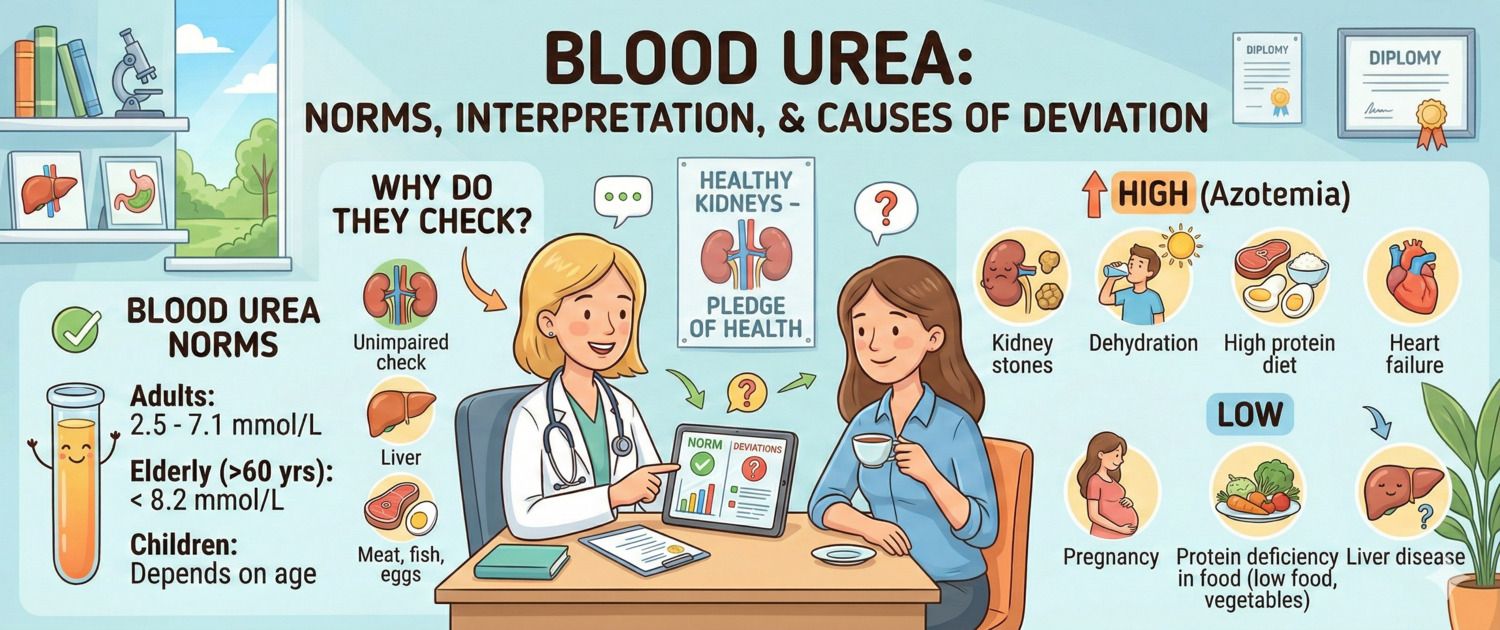
Urea is one of those markers that patients frequently confuse with uric acid — two different substances with entirely different clinical meanings. Urea is the end product of protein breakdown, and its blood level simultaneously reflects two systems: how well the kidneys are working, and how much protein is being consumed and catabolised. Unlike creatinine, urea is sensitive to diet and catabolism — which is precisely why it is best interpreted as a pair with creatinine rather than in isolation.
What Urea Is and How It Forms
When the body breaks down proteins — from food or its own tissues (during stress, inflammation, or tissue breakdown) — ammonia is released. Ammonia is toxic to the nervous system, so the liver neutralises it by converting it to urea through the ornithine (urea) cycle. The resulting urea enters the bloodstream and is excreted by the kidneys in urine.
This two-step route — liver synthesises, kidneys excrete — explains why urea can be abnormal in disease of either organ. Elevation usually points to a problem with excretion (kidneys); reduction points to a problem with synthesis (liver) or simply to low dietary protein.
Urea is a standard component of the kidney function panel alongside creatinine, electrolytes, and uric acid. Interpreting it in isolation without companion markers provides an incomplete picture.
How to Prepare for a Urea Blood Test
Urea is sensitive to several easily controllable factors:
- Fasting: blood is drawn 8–12 hours after the last meal
- Protein-rich food: a large meat-heavy dinner the evening before raises urea by 10–20% — limit red meat for 24 hours before the test
- Physical exercise: intense training accelerates muscle protein breakdown and transiently elevates urea — avoid for 24 hours
- Hydration: dehydration concentrates the blood and inflates the reading; drink adequate water the day before
- Medications: corticosteroids, tetracyclines, and some diuretics raise urea — inform your doctor about current medications
- Serial monitoring: for tracking trends, use the same laboratory and preparation conditions each time
Normal Urea Levels by Age and Sex
Urea depends on muscle mass and protein metabolism — men average slightly higher than women, although the adult reference range is the same for both sexes. Children sit lower at the bottom of the range, and after 60 the upper limit widens as filtration declines physiologically.
| Group | mmol/L | mg/dL (urea) | BUN (mg/dL) |
|---|---|---|---|
| Children under 14 | 1.8–6.4 | 11–38 | 5–18 |
| Adults 14–60 | 2.5–6.4 | 15–38 | 7–18 |
| Over 60 years | 2.9–7.5 | 17–45 | 8–21 |
| Pregnancy (2nd–3rd trimester) | 1.5–5.3 | 9–32 | 4–15 |
Unit note: US laboratories commonly report Blood Urea Nitrogen (BUN) in mg/dL. To convert: urea (mmol/L) × 2.8 = BUN (mg/dL). Normal BUN/creatinine ratio (in mg/dL) is 10–20.
During pregnancy, urea physiologically falls: expanding blood volume increases renal blood flow and dilutes the marker. A "normal" urea level for non-pregnant women may already indicate impairment in the second or third trimester.
Causes of Elevated Urea (Azotemia)
Urea elevation above the normal range is called azotemia. Like creatinine elevation, causes are classified into three categories.
Prerenal causes (kidneys are intact but load or blood flow has changed):
- Dehydration, vomiting, diarrhoea, heat exposure — reduced renal perfusion concentrates urea
- High-protein diet or parenteral nutrition — excess substrate for urea synthesis
- Catabolic states: fever, major trauma, burns, sepsis — accelerated breakdown of tissue proteins
- Gastrointestinal haemorrhage: blood in the intestinal lumen is digested as dietary protein → urea spikes with normal or only mildly elevated creatinine
- Heart failure — reduced cardiac output decreases renal blood flow
Renal causes (intrinsic kidney damage):
- Chronic kidney disease — the most common cause of persistently elevated urea
- Acute kidney injury — rapid rise in both urea and creatinine over hours to days
- Glomerulonephritis, severe pyelonephritis
Postrenal causes (obstructed urine outflow):
- Urolithiasis with ureteral obstruction
- Benign prostatic hyperplasia with urinary retention
Causes of Low Urea
Low urea is less common than elevated and usually reflects reduced synthesis in the liver or insufficient protein substrate.
Main causes:
- Severe liver disease — liver cirrhosis and acute hepatic failure disrupt the ornithine cycle; the liver cannot convert ammonia to urea. This is a dangerous situation: accumulating ammonia is toxic to the brain
- Low-protein diet or starvation — reduced substrate. A vegan diet with minimal protein characteristically produces urea at or below the lower normal limit
- Pregnancy — physiological reduction from haemodilution and enhanced renal clearance
- SIADH (syndrome of inappropriate antidiuretic hormone secretion) — overhydration dilutes all blood markers
- Severe malabsorption — reduced intestinal protein absorption
Isolated low urea with normal albumin and normal liver tests is almost always diet or pregnancy-related rather than pathological. But low urea combined with low albumin and elevated bilirubin is a warning sign of decompensated liver function.
Urea and Creatinine Ratio: A Diagnostic Tool
Both markers reflect renal excretory function, but with different sensitivity to extrarenal factors. Their ratio helps distinguish the cause of azotemia.
The urea/creatinine ratio (in mmol/L) is normally 40–80. In US units, the BUN/creatinine ratio (in mg/dL) is normally 10–20.
| Ratio | Interpretation |
|---|---|
| > 80 (BUN/Cr > 20) | Prerenal azotemia: dehydration, GI bleed, hypercatabolism |
| 40–80 (BUN/Cr 10–20) | Renal azotemia or normal |
| < 40 (BUN/Cr < 10) | Reduced urea synthesis (cirrhosis) or low-protein diet |
A classic example: gastrointestinal haemorrhage produces disproportionately elevated urea with normal or mildly elevated creatinine — because blood in the intestinal lumen is digested as dietary protein. A ratio sharply above 80 in this context is a signal for endoscopy, not nephrology.
When to See a Doctor
Schedule a routine appointment when:
- Urea is above the upper reference limit on repeat testing without an obvious cause (diet, dehydration)
- Urea is rising steadily over serial measurements — even within the "normal" absolute range
- Low urea alongside worsening weakness, jaundice, and oedema — possible liver decompensation
Seek urgent care when:
- Urea and creatinine rise sharply together with oliguria or anuria — acute kidney injury
- Uraemic symptoms are present: nausea, vomiting, confusion, ammonia breath
- Very low urea (< 1.5 mmol/L) with altered consciousness — possible hepatic encephalopathy
This article is for informational purposes only and does not replace professional medical advice. Consult a GP or nephrologist if your urea level is outside the normal range.
For informational purposes only
This article is for informational purposes only and does not constitute medical advice, diagnosis, or treatment. Please consult a healthcare professional for medical guidance.