Hematocrit Blood Test: Normal Range, Causes of High and Low Levels
Reviewed by the LabReadAI medical team
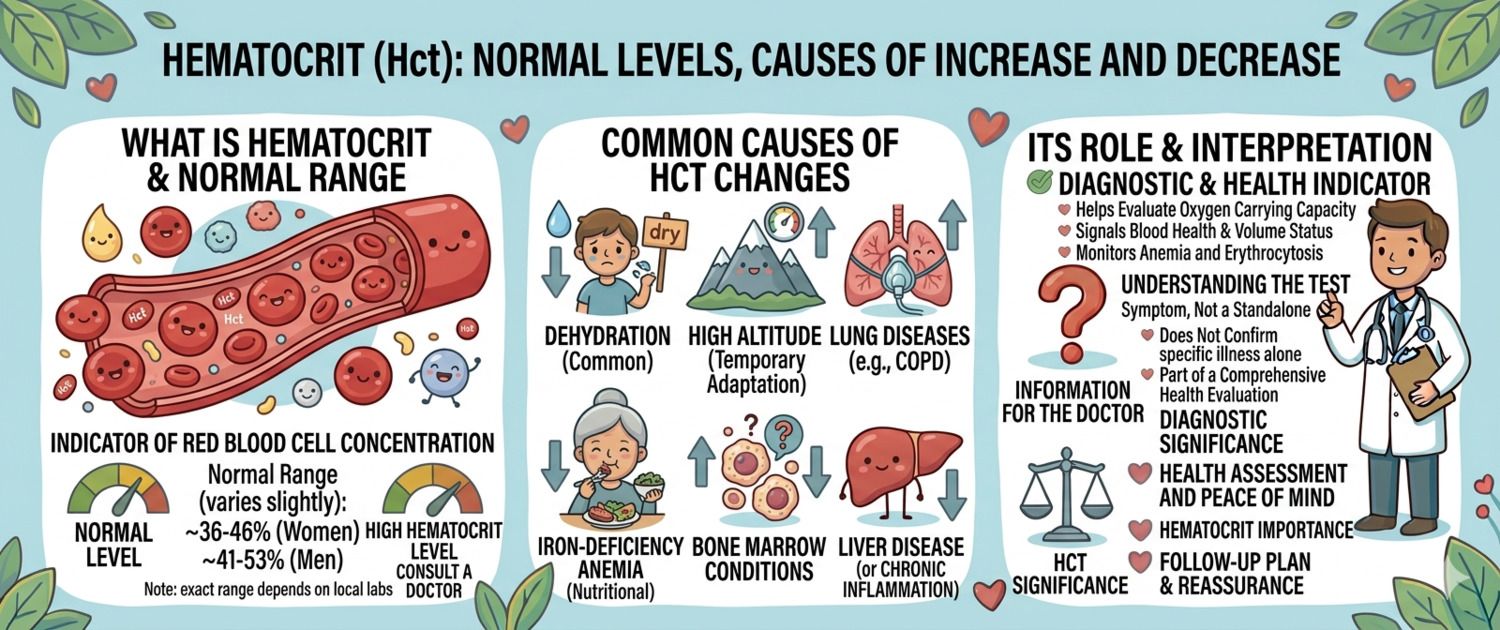
Hematocrit rarely gets its own spotlight — it's usually treated as a shadow of haemoglobin. But it has its own diagnostic niche: it reflects not only the number of red cells but the ratio of cellular mass to plasma volume, which matters when assessing blood viscosity, hydration status, and deciding how to manage anaemia. Here's what hematocrit measures and where it is more informative than haemoglobin alone.
What Is Hematocrit and What Does It Measure
Hematocrit (Hct) is the percentage (or fraction) of total blood volume occupied by red blood cells. If red cells take up 45% of the volume in a centrifuged blood sample, the hematocrit is 45% (or 0.45).
In essence, hematocrit measures how "packed" the blood is with red cells. It depends on two factors simultaneously: red cell count and plasma volume. This is what makes it unique: haemoglobin falls only when red cell numbers or quality decrease, while hematocrit can also change when the liquid component of blood shifts — rising with dehydration or falling with fluid overload.
Hematocrit is especially important in two situations: assessing anaemia severity (alongside haemoglobin) and evaluating hydration status (dehydration raises hematocrit and makes blood more viscous — increasing thrombosis risk).
It is automatically calculated in a complete blood count.
Normal Hematocrit by Sex and Age
Hematocrit norms differ significantly by sex — men have physiologically higher values due to testosterone's stimulating effect on erythropoiesis. In pregnancy, hematocrit physiologically falls due to haemodilution: plasma volume expands faster than red cell production.
| Group | Normal Hematocrit (%) |
|---|---|
| Newborns | 45–65 |
| Infants 1–6 months | 29–41 |
| Children 1–6 years | 32–42 |
| Children 6–12 years | 34–43 |
| Adolescents 12–18 years | 35–47 |
| Men | 39–49 |
| Women | 35–45 |
| Pregnancy, third trimester | 31–41 |
Reference ranges may vary slightly between laboratories. Always use the values on your specific report.
Why Is Hematocrit Low?
A low hematocrit almost always reflects a reduced number or quality of red blood cells — that is, anaemia. But an important nuance: hematocrit can be falsely low when body fluid volume is excessive (overhydration), even with a normal red cell count.
Anaemia of any cause — the most common reason. Iron-deficiency, B12-deficiency, haemolytic, and aplastic anaemias all reduce red cell number or volume, and hematocrit falls alongside haemoglobin. MCV then helps identify the anaemia type.
Pregnancy — physiological hematocrit fall. Plasma volume expands by 40–50% while red cell production increases by only 20–30%, resulting in "diluted" blood with hematocrit around 31–41% despite normal wellbeing.
Acute blood loss — in the first hours after haemorrhage, hematocrit and haemoglobin may appear normal (blood hasn't yet been diluted by plasma). After 24–48 hours, as the body replenishes plasma, hematocrit falls — now reflecting true red cell loss.
Chronic kidney disease — erythropoietin deficiency reduces red cell production and hematocrit falls gradually.
Excessive intravenous fluid administration — haemodilution lowers hematocrit without actual red cell loss.
Why Is Hematocrit High?
Elevated hematocrit means red cells occupy a disproportionately large share of blood volume — either because their number has increased or because plasma volume has decreased.
Dehydration is the most common and reversible cause. With fluid deficit, plasma volume falls, cells "concentrate," and hematocrit rises. Blood becomes viscous — risk of thrombosis, particularly venous, increases substantially. Hematocrit above 55% with clinical signs of dehydration is an urgent situation.
High-altitude living — chronic hypoxia stimulates erythropoietin production; the bone marrow produces more red cells — compensatory erythrocytosis.
Chronic lung disease (COPD, emphysema) — chronic hypoxia by the same mechanism.
Polycythaemia vera — a myeloproliferative disorder in which the bone marrow uncontrollably overproduces red cells. Hematocrit can reach 60–70% or higher. Rare but serious — requires haematology evaluation.
Gaisböck syndrome (pseudo-polycythaemia) — elevated hematocrit with normal red cell count due to reduced plasma volume. Seen in obese hypertensive men under stress.
Smoking elevates carboxyhaemoglobin, impairing oxygen delivery — compensatory erythrocytosis and moderate hematocrit rise.
Hematocrit and Blood Viscosity: The Practical Angle
The link between hematocrit and blood viscosity is not merely theoretical. Above 50–55%, viscosity rises exponentially rather than linearly: the blood becomes harder for the heart to pump, microcirculation slows, and the risk of small vessel thrombosis increases sharply.
This is why the primary treatment for polycythaemia vera is phlebotomy — removing blood to reduce hematocrit toward target values of 42–45%. And why rehydration in severe dehydration is not just fluid replacement but also thrombosis risk reduction.
For complete assessment, hematocrit is always read alongside haemoglobin, red cell count, and MCV in the complete blood count.
How to Prepare for the Test
Hematocrit is measured in the complete blood count. Standard preparation: fasting draw. Critical point: test in a state of normal hydration — not immediately after intense exercise with fluid losses, not after prolonged fluid restriction. Dehydration will artificially raise hematocrit; excess fluid will lower it, and the result will not reflect the true state.
When to See a Doctor
Seek immediate medical attention if:
- Hematocrit exceeds 55–60% — marked erythrocytosis requires urgent investigation.
- High hematocrit is combined with headaches, facial flushing, or skin itching after a hot bath — possible polycythaemia vera.
Schedule a routine GP appointment if:
- Hematocrit is below 30% in adults — severe anaemia requiring investigation.
- Hematocrit is persistently elevated on repeat tests without obvious dehydration or altitude adaptation.
Conclusion
Hematocrit sits at the intersection of two worlds: red cell count and plasma volume. This is what makes it indispensable when assessing dehydration and blood viscosity — where haemoglobin alone is insufficient. Combined with haemoglobin, red cell count, and MCV, it provides the complete morphological picture of the erythrocyte component of blood.
This article is for informational purposes only. Interpreting test results and prescribing treatment is exclusively the responsibility of a physician.
For informational purposes only
This article is for informational purposes only and does not constitute medical advice, diagnosis, or treatment. Please consult a healthcare professional for medical guidance.