Multiple Myeloma: Symptoms, Diagnosis and Treatment
Reviewed by the LabReadAI medical team
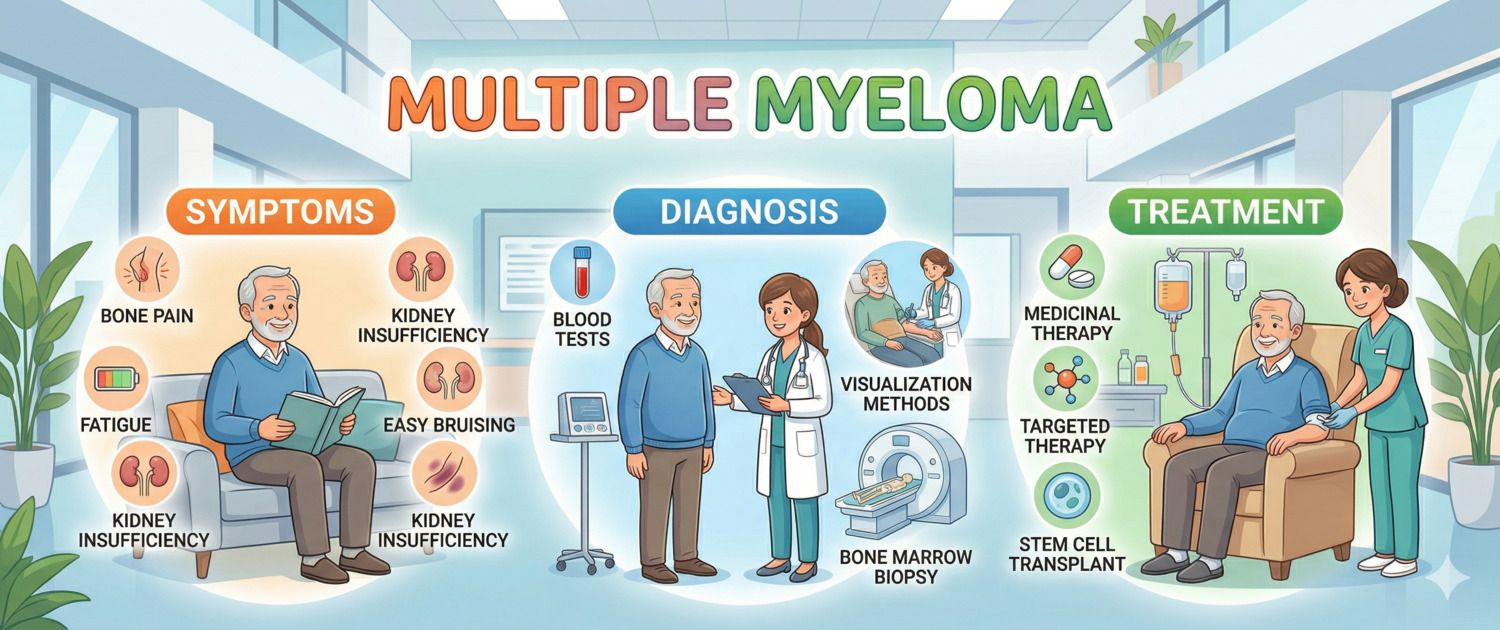
Back pain in an older person that persists for months, unexplained anaemia, unexpectedly high total protein with normal albumin — this combination should immediately raise suspicion for multiple myeloma. It is the second most common haematological malignancy after lymphoma, and its insidious nature lies in how convincingly it mimics ordinary diseases of ageing.
What Multiple Myeloma Is
Multiple myeloma (MM) is a malignant disorder in which a monoclonal clone of plasma cells (the terminal cells of the B-lymphocyte lineage) proliferates uncontrollably in the bone marrow. Plasma cells normally produce antibodies; in myeloma, they generate vast quantities of a defective, monotypic immunoglobulin — a paraprotein (M-protein).
Proliferation of myeloma cells in the bone marrow triggers a chain of damage:
- Displacement of normal haematopoiesis → anaemia, thrombocytopenia, neutropenia
- Osteoclast activation → bone destruction, hypercalcaemia, pathological fractures
- M-protein accumulation in the blood → kidney impairment, hyperviscosity
- Suppression of normal immunoglobulins → immunodeficiency, recurrent infections
MM accounts for approximately 10% of all haematological malignancies. The median age at diagnosis is 65–70 years; it is rare below 40. Men are more frequently affected. With modern therapy, one-year survival exceeds 85%; five-year survival is approximately 55%.
Symptoms: CRAB Criteria for Organ Damage
The clinical picture of myeloma is captured by the acronym CRAB:
C — Calcium (hypercalcaemia): serum calcium > 2.75 mmol/L (or > 0.25 mmol/L above the upper limit of normal). Symptoms: nausea, vomiting, constipation, polyuria, thirst, weakness, confusion ("stones, bones, groans, and psychic moans" — the classic mnemonic).
R — Renal failure: creatinine > 177 µmol/L. Causes: direct tubular toxicity from immunoglobulin light chains, hypercalcaemia, hyperuricaemia, amyloidosis, contrast-induced dehydration.
A — Anaemia: haemoglobin < 100 g/L or > 20 g/L below baseline. Normochromic, normocytic — due to displacement of normal erythropoiesis.
B — Bone lesions: osteolytic lesions, vertebral compression fractures, pathological fractures of long bones. Typical sites: spine (especially thoracic and lumbar), ribs, pelvis, skull. Back pain is the most common symptom at diagnosis.
Additional features:
- Recurrent infections (pneumonia, sepsis) — from suppression of normal immunoglobulins
- Hyperviscosity syndrome: headache, visual disturbances, epistaxis — at very high M-protein levels (more common in Waldenström's macroglobulinaemia)
- Peripheral neuropathy — direct light chain toxicity or AL amyloidosis
Diagnosis of Multiple Myeloma
Diagnosis of myeloma is multi-layered.
Laboratory markers
Screening tests — first suspicion:
- Total protein — markedly elevated (> 90–100 g/L) with normal or reduced albumin: the classic hallmark of paraproteinaemia. A/G ratio sharply reduced (< 0.8)
- Calcium — elevated with active bone disease
- Creatinine, urea — elevated with renal involvement
- Haemoglobin, platelets — reduced from haematopoietic displacement
- Uric acid — often elevated (high cell turnover)
- LDH — elevated in active disease (tumour burden marker)
- ESR — markedly elevated from paraprotein (sometimes > 100 mm/hour)
- β₂-microglobulin — a critical prognostic marker; part of the ISS staging system
Specific tests — diagnostic confirmation:
- Serum protein electrophoresis — identifies the M-gradient (a sharp spike in the γ-zone); immunofixation defines the immunoglobulin class (IgG, IgA, IgD, IgM) and light chain type (κ or λ)
- Urine Bence Jones protein — free immunoglobulin light chains filtered by the kidneys. Present in the urine of 60–70% of MM patients. 24-hour light chain excretion is an activity criterion
- Serum free light chains (FLC) — highly sensitive; detects an abnormal κ/λ ratio (normal 0.26–1.65)
- Bone marrow trephine biopsy — the primary confirmatory method: plasma cells > 10% of marrow cells; in MM typically > 30%
Imaging:
- Low-dose whole-body CT — standard for detecting lytic lesions
- MRI of the spine — for compression fractures and neurological symptoms
- PET/CT — for staging and treatment response monitoring
Diagnostic criteria (IMWG, 2014)
A diagnosis of symptomatic MM requires:
- Clonal plasma cells ≥ 10% in bone marrow (or biopsy-confirmed plasmacytoma)
- One or more CRAB criteria or one myeloma-defining biomarker: plasma cells ≥ 60%, FLC ratio ≥ 100, > 1 focal lesion on MRI
It is important to distinguish MM from precursor conditions:
- MGUS (monoclonal gammopathy of undetermined significance) — M-protein < 30 g/L, plasma cells < 10%, no CRAB damage. Risk of MM transformation: ~1% per year. Surveillance only.
- Smouldering (indolent) myeloma — M-protein ≥ 30 g/L or plasma cells 10–60%, but no CRAB damage. Risk of progression: ~10% per year. Surveillance or clinical trial enrolment.
Treatment of Multiple Myeloma
MM is currently not curable in most patients (except a minority after allogeneic transplantation), but it is well controlled. The goal is achieving the deepest possible response and prolonging remission.
First line (transplant-eligible — age < 65–70, good performance status):
- Induction: VRd (bortezomib + lenalidomide + dexamethasone) or VCd (bortezomib + cyclophosphamide + dexamethasone)
- Autologous stem cell transplantation (ASCT) — prolongs remission
- Maintenance: lenalidomide until progression
First line (transplant-ineligible):
- Rd (lenalidomide + dexamethasone) — continuous until progression
- VMP (bortezomib + melphalan + prednisone)
- Daratumumab-based regimens (anti-CD38 monoclonal antibody) — substantially improved outcomes in older patients
Relapsed/refractory MM:
- Pomalidomide, carfilzomib, daratumumab, elotuzumab
- CAR-T cell therapy (idecabtagene vicleucel, ciltacabtagene autoleucel) — at multiple relapses, high efficacy demonstrated
Supportive and adjunctive therapy:
- Bisphosphonates (zoledronic acid) — all patients with bone disease: reduce skeletal complications and slow osteolysis
- Pain management — NSAIDs (cautiously with renal impairment), opioids, targeted radiotherapy for isolated lesions
- Thromboprophylaxis — mandatory with immunomodulatory agents (lenalidomide, thalidomide)
- Renal failure management — aggressive hydration, immediate initiation of specific therapy; dialysis if needed
When to See a Doctor
- Persistent back or bone pain in a person over 50 with no trauma — investigate including total protein and ESR
- Unexplained anaemia + elevated serum protein with normal albumin — urgent haematology referral
- Pathological fracture (fracture from minimal or no trauma) — exclude myeloma as the cause
- Frothy urine + high serum protein + anaemia — three-component combination requiring myeloma exclusion
- Symptoms of hypercalcaemia (thirst, polyuria, nausea, weakness) + bone pain — urgent hospitalisation
This article is for informational purposes only and does not replace consultation with a haematologist-oncologist.
For informational purposes only
This article is for informational purposes only and does not constitute medical advice, diagnosis, or treatment. Please consult a healthcare professional for medical guidance.