ALT in Blood: Normal Levels, Causes of Elevation and Interpretation
Reviewed by the LabReadAI medical team
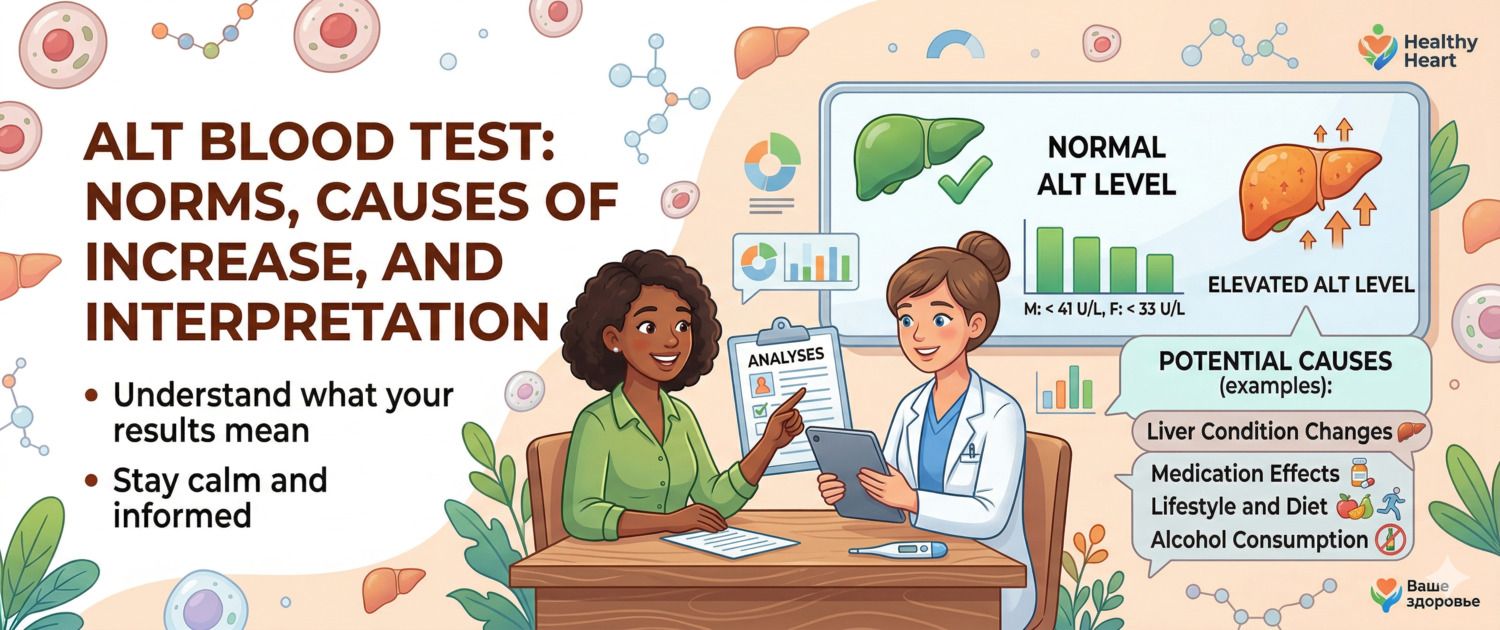
When a doctor says "your liver enzymes are elevated," they are almost always talking about ALT. Alanine aminotransferase is an enzyme that normally works inside liver cells and barely reaches the bloodstream. When cells are damaged, the enzyme leaks out — and its blood level rises. This simple mechanism makes ALT the most sensitive and specific marker of hepatocellular damage available on a routine biochemistry panel. Here is what each level of deviation means, and how to read the result correctly.
What Alanine Aminotransferase (ALT) Is and Why It Enters the Blood
ALT (alanine aminotransferase) is an enzyme from the transaminase family. Its biological role is to transfer an amino group from alanine to alpha-ketoglutarate — a step in the gluconeogenesis pathway. The enzyme is present in many tissues, but its highest concentration is in hepatocytes — liver cells. This is why elevated ALT points primarily to the liver.
Think of a hepatocyte as a sealed vessel with a high intracellular concentration of the enzyme. As long as the cell is alive and its membrane is intact, ALT stays inside. When inflammation, toxic injury or ischaemia disrupts the membrane, the contents spill into the intercellular space and from there into the bloodstream. The greater the damage, the larger the ALT spike.
One important distinction: ALT reflects liver injury, not liver function. A normal ALT in chronic hepatitis does not mean the liver is working well — it means active cell destruction is not occurring at that moment. Function is assessed by other markers — albumin, bilirubin and coagulation tests.
Normal ALT Levels in Blood
ALT reference values depend on sex, age and the analytical method used. The figures below are the most widely used in clinical practice.
| Group | ALT normal range, U/L |
|---|---|
| Men 18–60 years | up to 45 |
| Men over 60 years | up to 40 |
| Women 18–60 years | up to 34 |
| Women over 60 years | up to 30 |
| Children under 1 year | up to 54 |
| Children 1–14 years | up to 45 |
Reference ranges at your specific laboratory may differ slightly depending on equipment and reagents. Always use the values printed on your own lab report.
The difference between male and female norms reflects greater muscle mass in men (muscle contains ALT, though at lower concentrations than liver), as well as possible hormonal influences. This is why the upper limit of normal in men is approximately 25–35% higher than in women.
How to Prepare for an ALT Blood Test
ALT is part of a standard biochemistry panel and is measured from a venous blood sample.
Fasting. Blood should be drawn fasting — last meal 8–12 hours before. Food intake, particularly fatty meals, has a minor direct effect on ALT but can confound interpretation of the full panel.
Physical exercise. Intense training within 24–48 hours before the test can elevate ALT — muscles contain the enzyme and release it when damaged. Avoid strength training before the test.
Medications. A wide range of drugs raise ALT: statins, paracetamol (at high doses), NSAIDs, antibiotics, antifungals, and some supplements. Tell your doctor about any medications you are taking before testing.
Alcohol. Avoid for 48–72 hours — alcohol is directly hepatotoxic and raises ALT in a dose-dependent manner.
Repeat testing. For a single mild ALT elevation, repeat the test in 2–4 weeks at the same laboratory. Transient rises occur with viral infections, intense physical activity and certain medications.
Elevated ALT in Hepatitis and Other Conditions: Causes and Degrees
The degree of ALT elevation is an important diagnostic guide. Clinicians assess not simply whether ALT is raised, but how many times it exceeds the upper limit of normal (ULN).
| Degree of elevation | Fold above ULN | Typical causes |
|---|---|---|
| Mild | 1–3× ULN | NAFLD, moderate alcohol use, drug effect, coeliac disease, hypothyroidism |
| Moderate | 3–10× ULN | Chronic viral hepatitis B/C, autoimmune hepatitis, alcoholic hepatitis, drug-induced hepatitis |
| High | 10–25× ULN | Acute viral hepatitis, severe toxic hepatitis, ischaemic hepatitis ("shock liver") |
| Very high | > 25× ULN | Fulminant hepatitis, acute poisoning (paracetamol, amanita mushrooms), acute hepatic ischaemia, Reye syndrome |
An important clinical principle: the absolute ALT value does not always correlate with the severity of liver damage. In cirrhosis, ALT can be only mildly elevated or even normal — simply because so few viable cells remain to release the enzyme.
Several specific scenarios deserve attention:
Isolated mild ALT elevation (1–3× ULN) with normal GGT and bilirubin — most often NAFLD or a muscular source. Requires clarification with liver ultrasound and assessment of metabolic risk factors.
High ALT with normal or only slightly elevated GGT — points to hepatocellular rather than cholestatic injury; narrows the differential.
ALT > 1000 U/L — always an urgent situation regardless of how the patient feels.
Low ALT: When It Matters
ALT below the reference range is uncommon and usually clinically insignificant. However, in certain settings it carries meaning:
- Severe hepatic insufficiency — in end-stage cirrhosis, so few functioning hepatocytes remain that ALT has nowhere to be produced, and it falls below normal. This is paradoxically a marker of poor prognosis.
- Vitamin B6 deficiency — pyridoxal phosphate is a cofactor for transaminase activity; its deficiency reduces ALT activity.
- Uraemia in end-stage renal failure — uremic toxins inhibit enzyme activity.
ALT and AST: The De Ritis Ratio
ALT is never interpreted in isolation — it is always viewed alongside AST. The AST:ALT ratio (de Ritis ratio) carries its own diagnostic value.
| AST:ALT ratio | Interpretation |
|---|---|
| < 1 (ALT > AST) | Typical of viral hepatitis, NAFLD, drug-induced liver injury |
| ≈ 1 | Non-specific |
| > 2 (AST >> ALT) | Characteristic of alcoholic hepatitis — high specificity |
| > 2 with high absolute values | Consider acute myocardial ischaemia (AST is also present in cardiomyocytes) |
The logic is straightforward: alcoholic injury preferentially damages the mitochondrial pool of AST (which is more abundant in the cell), while viruses and most hepatotoxins disrupt the cell membrane — releasing cytoplasmic ALT first.
For a complete assessment of liver damage, ALT and AST are reviewed together as part of a comprehensive liver function test panel, which also includes GGT, alkaline phosphatase, bilirubin and albumin.
High ALT — What to Do and When to See a Doctor Urgently
Most cases of elevated ALT are managed electively. However, some presentations require immediate assessment:
- ALT above 500 U/L — regardless of symptoms; requires urgent review and hospitalisation if confirmed
- Jaundice with elevated ALT — the combination points to significant hepatic injury with functional impairment
- Abdominal pain with high ALT — possible acute hepatitis, gallstone disease with cholestasis, or acute pancreatitis
- Rising ALT on repeat testing — even at moderate levels, a consistent upward trend warrants investigation
- Sudden fall in ALT after very high values — not always reassuring; in fulminant hepatitis this may indicate that most cells have already been destroyed
On an elective basis: any ALT elevation above normal found incidentally on a routine panel warrants a visit to a GP for interpretation in the context of the full biochemistry picture. ALT is a signal, not a diagnosis.
This article is for informational purposes only. Interpretation of test results and diagnosis are the responsibility of a qualified physician.
For informational purposes only
This article is for informational purposes only and does not constitute medical advice, diagnosis, or treatment. Please consult a healthcare professional for medical guidance.