Non-Alcoholic Fatty Liver Disease: Symptoms and Treatment
Reviewed by the LabReadAI medical team
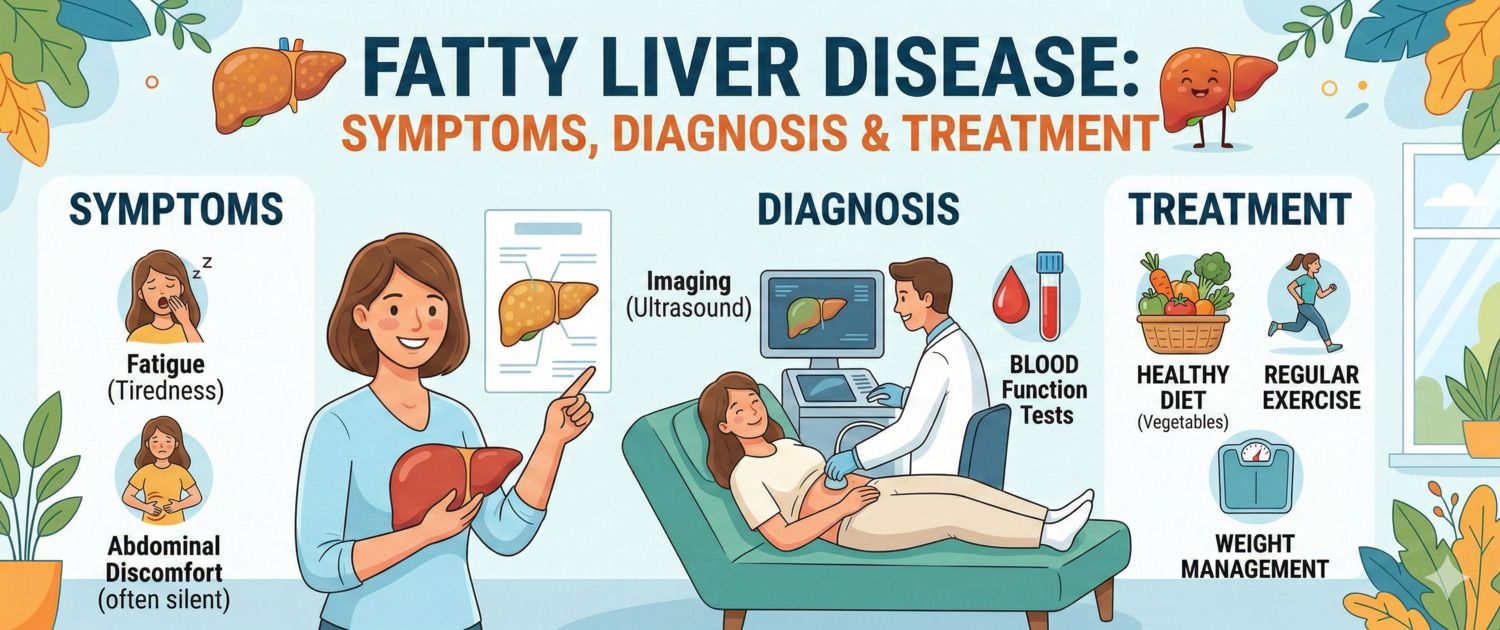
An ultrasound reports "fatty infiltration", ALT is slightly above normal, and you feel reasonably well — this is how most people discover they have fatty liver disease. NAFLD (non-alcoholic fatty liver disease) is today the most prevalent chronic liver condition worldwide: large population studies estimate it affects one in four adults. Most patients are unaware of their diagnosis until it appears as an incidental finding. Silent progression is not the same as safe.
What Is NAFLD and How Does Fatty Liver Develop
NAFLD is the accumulation of fat (primarily triglycerides) in liver cells — hepatocytes — in people who do not drink excessively. The threshold for "non-alcoholic" is defined as fewer than 20–30 g of ethanol per day for men and fewer than 10–20 g for women.
Fatty liver disease is not a single entity but a spectrum from benign to progressive:
- Simple steatosis (NAFLD) — fat in hepatocytes without inflammation. Stable in most patients for years; progression risk roughly 20–25%.
- Non-alcoholic steatohepatitis (NASH) — steatosis plus inflammation plus cell damage. This is the stage where the disease begins to progress actively.
- Liver fibrosis — scarring in response to chronic inflammation. Reversible in early stages if the underlying cause is addressed.
- Liver cirrhosis — end-stage fibrosis with disrupted liver architecture and impaired function. Irreversible.
- Hepatocellular carcinoma — liver cancer that can develop even without cirrhosis in long-standing NASH.
The central mechanism of NAFLD is insulin resistance. When muscle and liver cells stop responding normally to insulin, the pancreas compensates by raising insulin levels. High insulin drives hepatic fatty acid synthesis and suppresses fat oxidation — fat accumulates in hepatocytes. A second hit comes from free fatty acids delivered from visceral adipose tissue via the portal vein, further overloading hepatic metabolism.
The term NAFLD is gradually being replaced by MAFLD (metabolic-associated fatty liver disease) — to emphasise the metabolic rather than simply "non-alcoholic" nature of the condition.
Causes and Risk Factors for NAFLD
Insulin resistance and metabolic syndrome form the backdrop for most cases. Specific risk factors include:
Metabolic:
- obesity — particularly visceral (waist > 94 cm in men, > 80 cm in women);
- type 2 diabetes — present in 70–80% of NAFLD patients;
- dyslipidaemia — elevated triglycerides and reduced HDL;
- hypothyroidism and polycystic ovary syndrome (both worsen insulin sensitivity).
Dietary:
- high fructose intake (especially from sugar-sweetened beverages) — fructose is metabolised exclusively in the liver and directly stimulates lipogenesis;
- diet rich in saturated fats and ultra-processed foods;
- rapid weight loss or prolonged fasting — paradoxically accelerates fat mobilisation into the liver.
Drug-induced and other:
- tamoxifen, methotrexate, amiodarone, valproic acid;
- small intestinal bacterial overgrowth — gut microbiome disruption can contribute to hepatic inflammation;
- genetic factors — the PNPLA3 gene variant substantially raises the risk of NASH and fibrosis.
NAFLD at normal weight. Approximately 10–15% of NAFLD patients have a normal BMI. They typically share low muscle mass, high visceral fat despite normal weight, and genetic predisposition. Normal weight does not rule out the diagnosis.
Symptoms of Fatty Liver Disease: Stages and Signs
Simple steatosis is usually asymptomatic — which makes it particularly treacherous. Complaints emerge when the disease has already progressed to NASH or fibrosis has developed.
In simple steatosis — no symptoms, or minimal:
- dull heaviness or discomfort in the right upper abdomen after fatty meals;
- generalised fatigue without a clear cause.
In steatohepatitis (NASH):
- pronounced weakness and reduced work capacity;
- heaviness and pain in the right upper abdomen;
- nausea after fatty food;
- an enlarged liver detectable on physical examination or ultrasound.
In fibrosis and pre-cirrhotic change:
- intensification of all previous symptoms;
- unintentional weight loss;
- intermittent yellowing of the skin or sclera;
- leg oedema — a sign of developing portal hypertension.
In many patients, NASH and even early fibrosis produce no symptoms at all. This is why NAFLD is identified predominantly as an incidental finding — elevated liver enzymes or an abdominal ultrasound performed for an unrelated reason.
Which Blood Tests Show Fatty Liver Disease
Laboratory findings in NAFLD are often subtle, especially in simple steatosis. Enzymes can be entirely normal even in significant fibrosis.
Liver enzymes:
- ALT — the most sensitive marker of hepatocyte damage. In NAFLD, typically mildly elevated at 1.5–3 times the upper limit of normal. ALT > AST is the characteristic pattern in NAFLD (unlike alcoholic liver disease, where AST usually exceeds ALT).
- AST — rises in parallel with ALT. An AST/ALT ratio > 2 in NAFLD is a warning sign suggesting possible progression toward cirrhosis.
- GGT — gamma-glutamyl transferase rises with fatty degeneration and serves as a marker of hepatic metabolic stress. Elevated GGT with normal ALT/AST does not exclude NAFLD; how to read this marker is covered in GGT: reading the test.
Comprehensive assessment via liver function tests also covers albumin (falls with severe damage), bilirubin (rises with decompensation), and prothrombin time.
Metabolic context:
- fasting glucose and HbA1c — to detect co-existing type 2 diabetes;
- full lipid profile — high triglycerides and low HDL are typical in NAFLD;
- fasting insulin and HOMA-IR — confirm insulin resistance as the driving force.
Normal liver enzymes do NOT exclude NAFLD, and certainly do not exclude fibrosis. Approximately 30% of patients with histologically confirmed NASH have enzymes within the normal range.
Diagnosing NAFLD: From Ultrasound to Biopsy
Liver ultrasound — the standard first step. Detects steatosis when fat accumulation exceeds 20–33% of hepatocytes: the liver appears hyperechoic ("bright") compared with the kidney. Sensitivity falls in obesity and mild steatosis. Ultrasound cannot distinguish steatosis from NASH and does not assess fibrosis stage.
Liver elastography (FibroScan) — ultrasound or MR elastographic measurement of liver stiffness. Allows non-invasive staging of fibrosis (F0–F4). Considerably more accurate than standard ultrasound for diagnosing cirrhosis.
Non-invasive fibrosis scores:
- FIB-4 = (age × AST) / (platelets × √ALT) — a value < 1.3 makes significant fibrosis unlikely; > 2.67 indicates high risk.
- NAFLD Fibrosis Score (NFS) — incorporates BMI, age, glucose, platelets, and albumin.
These scores guide decisions about who needs deeper investigation and who can be safely monitored.
Liver biopsy — the only method that precisely distinguishes steatosis from NASH and determines exact fibrosis stage. Reserved for cases where non-invasive methods are inconclusive and the choice of treatment depends critically on staging.
MRI proton density fat fraction (MR-PDFF) — the most accurate non-invasive method for quantifying liver fat; used primarily in research and for treatment monitoring.
Treatment and Correction of Fatty Liver Disease
Specific pharmacological treatments for NAFLD remain limited — lifestyle modification is the foundation. The good news: fatty liver is reversible at the steatosis and early fibrosis stages with sufficient weight loss.
Weight loss — the primary therapeutic lever:
- 3–5% reduction from baseline reduces steatosis;
- 7–10% eliminates inflammation (NASH) in the majority of patients;
10% can achieve fibrosis regression.
Nutrition: no single "correct" diet exists for NAFLD, but strong evidence supports the Mediterranean dietary pattern — it reduces liver fat independently of weight loss. The main hepatic enemies in NAFLD: fructose from beverages, red and processed meat, trans fats. Complete alcohol abstinence in NASH and fibrosis is mandatory, not optional.
Physical activity: both aerobic and resistance training reduce liver fat independently of each other — even without weight loss. 150–300 minutes of moderate activity per week is the target minimum.
Pharmacological therapy:
- Vitamin E (800 IU/day) — proven to reduce inflammation in NASH in patients without diabetes; not used in cirrhosis, does not prevent fibrosis.
- GLP-1 receptor agonists (semaglutide, liraglutide) — reduce weight and liver fat; drugs of choice in NAFLD with co-existing obesity or diabetes.
- Resmetirom (thyroid hormone receptor agonist) — the first drug approved by the FDA (2024) specifically for NASH with fibrosis stage 2–3.
- Metformin and statins: metformin does not reduce steatosis directly but is indicated for co-existing diabetes; statins are safe in NAFLD and reduce cardiovascular risk.
Liver transplantation — for decompensated cirrhosis related to NAFLD; NAFLD has become one of the leading transplant indications in developed countries.
When to See a Doctor
See a gastroenterologist or hepatologist if:
- an ultrasound has identified "fatty infiltration" or a "bright liver" on any examination;
- ALT or AST are elevated on more than one test without an obvious cause;
- you have metabolic syndrome: obesity + raised blood sugar + hypertension + dyslipidaemia;
- a first-degree relative has cirrhosis of non-alcoholic origin;
- you develop worsening right upper abdominal discomfort, yellowing of the skin, or increasing fatigue.
NAFLD responds well to treatment in its early stages. Lifestyle change can reverse the disease — but only if started before fibrosis becomes established. Do not interpret ultrasound results or blood tests on your own; consult a doctor.
For informational purposes only
This article is for informational purposes only and does not constitute medical advice, diagnosis, or treatment. Please consult a healthcare professional for medical guidance.