Vitamin B12 Deficiency: Symptoms, Causes, Tests and Treatment
Reviewed by the LabReadAI medical team
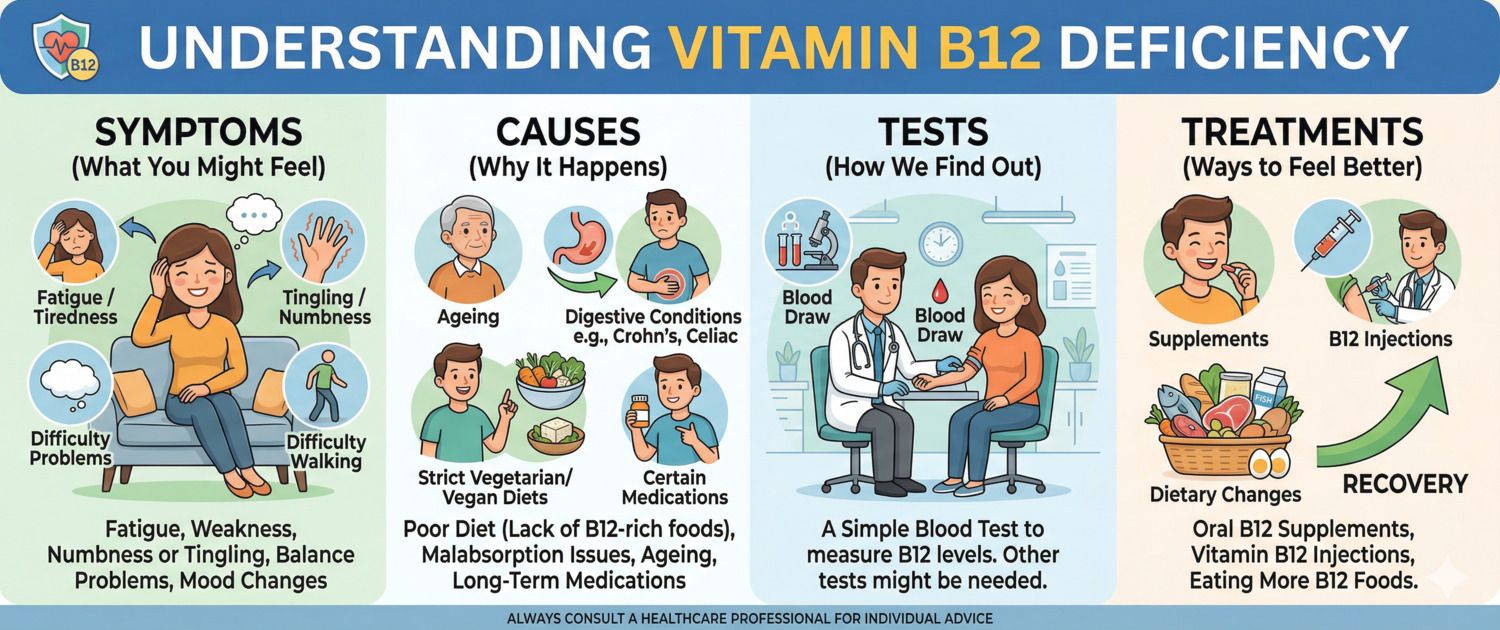
Pallor, exhaustion, tingling fingers, an unsteady gait — each of these can easily be attributed to stress, a sedentary job, or simply getting older. But when they appear together, one test is worth checking first: vitamin B12 in the blood. B12 deficiency is unique in that it attacks on two fronts simultaneously: it disrupts normal blood cell production and damages the nervous system. Neurological injury can progress even when anaemia is not yet present. Here is how this happens, who is at risk, and what to do about it.
What Is B12-Deficiency Anaemia and Why the Vitamin Matters
Vitamin B12 (cobalamin) is a water-soluble vitamin the body cannot synthesise on its own. It comes exclusively from animal-source foods: meat, fish, eggs and dairy. Liver stores are substantial — around 2–5 mg, enough for 3–5 years. This is precisely why deficiency develops slowly and goes undetected for a long time.
B12 is essential for two key biochemical reactions.
The first is DNA synthesis. Without B12, cells cannot divide normally. The first to suffer are the fastest-dividing cells — red blood cell precursors in the bone marrow. They grow but cannot split: the result is giant, immature cells called megaloblasts. Hence the name — megaloblastic anaemia.
The second is myelin maintenance. B12 participates in the synthesis of myelin — the fatty sheath that insulates nerve fibres. Without it, nerve impulse conduction deteriorates or fails entirely. Chronic deficiency leads to degeneration of the posterior and lateral columns of the spinal cord — a condition known as subacute combined degeneration (funicular myelosis).
This combination — anaemia plus neuropathy — makes B12 deficiency unique: it is the only vitamin deficiency in which neurological damage can progress with a completely normal blood count.
B12 Deficiency Neurological and Anaemia Symptoms
The symptom picture of B12 deficiency reflects two parallel processes — anaemia and nervous system injury. They may develop together or independently. The early neurological part looks mundane — slowed thinking, forgetfulness, a cotton-wool head — and it is exactly what gets mistaken for an attention deficit: see the walk-through of what steals your attention.
Haematological symptoms — a consequence of ineffective blood cell production:
- Pallor, sometimes with a faint yellow tinge (from breakdown of defective red cells)
- Weakness and rapid fatigue with minimal exertion
- Shortness of breath on ordinary walking
- Palpitations and dizziness
- Inflamed, smooth, red "glazed" tongue (Hunter's glossitis) — a near-pathognomonic sign seen in about 25% of patients
Neurological symptoms — a consequence of demyelination:
- Numbness and tingling beginning symmetrically at the fingertips and toes
- Unsteady gait, imbalance in the dark or with eyes closed
- Muscle weakness, especially in the legs
- Cognitive disturbances: poor concentration, memory lapses, slowed thinking
- In severe cases — spasticity and bladder or bowel dysfunction
One critical point: neurological symptoms can precede anaemia by months or years. If treatment begins late, some neurological damage is irreversible. This is the strongest argument for early diagnosis — do not wait for the haemoglobin to fall.
Causes of Vitamin B12 Deficiency: Pernicious Anaemia, Vegans and More
Deficiency develops through three main mechanisms: inadequate intake, impaired absorption, and increased demand.
| Cause | Mechanism | Who is at risk |
|---|---|---|
| Strict vegetarianism / veganism | B12 is found only in animal foods | Vegans not taking supplements |
| Pernicious anaemia (Addison-Biermer) | Autoimmune destruction of gastric cells producing intrinsic factor | Over 60, more common in women |
| Atrophic gastritis | Reduced stomach acid → impaired release of B12 from food proteins | Elderly, H. pylori carriers |
| Metformin use | Impairs B12 absorption in the ileum — dose-dependent effect | All type 2 diabetes patients on metformin |
| PPI use (omeprazole etc.) | Reduced gastric acid — same mechanism | Those taking PPIs for > 2 years |
| Gastric or ileal resection | Removal of the site of intrinsic factor production or absorption | After bariatric surgery |
| Crohn's disease, coeliac disease | Inflammation or atrophy of ileal mucosa | IBD patients |
| Fish tapeworm infection | Parasite competes for B12 in the gut | Endemic regions |
Metformin use deserves special mention: it is one of the most common and underappreciated causes of B12 deficiency. Clinical guidelines call for monitoring B12 in all patients on long-term metformin — yet in practice this is rarely done.
Macrocytic Anaemia Diagnosis: Which Blood Tests Are Needed
Vitamin B12 in blood — the primary test. A level below 148 pmol/L (200 pg/mL) indicates frank deficiency; 148–221 pmol/L is a "grey zone" requiring further assessment. Importantly: a normal B12 level does not completely exclude functional deficiency — some patients have symptoms with "normal" values. In equivocal cases, methylmalonic acid and homocysteine are measured additionally — they rise before B12 itself falls.
Complete blood count — key findings:
- MCV elevated (> 100 fL) — macrocytosis, enlarged red cells
- Haemoglobin reduced in established anaemia
- RDW elevated — anisocytosis, red cells of varying size
- Reticulocytes reduced — bone marrow production is failing
- Leukopaenia and thrombocytopaenia in severe deficiency (pancytopaenia)
- Blood film — hypersegmented neutrophils (5 or more nuclear lobes) — an early and specific sign
Folate — must always be measured simultaneously with B12. Folate deficiency produces an identical blood picture but does not cause neurological damage. Treatment differs — so distinguishing them before starting therapy is essential.
Additionally — when pernicious anaemia is suspected: anti-intrinsic factor antibodies (specificity ~95%) and anti-parietal cell antibodies.
Vitamin B12 Deficiency Treatment: Injections or Tablets
The choice of administration route is surrounded by more myths than almost any other aspect of B12 treatment.
Intramuscular injections of cyanocobalamin or hydroxocobalamin — the classical approach, mandatory when:
- Intestinal absorption is impaired (pernicious anaemia, atrophic gastritis, surgical resections)
- Severe anaemia with haemoglobin below 70–80 g/L
- Significant neurological deficits are present Loading schedule: 1000 µg daily or on alternate days for 1–2 weeks, then a maintenance dose once monthly for life (in pernicious anaemia).
High-dose oral B12 (1000–2000 µg/day) — a proven alternative when gut function is intact. About 1% of B12 is absorbed passively, without intrinsic factor — at high doses this is sufficient. Effective for dietary deficiency in vegans and for metformin-related deficiency.
Follow-up tests after starting treatment:
- At 7–10 days — reticulocyte crisis (a sharp rise in reticulocytes — the sign of treatment response)
- At 4–8 weeks — normalisation of MCV and haemoglobin
- Neurological symptoms regress more slowly — sometimes over months; when treatment begins late, partial irreversibility is possible
A critical warning: when both B12 and folate are deficient, starting treatment with folate alone can worsen neurological damage by "masking" the anaemia while nerve injury continues.
B12 Deficiency vs Folate Deficiency: How to Tell Them Apart
Both deficiencies cause macrocytic anaemia, and the blood count alone cannot distinguish them. The one defining difference is: folate deficiency does not cause neurological damage. This is an absolute rule and the primary clinical guide.
| Feature | B12 deficiency | Folate deficiency |
|---|---|---|
| MCV (macrocytosis) | ↑ | ↑ |
| Haemoglobin | ↓ | ↓ |
| Neuropathy, ataxia | Yes — frequently | No |
| B12 blood level | ↓ | Normal or mildly reduced |
| Folate level | May be secondarily low | ↓ |
| Methylmalonic acid | ↑ | Normal |
| Typical causes | Malabsorption, veganism, pernicious anaemia | Pregnancy, alcohol, coeliac disease, dietary deficit |
In practice, when macrocytic anaemia is found, both markers are always measured in a single blood draw — this takes one venepuncture and eliminates the risk of a treatment error.
When to See a Doctor Urgently
Most B12-deficiency cases are managed electively. However, several presentations call for rapid assessment:
- Progressive leg weakness or gait disturbance — possible subacute combined degeneration; delay increases the risk of irreversible cord damage
- Confusion or rapid cognitive decline in an older adult — B12 deficiency is one of the reversible causes of dementia
- Haemoglobin below 70 g/L with signs of heart failure — requires urgent correction
- Newly discovered macrocytosis (MCV > 110 fL) without explanation — warrants investigation without delay
Anyone who has followed a vegan or strict vegetarian diet for more than three years without taking B12 supplements should have their levels checked routinely — not waiting for symptoms. Liver stores last a long time, but when they run out the disease is already fully established.
This article is for informational purposes only. Diagnosis and treatment are the responsibility of a general practitioner or haematologist.
For informational purposes only
This article is for informational purposes only and does not constitute medical advice, diagnosis, or treatment. Please consult a healthcare professional for medical guidance.