Folate and MTHFR: Methylfolate for Anxiety, Depression and Mind
Reviewed by the LabReadAI medical team
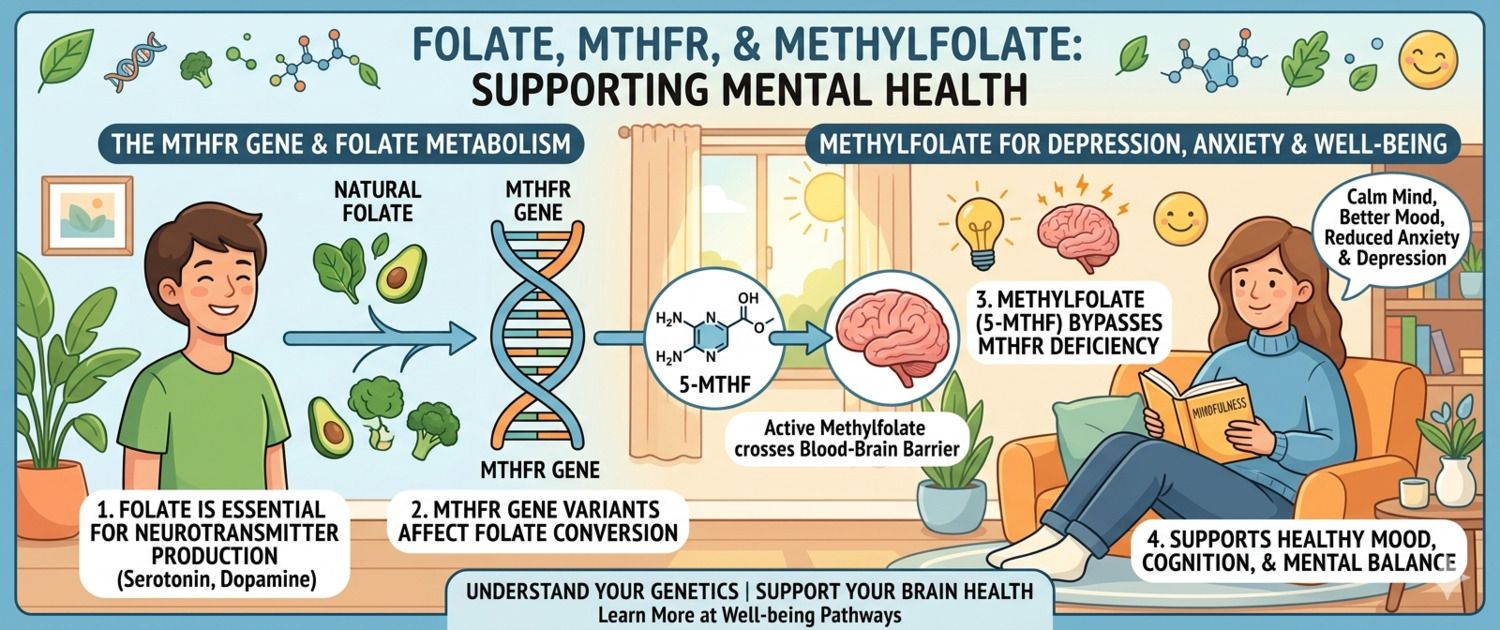
Folate (vitamin B9) is one of the most underappreciated nutrients in mental health. It is required for synthesis of all monoamines (serotonin, dopamine, noradrenaline) through production of the BH4 cofactor. But there's a nuance: in 30–40% of people the MTHFR gene mutation impairs the conversion of ordinary folic acid into the active form — methylfolate. For them, "taking folic acid" doesn't work; they need L-5-MTHF (methylfolate). Here's how this affects anxiety and depression.
Folate in Neurotransmitter Synthesis
Folate participates in several brain-critical processes:
- BH4 (tetrahydrobiopterin) synthesis — a cofactor for the enzymes converting tryptophan to serotonin and tyrosine to dopamine. Without BH4, neurotransmitters aren't synthesized.
- Methylation — the folate-dependent cycle converting homocysteine to methionine and on to SAM (S-adenosylmethionine), needed for melatonin, creatine, and cell membrane phospholipid synthesis.
- DNA and RNA synthesis — for normal cell division, including neurons.
Folate deficiency:
- Reduces serotonin and dopamine synthesis → depression and apathy
- Raises homocysteine → neuroinflammation
- Disrupts methylation → nervous system dysfunction
- Increases antidepressant resistance
For neurotransmitter biochemistry see neurotransmitters: serotonin, dopamine, GABA.
The MTHFR Mutation: What It Is and Why It Matters
MTHFR (methylenetetrahydrofolate reductase) is the key enzyme converting dietary folic acid to active methylfolate (5-methyltetrahydrofolate, L-5-MTHF). Only methylfolate crosses the blood-brain barrier and is used in the brain.
30–40% of the population have MTHFR mutations (C677T, A1298C):
- Heterozygous C677T (~40% of people) — enzyme activity reduced 30–40%
- Homozygous C677T (~10–15%) — activity reduced 60–70%
- Compound homozygous — rare but activity critically reduced
Consequences:
- Reduced folic acid to methylfolate conversion
- Elevated homocysteine (especially with B6, B12 deficiency)
- Reduced neurotransmitter synthesis
- Worse SSRI antidepressant response
- Increased risk of depression, anxiety, migraine
The MTHFR test is one-time, performed in specialized labs. It's meaningful for treatment-resistant depression, severe anxiety, and elevated homocysteine.
An alternative to testing: take methylfolate (L-5-MTHF) directly, which works in everyone, regardless of mutation. This simplifies the approach — testing is optional.
Methylfolate for Depression and Anxiety
SSRI augmentation with methylfolate 7.5–15 mg/day is one of the most studied strategies in treatment-resistant depression:
- Several placebo-controlled RCTs (Trivedi 2012, Papakostas 2012) showed 30–40% improved response when added to standard SSRIs
- Especially effective in patients with the MTHFR C677T variant
- Used as monotherapy in mild depression (evidence base is more modest)
- Safe, well tolerated, no serious side effects
For anxiety disorders the data is more limited, but with combined anxiety-depression methylfolate shows positive effect.
Dosing:
- Maintenance: 1–2 mg/day methylfolate
- Therapeutic (augmentation): 7.5–15 mg/day
- Prescribing and monitoring — with a psychiatrist
Which Tests to Take
Minimum block:
- Red-cell folate (not serum) — reflects 3–4 month stores, target > 700 nmol/L
- Vitamin B12 — folate cycle cofactor; B12 deficiency masks folate deficiency and vice versa
- Holotranscobalamin — active B12, more sensitive
- Homocysteine — integral methylation marker; target < 10 µmol/L
Extended block:
- Methylmalonic acid — specific B12 deficiency marker
- MTHFR genetic test — for treatment-resistant depression or elevated homocysteine
- Vitamin B6 (pyridoxal-5-phosphate, PLP) — folate cycle cofactor
- Vitamin D — parallel mental health support
Conveniently via the anxiety causes panel extended with MTHFR as indicated.
When to See a Doctor
To a psychiatrist for:
- Treatment-resistant depression (no SSRI response at 6–8 weeks)
- Elevated homocysteine + depressive symptoms
- Family history of MTHFR mutations and mental disorders
To a primary care doctor for:
- Confirmed red-cell folate deficiency
- High homocysteine without clear cause
- B12 + folate deficiency with clinical features
For details on antidepressant augmentation see antidepressants not working. For the homocysteine-mind link see homocysteine.
This article is for informational purposes only and does not replace professional medical advice. Methylfolate prescribing in mental disorders is the psychiatrist's domain.
For informational purposes only
This article is for informational purposes only and does not constitute medical advice, diagnosis, or treatment. Please consult a healthcare professional for medical guidance.