Neurotransmitters: Serotonin, Dopamine, GABA and Mood Balance
Reviewed by the LabReadAI medical team
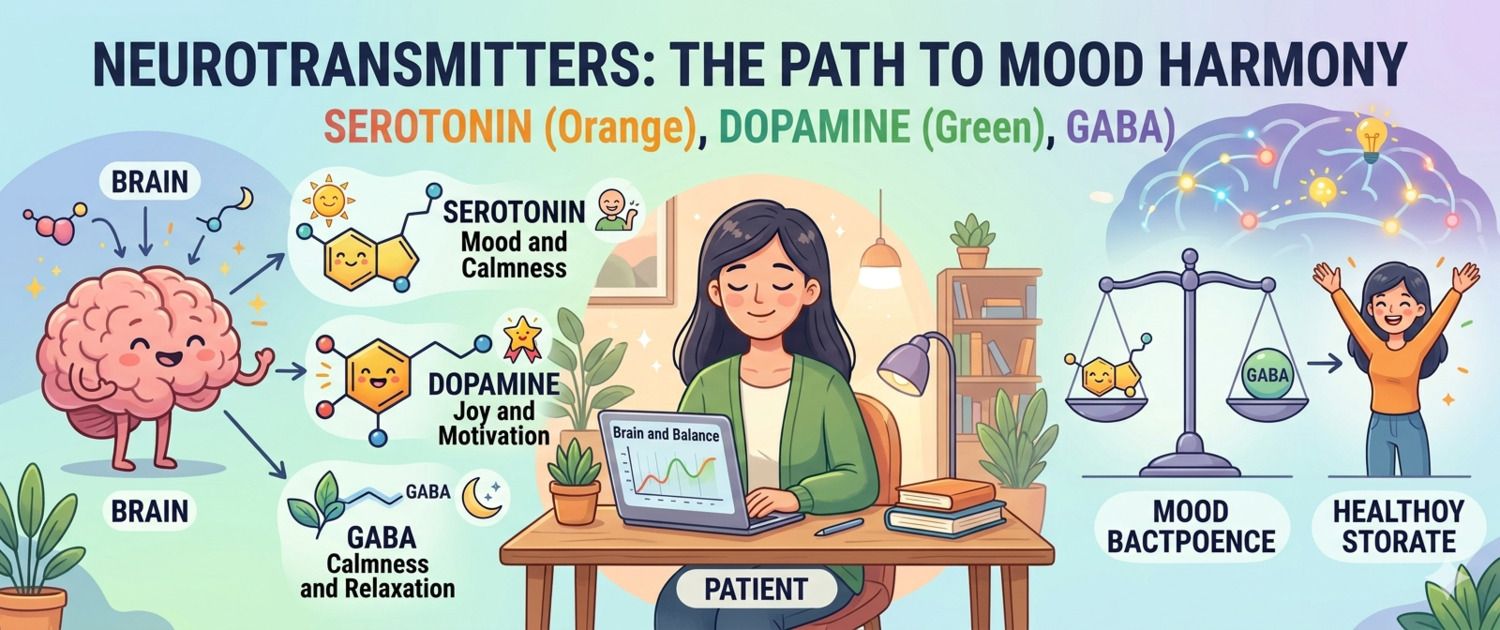
The idea that mood, motivation, and anxiety depend on "neurotransmitter levels in the brain" has long been a cliché. From it grew an industry of supplements promising to "boost serotonin," "restore dopamine," and "normalize GABA." The real biochemistry is more complex: brain neurotransmitters cannot be measured directly, and most blood tests say little about the central nervous system. So what can actually be done in the lab? And which neurotransmitter markers genuinely have clinical value?
What Neurotransmitters Are and Why Balance Matters
Neurotransmitters are chemicals that pass signals between neurons across synapses. The best-studied:
- Serotonin (5-HT) — mood, appetite, sleep, anxiety
- Dopamine — motivation, pleasure, focus
- GABA — the main inhibitory neurotransmitter; calming, anti-stress
- Noradrenaline — alertness, wakefulness, stress reactivity
- Glutamate — the main excitatory neurotransmitter
The "neurotransmitter balance" idea is simplified but workable: anxious depression, apathetic depression, panic disorder, ADHD, and chronic anxiety reflect different patterns of neurotransmitter imbalance and need different therapy. But the simple formula "low serotonin → depression" is a marketing oversimplification; real neurobiology is far more complex.
The main practical consequence: brain neurotransmitters cannot be measured externally. Blood gives only indirect signals. So with "neurotransmitter deficiency" it makes more sense to check cofactors and precursors than the neurotransmitters themselves.
Serotonin: Mood and Anxiety
Serotonin is the mood and autonomic-tone neurotransmitter. 95% of body serotonin is in the gut, ~3% in platelets, and only ~2% in the nervous system. Serotonin does not cross the blood-brain barrier — so the central pool is synthesized autonomously in the brain from tryptophan that does cross.
Symptoms of low serotonin:
- Low mood, apathy, anhedonia
- Anxiety, intrusive thoughts
- Sleep disturbance (via melatonin deficiency — serotonin is its precursor)
- Carbohydrate and sugar cravings
- Emotional lability, irritability
- Chronic migraines, GI complaints
Lab work: a blood serotonin test is uninformative — mostly reflecting gut synthesis. More useful are indirect markers — vitamin B6, magnesium, zinc, folate, and B12 (synthesis cofactors), and urinary 5-HIAA (metabolite). For more, see serotonin: what it is.
Dopamine: Motivation and Pleasure
Dopamine is the neurotransmitter of motivation and the reward system. Its deficiency manifests not as "sadness" but as "absence of wanting": a person can do things, but doesn't want to. This is exactly the state the internet calls a "dopamine pit" — what is true in that metaphor and what is invented is unpacked separately: the dopamine pit and dopamine fasting.
Symptoms of low dopamine:
- Reduced motivation, procrastination
- Anhedonia — inability to enjoy
- Reduced focus, "brain fog"
- Low drive at work and in personal life
- Cravings for stimulants (coffee, nicotine, sugar)
- Paradoxically — heightened anxiety through depleted drive
Lab work: blood dopamine is uninformative. Indirect markers — ferritin (iron is needed for dopamine synthesis from tyrosine), B6, folate. Low ferritin is one of the most common and missed causes of "dopaminergic" symptoms, especially in women.
Dopaminergic function is easily confused with thyroid — TSH is mandatory in parallel with apathy and low motivation.
GABA: The Brain's Inhibitory System
GABA (gamma-aminobutyric acid) is the main inhibitory neurotransmitter. If serotonin and dopamine form "the signal," GABA is the "silence" against which those signals are heard.
Symptoms of low GABAergic function:
- Anxiety, especially baseline
- Difficulty relaxing
- Light sleep, frequent awakenings
- Muscle hyperexcitability, tremor
- The sense of a "mind that won't switch off" in the evening
- Worsening symptoms after caffeine
Lab work: direct GABA testing is clinically uninformative. Indirectly — via magnesium (synthesis cofactor and receptor activator), B6, taurine, glycine. Magnesium deficiency is the most common and addressable aspect of "GABAergic dysfunction." Benzodiazepines and alcohol act on GABA receptors — so chronic use creates functional GABA deficiency with rebound anxiety on withdrawal.
Neurotransmitter Tests: What Actually Works
As noted, direct blood neurotransmitter tests have limited value. What is reasonable to check:
Direct tests (in specific situations):
- 24-hour urinary 5-HIAA — to exclude carcinoid syndrome with persistently elevated serotonin
- Urinary metanephrines and normetanephrines — for suspected pheochromocytoma
- Blood serotonin — limited information, mostly for suspected neuroendocrine tumors
Indirect markers (always meaningful):
- Ferritin — for dopamine and noradrenaline synthesis
- Vitamin B12 + folate — methylation cofactors and monoamine synthesis cofactors
- Vitamin B6 — decarboxylation cofactor (tryptophan → 5-HTP, tyrosine → dopamine)
- Vitamin D — regulates brain serotonin synthesis
- Red-cell magnesium — GABA receptor activator
- Homocysteine — reflects methylation status
Hormonal background:
- Cortisol morning and evening — hypercortisolism depletes all neurotransmitter systems
- TSH + free T4 — hypothyroidism mimics dopamine deficiency
- Sex hormones — estradiol and progesterone modulate the GABAergic system
Conveniently combined into a hormone panel and sleep disorders panel.
Synthesis Cofactors: Micronutrients
All four key neurotransmitters are synthesized through overlapping cofactors:
| Neurotransmitter | Precursor | Key cofactors |
|---|---|---|
| Serotonin | Tryptophan | B6, magnesium, zinc, vitamin D |
| Melatonin | Serotonin | B6, magnesium, zinc |
| Dopamine | Tyrosine | Iron/ferritin, B6, folate |
| Noradrenaline | Dopamine | Vitamin C, copper |
| GABA | Glutamate | B6, magnesium |
Deficiency of B6, B12, folate, iron, magnesium, and vitamin D is the common "biochemical basis" of symptoms that subjectively read as "neurotransmitter imbalance." Replacing these deficiencies is the first line of objective intervention; in most cases it delivers more benefit than supplementing the neurotransmitters themselves.
For detail on magnesium in sleep and anxiety, see magnesium for insomnia and anxiety. For the serotonin→melatonin link, see melatonin: what it is.
When to See a Specialist
Laboratory diagnostics of "neurotransmitters" is an auxiliary tool. Whom to see:
- A psychiatrist — for severe depression, anxiety, obsessive states, suicidal thoughts; decides on therapy (SSRIs, SNRIs, benzodiazepines)
- A psychotherapist — for moderate anxiety-depressive states and adjustment disorders
- An endocrinologist — for suspected hyperthyroidism, hypercortisolism, pheochromocytoma
- A primary care doctor — for correcting baseline nutrient deficiencies
- A sleep specialist — for severe sleep disturbance, apnea
Self-administered "neurotransmitter supplements" (5-HTP, tyrosine, GABA blends) without cofactor assessment and without clear goals more often create the illusion of action than solve the problem. For the full anxiety approach, see anxiety: which lab tests.
This article is for informational purposes only and does not replace professional medical advice. Significant neuropsychiatric symptoms require clinical evaluation.
For informational purposes only
This article is for informational purposes only and does not constitute medical advice, diagnosis, or treatment. Please consult a healthcare professional for medical guidance.