Rickets: Symptoms, Causes and Treatment in Children
Reviewed by the LabReadAI medical team
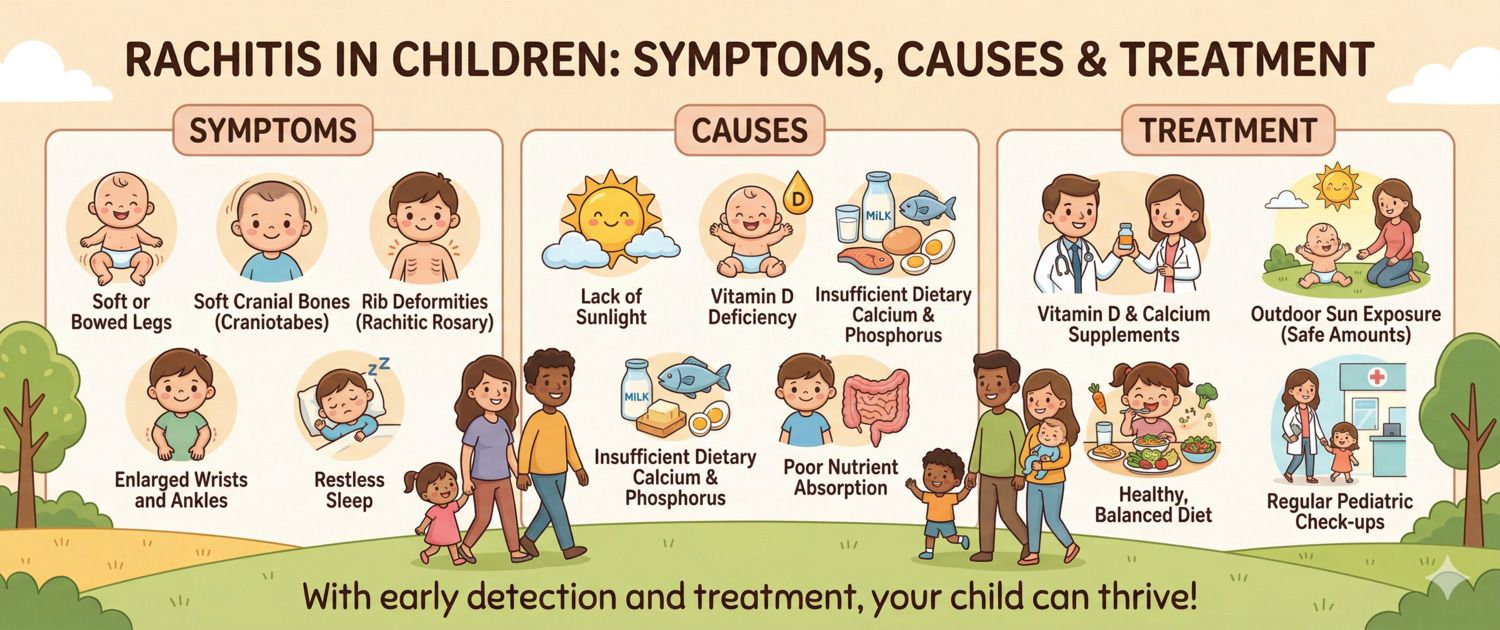
Rickets is a disease once considered defeated — but it is making a comeback. Against a backdrop of growing awareness about sun exposure harm, darker-skinned migrant children, and inadequate vitamin D supplementation, rickets cases are increasing again in developed countries. Understanding rickets matters for every parent: its early signs are easy to miss, and the skeletal consequences of late treatment are irreversible.
What Rickets Is and How Vitamin D Deficiency Causes It
Rickets is a disease of the growing skeleton in which mineralisation of cartilage and bone tissue in the growth zones is impaired. Bones remain soft and pliable instead of becoming hard — and deform under the weight of the body.
In most cases, the cause is vitamin D deficiency. Without sufficient active vitamin D (calcitriol), the intestine cannot absorb calcium from food adequately. In response, parathyroid hormone rises, "leaching" calcium from bones — but even this fails to maintain calcium and phosphorus within normal range. The growth zones of bones, which are especially active in children, fill with unmineralised osteoid — soft tissue instead of solid bone.
Rickets develops only in childhood — while the skeleton is growing. In adults, the same mechanism produces osteomalacia (softening of already formed bones), but without growth-related deformities.
Risk factors:
- Exclusive breastfeeding without vitamin D supplementation: breast milk contains only 50–80 IU/L — catastrophically insufficient
- Dark skin: melanin reduces UVB synthesis by 3–6 times
- Living at northern latitudes or a lifestyle with minimal sun exposure
- Prematurity: vitamin D and calcium stores accumulate in the final trimester
- Maternal vitamin D deficiency during pregnancy and breastfeeding
- Malabsorption syndromes
Rare forms of rickets unrelated to vitamin D deficiency:
- Hypophosphataemic rickets (vitamin D-resistant) — genetic defect in renal phosphate reabsorption
- Renal osteodystrophy in chronic kidney disease — impaired vitamin D activation
- Oncogenic osteomalacia
Symptoms of Rickets by Age
The clinical picture of rickets changes with the child's age — different growth zones are active at different times.
Early signs (2–6 months)
At this stage, bony changes are minimal, but the nervous system already responds to disturbed mineral metabolism:
- Increased irritability — tearfulness, restless sleep, startle response to sounds
- Head sweating — especially the occiput during feeding and sleep. The baby rubs its head against the pillow → occipital alopecia (one of the most recognised, though non-specific, signs)
- Craniotabes — softening of the occipital and parietal bones: gentle pressure produces a "parchment crackling" sensation. Appears at 3–6 months, then resolves spontaneously
- Delayed closure of the anterior fontanelle
Active disease (6–18 months)
Rapid skeletal growth combined with worsening deficiency produces pronounced changes:
Head:
- Frontal and parietal bossing — the skull takes on a "square head" shape (caput quadratum)
- Delayed tooth eruption, malocclusion
Chest:
- "Rachitic rosary" — bead-like enlargements at the costochondral junctions, palpable as a row of nodules along the ribs
- "Pigeon chest" (pectus carinatum) — forward protrusion of the sternum
- "Cobbler's chest" (pectus excavatum) — sternal depression
- "Harrison's sulcus" — horizontal groove along the lower chest margin
Spine: rachitic kyphosis ("rachitic hump"), less commonly scoliosis
Limbs:
- "Rachitic bracelets" — widening at the wrists and ankles
- "String of pearls" — phalangeal widening
- Genu varum (bow legs) — when walking begins
- Genu valgum (knock knees) — less common, in older children
Muscular hypotonia — "frog belly," delayed motor milestones: the child is slow to hold the head up, sit, or walk
Late manifestations and residual changes
With treatment, most changes are reversible. Permanent deformities can include pelvic narrowing (problematic for delivery in girls) and significant limb deformities when treatment is delayed.
Diagnosis of Rickets: Lab Tests and X-ray
Laboratory findings:
| Marker | In rickets | Normal in children |
|---|---|---|
| Vitamin D 25(OH)D | < 20, often < 10 ng/mL | 30–50 ng/mL |
| Calcium | Normal or reduced | 2.2–2.7 mmol/L |
| Phosphorus | Reduced — key finding | 1.3–2.1 mmol/L |
| Parathyroid hormone | Markedly elevated | 15–65 pg/mL |
| Alkaline phosphatase (ALP) | Sharply elevated | Up to 350 U/L in children |
Alkaline phosphatase in rickets reflects osteoblast activity as they attempt to mineralise bone — it is the primary marker of disease activity.
X-ray: Radiographic changes appear later than laboratory abnormalities. Characteristic findings: widening and "fraying" (cupping) of metaphyses, concave ends of long bones, delayed ossification of epiphyseal nuclei.
Treatment of Rickets: Vitamin D Dosage and Calcium
Treatment depends on the cause: vitamin D-deficiency rickets — correct the deficiency; genetic forms — specialist management with a geneticist and nephrologist.
Vitamin D-deficiency rickets (the main form):
- Therapeutic dose of vitamin D3: 2,000–4,000 IU/day for 3 months, then maintenance (400–1,000 IU/day) until age 2–3 years
- In severe deficiency — 5,000 IU/day under paediatric supervision with urine calcium monitoring
- Preparation: cholecalciferol (D3) drops — the standard of care
- Calcium: in cases of significant hypocalcaemia — calcium supplements (carbonate or citrate) for the first 2–4 weeks of treatment. When calcium is normal — dietary sources only
- Adequate nutrition: breast milk or formula with timely introduction of complementary foods
Monitoring treatment response:
- At 1 month: clinical assessment, ALP, phosphorus
- At 3 months: 25(OH)D, ALP, calcium, phosphorus, PTH
- ALP normalisation is the most reliable marker of restored mineralisation
Prognosis: When treatment begins before 18 months of age, most deformities resolve completely with growth. Deformities that develop after age 2 resolve more slowly — some require orthopaedic correction.
Prevention of Rickets
Prevention is a standard of paediatric practice:
- All breastfed infants from the first days of life: 400 IU of vitamin D3 per day — regardless of feeding type, until 12 months (some guidelines recommend until age 2)
- High-risk children (dark skin, prematurity, maternal deficiency): 800–1,000 IU/day
- Pregnant women: prevent vitamin D deficiency — target 25(OH)D ≥ 30–40 ng/mL during pregnancy
- Timely introduction of complementary foods with adequate calcium and phosphorus content
When to See a Doctor
- Visible bone deformities in a child of any age — paediatrician within the next few days
- Occipital hair loss + irritability in the first months of life — routine visit with vitamin D level check
- Delayed fontanelle closure after 18 months — investigation warranted
- A child on exclusive breastfeeding with no vitamin D supplementation — paediatric consultation immediately
Night sweating, traditionally linked with rickets, does not confirm the diagnosis by itself — see child sweating in sleep.
This article is for informational purposes only and does not replace consultation with a paediatrician or paediatric endocrinologist.
For informational purposes only
This article is for informational purposes only and does not constitute medical advice, diagnosis, or treatment. Please consult a healthcare professional for medical guidance.