Hyperparathyroidism: Symptoms, Causes, Diagnosis and Treatment
Reviewed by the LabReadAI medical team
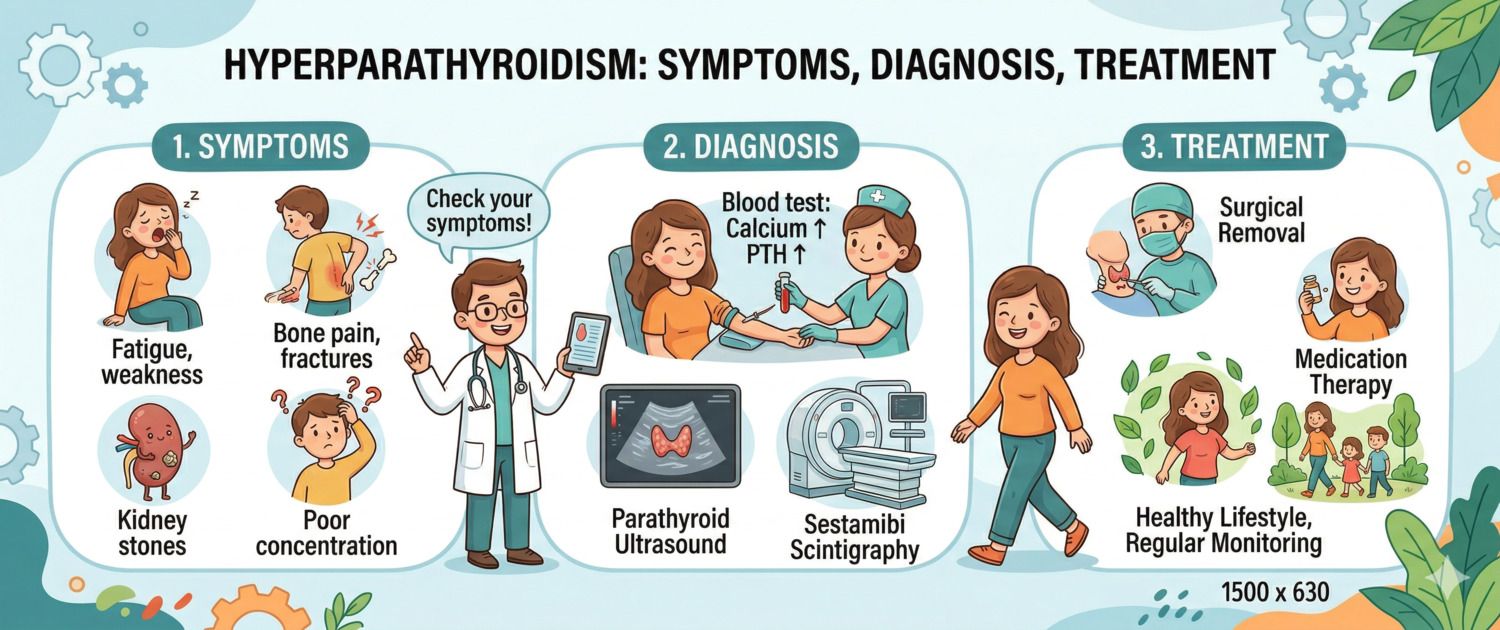
Bone pain, recurrent kidney stones, chronic fatigue and persistent thirst — four symptoms that may share one overlooked cause. Hyperparathyroidism — excess secretion of parathyroid hormone by the parathyroid glands — leaches calcium from bone, overloads the kidneys and disrupts the nervous system. Yet a third of patients have no symptoms at all and discover their diagnosis by chance when a blood test reveals elevated calcium.
What Is Hyperparathyroidism and How Does Parathyroid Hormone Work
The parathyroid glands — four small structures on the posterior surface of the thyroid — produce parathyroid hormone (PTH). Its job: to maintain blood calcium within a narrow range.
When calcium falls, PTH immediately activates three mechanisms: it mobilises calcium from bone (by stimulating osteoclasts), increases calcium reabsorption in the kidney tubules, and stimulates synthesis of active vitamin D, which enhances intestinal calcium absorption. Calcium rises — PTH falls. A textbook negative feedback loop.
In hyperparathyroidism this balance is broken: PTH is secreted in excess regardless of the calcium level. The consequences — chronically high blood calcium (hypercalcaemia), progressive destruction of bone tissue and renal overload.
Types of Hyperparathyroidism: Primary, Secondary and Tertiary
The distinction between forms is fundamental — it determines the entire treatment approach.
Primary hyperparathyroidism — the most common form. One or more parathyroid glands begin functioning autonomously, independent of calcium levels. In 80–85% of cases the cause is a single benign parathyroid adenoma. Less commonly — hyperplasia of all four glands (10–15%) or parathyroid carcinoma (< 1%). It affects 1 in 500–1000 adults, significantly more often in postmenopausal women.
Secondary hyperparathyroidism — a reactive rise in PTH in response to chronically low calcium. The parathyroid glands are working correctly — they are responding to genuine calcium deficiency. The most common cause is chronic kidney disease: failing kidneys cannot activate vitamin D, calcium falls, PTH rises compensatorily. Other causes: severe vitamin D deficiency, malabsorption syndromes.
Tertiary hyperparathyroidism — develops in patients with long-standing secondary hyperparathyroidism (most often after years of dialysis): the hyperplastic glands acquire autonomy and continue secreting excess PTH even after calcium is corrected, for example after kidney transplantation.
The key laboratory distinction: in primary hyperparathyroidism, PTH is elevated alongside high calcium. In secondary hyperparathyroidism, PTH is elevated alongside normal or low calcium. This difference makes simultaneously drawn PTH and calcium measurements the single most important diagnostic tool.
Symptoms of Hyperparathyroidism
The classic clinical mnemonic — "bones, stones, groans, and psychic moans" — describes the four systems damaged by prolonged PTH excess.
Asymptomatic form. Today approximately 50–80% of patients with primary hyperparathyroidism have no specific complaints. Diagnosis is made incidentally when hypercalcaemia is found on a biochemical panel.
Renal symptoms — the most common in symptomatic disease:
- recurrent kidney stones (nephrolithiasis) — in 15–20% of patients;
- nephrocalcinosis — calcium deposits within the renal parenchyma;
- polyuria and polydipsia — impaired renal concentrating ability from excess calcium.
Skeletal symptoms:
- diffuse bone pain, particularly in the back, ribs and joints;
- osteoporosis — reduced bone mineral density, elevated fracture risk;
- in severe cases — osteitis fibrosa cystica (rarely seen today with early diagnosis).
Gastrointestinal symptoms (groans): nausea, poor appetite, constipation, abdominal pain. Elevated calcium stimulates gastrin secretion, which may lead to peptic ulcer disease. Recurrent pancreatitis is an important if uncommon association.
Neuropsychiatric symptoms (psychic moans): chronic fatigue, muscle weakness, depression, impaired concentration, irritability. Cognitive complaints frequently persist for years before diagnosis and improve substantially after treatment.
Cardiovascular manifestations: hypertension, shortening of the QT interval on ECG, accelerated valve calcification.
Diagnosis: Which Tests Confirm Hyperparathyroidism
Diagnosis proceeds in two stages: confirming hyperparathyroidism and identifying its cause.
Core laboratory tests:
- Calcium and PTH simultaneously — the key pair. Elevated PTH with elevated calcium is virtually sufficient to diagnose primary hyperparathyroidism. Ionised calcium is more accurate than total calcium, especially when albumin is altered.
- Serum phosphorus — low or at the lower end of normal in primary hyperparathyroidism: PTH drives renal phosphorus excretion.
- Vitamin D (25-OH) — deficiency can mask hypercalcaemia in primary hyperparathyroidism and is the cause of secondary disease.
- Kidney function test — assessment of estimated GFR: chronic hypercalcaemia damages the kidneys; reduced filtration can itself cause secondary hyperparathyroidism.
- 24-hour urinary calcium — essential to distinguish primary hyperparathyroidism from familial hypocalciuric hypercalcaemia (FHH): in FHH calcium is not excreted in urine, whereas in primary hyperparathyroidism urinary calcium is actively elevated.
Imaging to localise the source:
- Neck ultrasound — identifies a parathyroid adenoma in 70–80% of cases with an experienced examiner.
- Technetium-99m sestamibi scintigraphy — the gold standard for pre-operative adenoma localisation.
- 4D-CT or MRI — when ultrasound and scintigraphy are inconclusive.
All patients with confirmed primary hyperparathyroidism also undergo bone densitometry (DXA) and renal ultrasound to assess existing end-organ damage.
Treatment of Hyperparathyroidism
Surgery — the only curative treatment for primary hyperparathyroidism. Parathyroidectomy (removal of the adenoma or hyperplastic glands) normalises calcium and PTH in 95–98% of patients when performed by an experienced parathyroid surgeon.
Indications for surgery in primary hyperparathyroidism:
- calcium > 0.25 mmol/L above the upper limit of normal;
- estimated GFR < 60 mL/min/1.73 m²;
- DXA T-score < –2.5 at any site;
- nephrolithiasis or nephrocalcinosis;
- age < 50 years (surgery is recommended even in "mild" disease in young patients).
In asymptomatic elderly patients who do not meet surgical criteria, watchful waiting is an option: calcium and PTH every 6–12 months, annual densitometry, annual renal ultrasound.
Medical treatment for primary hyperparathyroidism:
- Cinacalcet (calcimimetic) — lowers PTH and calcium without affecting bone density; used when surgery is not possible, in parathyroid carcinoma or patient refusal.
- Bisphosphonates — to protect bone density when surgery cannot be performed.
- Adequate fluid intake (2–2.5 litres/day) — mandatory for kidney stone prevention.
Treatment of secondary hyperparathyroidism addresses the underlying cause: correcting vitamin D deficiency, normalising dietary phosphorus intake and using phosphate binders in chronic kidney disease. Cinacalcet or paricalcitol are used in decompensated secondary disease.
Complications of Untreated Hyperparathyroidism
Years of excess PTH accumulate damage across several organs simultaneously.
The skeleton bears the greatest burden: cortical bone (forearm radius, femoral neck) loses density faster than trabecular bone. Pathological fractures from minimal trauma are a characteristic complication of severe primary hyperparathyroidism.
The kidneys suffer in two ways: nephrolithiasis with recurrent colic, and nephrocalcinosis with progressive functional decline. Some nephrocalcinosis is irreversible even after the hyperparathyroidism is cured.
The cardiovascular system: chronically elevated calcium accelerates coronary artery and valve calcification. The risk of cardiovascular events in primary hyperparathyroidism is higher than in the general population, though the magnitude of this excess risk in mild asymptomatic disease continues to be studied.
Neuropsychiatric impairment: in some patients depression, fatigue and cognitive symptoms are not fully reversible after surgery — particularly after years of uncorrected disease.
When to See a Doctor
See an endocrinologist when any of the following are found:
- calcium above normal on two consecutive tests, especially combined with elevated PTH;
- recurrent kidney stones without another obvious cause;
- osteoporosis in a premenopausal woman or a man under 60;
- chronic fatigue and muscle weakness combined with thirst and frequent urination;
- incidental finding of a mass in the neck region on ultrasound.
For urgent management of hypercalcaemic crisis (calcium > 3.5 mmol/L with neurological symptoms or cardiac arrhythmia), see the hypercalcaemia article. Do not interpret blood tests independently — treatment is guided by an endocrinologist or parathyroid surgeon.
This content is for informational purposes only and does not replace professional medical advice.
For informational purposes only
This article is for informational purposes only and does not constitute medical advice, diagnosis, or treatment. Please consult a healthcare professional for medical guidance.