High Cholesterol: What to Do, How to Lower It and Statins
Reviewed by the LabReadAI medical team
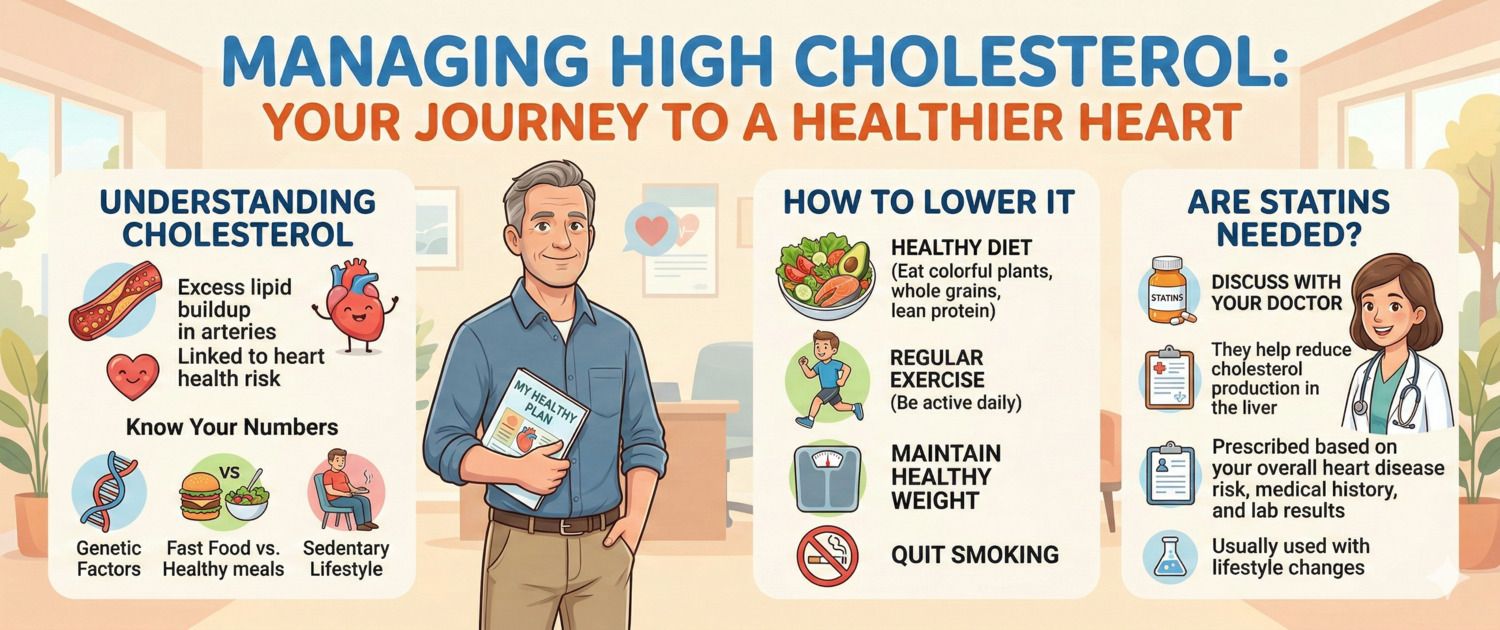
Your blood test comes back — cholesterol is high. Your doctor says it needs to come down; you search online for "how to lower cholesterol fast" and find hundreds of tips, half of which contradict the other half. Here is a clear-eyed look at the facts: what high cholesterol actually means, when it is genuinely dangerous, when diet and exercise are enough, and when statins are the right call.
Why Cholesterol Rises and Why It Matters
Cholesterol is not a poison. It is an essential building material: cell membranes are assembled from it, and the body uses it to synthesise sex hormones, cortisol, and vitamin D. The problem is not cholesterol itself, but excess quantities and which form predominates in the blood.
The liver produces about 80% of the body's cholesterol; the remaining 20% comes from food. When there is too much cholesterol in circulation, the surplus begins accumulating in arterial walls, forming atherosclerotic plaques. Plaques narrow the vessel, reduce blood flow, and can rupture — triggering clot formation. This mechanism underlies most myocardial infarctions and ischaemic strokes. The full progression of this damage is described in the article on atherosclerosis.
Causes of elevated cholesterol fall into non-modifiable and modifiable categories. Non-modifiable: familial hypercholesterolaemia (a genetic defect in LDL receptors), age (cholesterol rises with years), and male sex (men under 50–55 tend to have higher levels). Modifiable: excess weight and obesity, low physical activity, diets high in saturated and trans fats, smoking, heavy alcohol use, type 2 diabetes, hypothyroidism, and chronic kidney disease.
Elevated cholesterol produces no symptoms — it is a silent threat. A person can carry a high cholesterol level for years and feel completely healthy, until the first manifestation turns out to be a heart attack.
How to Read a Lipid Panel: LDL, HDL and Triglycerides
Total cholesterol is just a single sum that says little about actual cardiovascular risk. Clinical decisions require a full lipid panel — it breaks cholesterol into its fractions and gives a far more accurate picture.
LDL (low-density lipoprotein) — "bad" cholesterol. LDL carries cholesterol from the liver into tissues and deposits it in arterial walls. The higher the LDL, the higher the risk of atherosclerosis. It is the primary treatment target: each 1 mmol/L reduction in LDL cuts the risk of heart attack by approximately 22%.
HDL (high-density lipoprotein) — "good" cholesterol. HDL works in reverse: it collects cholesterol from tissues and delivers it back to the liver for processing. High HDL is protective. Low HDL (< 1.0 mmol/L in men, < 1.2 mmol/L in women) is an independent cardiovascular risk factor even when total cholesterol is normal.
Triglycerides are neutral fats circulating in the blood. They rise after meals, in obesity, with heavy alcohol use, and in diabetes. Levels above 5.6 mmol/L sharply raise the risk of acute pancreatitis. Moderate elevation (1.7–5.6 mmol/L) is an additional cardiovascular risk factor.
The atherogenicity index = (total cholesterol − HDL) / HDL. Normal is below 3.0. Values above 4–5 are associated with substantially increased risk of atherosclerotic disease.
Cholesterol Targets by Cardiovascular Risk Category
Target LDL values are not based on a single universal "normal" — they depend on the patient's individual cardiovascular risk. The higher the risk, the tighter the target.
| Risk Category | LDL Target | Typical Patients |
|---|---|---|
| Very high | < 1.4 mmol/L | Prior heart attack or stroke, diabetes with organ damage |
| High | < 1.8 mmol/L | Diabetes without complications, severe CKD, 10-yr CV risk > 10% |
| Moderate | < 2.6 mmol/L | Moderate risk factors, 10-yr CV risk 1–10% |
| Low | < 3.0 mmol/L | No significant risk factors |
Total cholesterol: optimal < 5.0 mmol/L; in high-risk patients < 4.0 mmol/L. HDL: men ≥ 1.0 mmol/L, women ≥ 1.2 mmol/L. Triglycerides: < 1.7 mmol/L optimal; 1.7–5.6 mmol/L elevated; > 5.6 mmol/L critically high.
The practical rule: if your LDL is above the target for your risk category, that is a reason to discuss strategy with your doctor — regardless of whether you have symptoms.
Diet for High Cholesterol: What to Eat and What to Cut
A well-designed diet lowers LDL by an average of 10–20%. For most people this is not enough to reach target values alone, but dietary change is a mandatory foundation of any strategy, with or without medication.
The main enemy — saturated and trans fats. Saturated fats (fatty meat, butter, coconut oil, high-fat cheese, palm oil) stimulate LDL production in the liver. Trans fats (margarine, industrial baked goods, fried fast food) both raise LDL and lower HDL — a double blow to the cardiovascular system. Replacing saturated fats with unsaturated fats reduces LDL by 8–10% on average.
What genuinely lowers cholesterol. Soluble fibre — oat bran, legumes, apples, citrus, barley — binds cholesterol in the gut and removes it with faeces. 5–10 g of soluble fibre daily reduces LDL by 5–7%. Omega-3 fatty acids from oily fish (salmon, sardines, mackerel) primarily lower triglycerides — by 20–30% at 2–3 servings per week. Plant sterols and stanols (fortified margarines, functional yoghurts) block intestinal cholesterol absorption — daily use lowers LDL by 7–12%.
In fatty liver disease, which frequently accompanies hypercholesterolaemia, restricting simple carbohydrates and alcohol is particularly important: they drive hepatic triglyceride synthesis and further raise LDL through a VLDL-mediated mechanism.
Practical menu: the foundation should be vegetables, legumes, whole grains, fish, lean poultry, and olive oil. Limit red meat to 1–2 times per week; choose low-fat dairy products. Eliminate trans fats, industrial baked goods, and fast food.
Physical Activity, Weight Loss and Lifestyle
Exercise has a more modest direct effect on cholesterol than diet — LDL falls 5–8% — but its effect on HDL is valuable: it rises by 5–10%. Raising "good" cholesterol pharmacologically is considerably harder than lowering "bad" cholesterol, making exercise a uniquely effective tool for HDL improvement.
Recommended minimum: 150 minutes of moderate aerobic activity per week (brisk walking, cycling, swimming) or 75 minutes of vigorous activity. Consistency is what counts: occasional intense sessions do not work; daily or regularly alternating activity does.
Weight loss in overweight patients is one of the most powerful levers available. Every 5 kg lost reduces LDL by approximately 0.2 mmol/L and raises HDL by 0.1 mmol/L. In metabolic syndrome — the combination of abdominal obesity, high triglycerides, low HDL, and elevated blood pressure — weight correction can sometimes normalise the entire lipid profile without medication.
Smoking lowers HDL and oxidises LDL, making it more atherogenic. Quitting within a year raises HDL by 5–10% and substantially reduces overall cardiovascular risk — independently of cholesterol levels.
Managing blood pressure in arterial hypertension is critical in the overall picture: elevated pressure damages the arterial endothelium, making it vulnerable to LDL deposition even at moderate LDL concentrations.
Statins and Other Medications: When Are They Needed
Diet and exercise are the first step. But if LDL has not reached its target after 3–6 months, or the risk is already high, or LDL is very elevated to begin with — medications are required.
Statins (atorvastatin, rosuvastatin, pitavastatin) are the cornerstone of drug therapy. They inhibit the enzyme HMG-CoA reductase in the liver, reducing cholesterol synthesis. LDL falls 30–55% depending on the drug and dose. Taken once daily in the evening (the liver synthesises cholesterol primarily at night). Safety is well established: myopathy occurs in less than 1% of patients; serious rhabdomyolysis in 1 per 10 000. The myth that statins "damage the liver" is not supported by evidence: clinically significant elevation of liver enzymes at correctly titrated doses occurs in fewer than 1% of patients.
Statin effectiveness is monitored via total cholesterol and the full lipid panel: first check at 4–6 weeks after starting therapy, then every 3–6 months until stable, then annually.
Ezetimibe is the second agent added when statin response is insufficient or high statin doses are not tolerated. It blocks intestinal cholesterol absorption and lowers LDL by an additional 15–20% on top of statin therapy.
PCSK9 inhibitors (alirocumab, evolocumab) are injectable biologics. They lower LDL by 50–60% on top of maximum-dose statin therapy. Prescribed for very high-risk patients, familial hypercholesterolaemia, or statin intolerance.
Fibrates are used primarily for elevated triglycerides: they lower triglycerides by 30–50% and modestly raise HDL. Their effect on LDL is weaker than statins.
When to See a Doctor Urgently
Call emergency services immediately if, in the context of known high cholesterol, you develop:
- Chest pain or pressure radiating to the left arm, jaw, or back — classic signs of acute coronary syndrome.
- Sudden weakness on one side of the body, facial asymmetry, speech or vision disturbance — signs of stroke; every minute of delay destroys roughly two million neurons.
- Abdominal pain after eating combined with very high triglycerides (> 10 mmol/L) — risk of acute pancreatitis.
- Xanthomas — firm yellowish nodules under the skin at tendons, eyelids, or palms — a sign of familial hypercholesterolaemia with years of cholesterol deposition in tissues.
See your doctor on a planned basis if: LDL exceeds 4.9 mmol/L — the threshold for familial hypercholesterolaemia; cholesterol is elevated in a child or young adult under 30 without obesity; or after 3–6 months of diet and exercise, LDL has not reached the target value — medication is needed.
This article is for informational purposes only and does not replace medical consultation. Result interpretation and diagnosis are made by a qualified physician.
For informational purposes only
This article is for informational purposes only and does not constitute medical advice, diagnosis, or treatment. Please consult a healthcare professional for medical guidance.