Angina Pectoris: Symptoms, Causes, Diagnosis and Treatment
Reviewed by the LabReadAI medical team
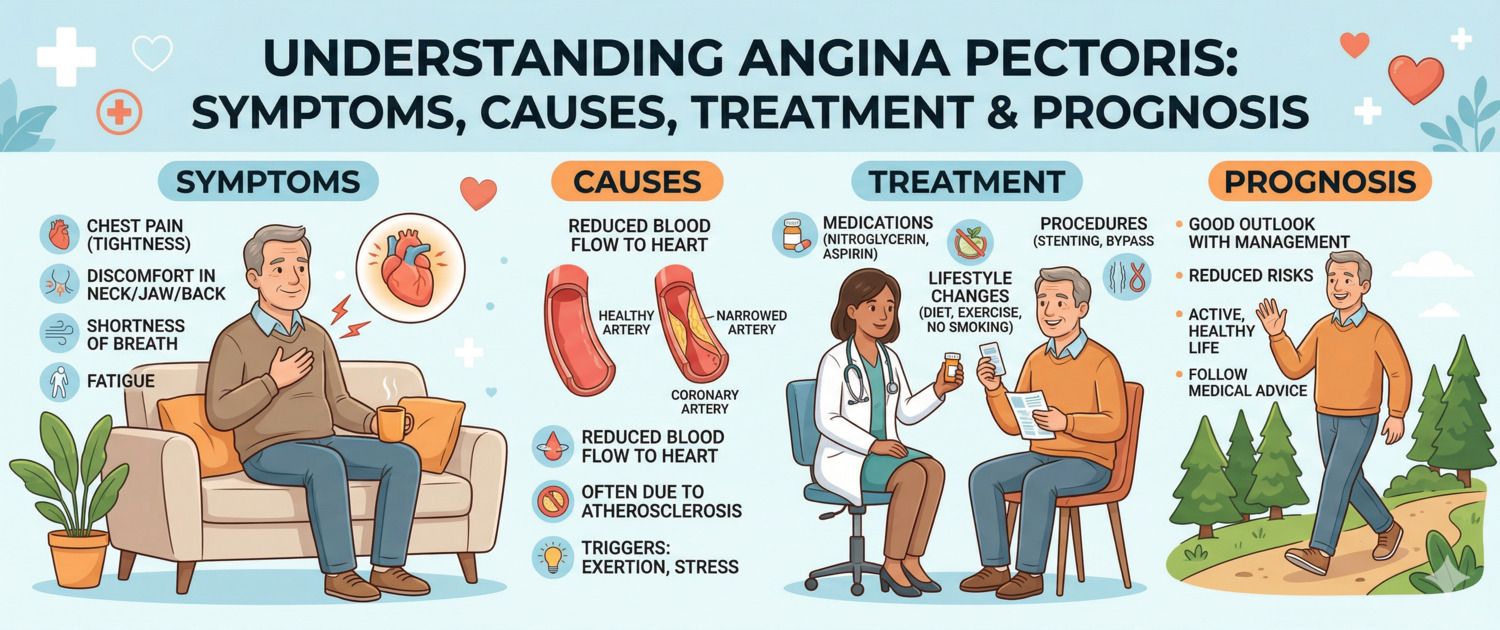
A pressing sensation behind the sternum when climbing stairs. Tightness in the chest walking fast in cold air. Discomfort that fades within a few minutes of rest — but returns again. This is classic angina: manageable, predictable, and at the same time a serious form of coronary artery disease. It does not kill instantly — but without correct treatment it leads steadily towards heart attack. This article covers what happens in the heart during angina, how it is diagnosed, and how it is treated.
What Is Angina and Why Does It Develop
Angina (from the Latin angina pectoris — "chest tightness") is a clinical syndrome caused by temporary myocardial ischaemia: the heart muscle receives less blood — and therefore less oxygen — than it needs at that moment. Crucially, this is not cellular death as in infarction — it is "starvation" of the cells, which ends when blood supply is restored.
The primary cause of angina is atherosclerosis of the coronary arteries. Cholesterol plaques narrow the vessel lumen. At rest, the narrowed artery can still deliver enough blood. Under exertion, myocardial oxygen demand rises sharply — but the narrowed vessel cannot proportionally increase flow. A mismatch develops: demand exceeds available supply. The myocardium signals this imbalance through pain.
Atherosclerosis is not the only cause. Coronary artery spasm (Prinzmetal's variant angina) produces ischaemia without plaques — through abrupt smooth muscle contraction. Severe anaemia, myocardial hypertrophy in arterial hypertension, and aortic stenosis can also cause angina with anatomically normal coronary arteries.
Risk factors mirror those for any atherosclerotic disease: male sex, age, smoking, high LDL, low HDL, diabetes, hypertension, and a family history of early coronary artery disease. The combination of several risk factors does not add — it multiplies risk.
Symptoms of Angina: Recognising an Attack
The classic angina attack carries several defining features, knowledge of which helps distinguish it from other causes of chest pain.
Pressure or squeezing in character. Patients describe it as: "an elephant sitting on my chest," "a metal band tightening around the ribcage," "a heavy weight behind the sternum." The pain is rarely sharp or stabbing — more often dull, diffuse, and non-localised.
Clear relation to exertion. An attack is triggered by physical effort (walking, climbing stairs, carrying loads), emotional stress, cold air, or a large meal. It disappears within 3–5 minutes after stopping the trigger.
Radiation. Pain frequently radiates to the left shoulder, arm (particularly along its inner surface to the little finger), neck, lower jaw, or epigastrium. Radiation to the right side is possible but atypical.
Brief duration. A typical attack lasts 1–15 minutes. Pain lasting more than 20 minutes is unstable angina or infarction and requires immediate hospitalisation.
Rapid response to nitroglycerine. A sublingual tablet or spray relieves the attack within 2–5 minutes. If pain persists 15–20 minutes after the second dose — call emergency services.
Atypical presentation — a special problem in women, older adults, and diabetic patients. Instead of pain: breathlessness, fatigue, nausea, back pain, or jaw discomfort. These "masks" of angina frequently lead to delayed diagnosis and worse outcomes.
Types of Angina: Stable and Unstable
The distinction between stable and unstable angina is a critical clinical decision that determines the entire management approach.
Stable exertional angina — attacks are reproducible: the same level of exertion produces the same symptom. The patient knows their threshold: "I can walk 200 metres on flat ground, but climbing one flight of stairs brings on the pain." Classified by functional class (FC I–IV, CCS scale): from "pain only with extreme exertion" to "pain at rest."
Unstable angina — a warning requiring hospitalisation. Criteria for instability: new-onset angina (within the past two months); crescendo angina (attacks are more frequent, triggered by less effort, or last longer); and rest angina (pain without exertion). Unstable angina is a pre-infarction state: the risk of myocardial infarction within the next few weeks is 10–20%.
Prinzmetal's variant angina — coronary artery spasm, most often occurring at night or in the early morning hours. Pain can be intense and prolonged. ECG during the attack shows characteristic ST-segment elevation.
Diagnosis of Angina: Tests and Investigations
Diagnosis of angina combines clinical assessment, resting and stress ECG, and non-invasive imaging. Blood tests are used to assess risk and exclude other causes of pain.
Troponin — the first-priority test in any chest pain syndrome. Normal troponin in stable angina: the myocardium experienced ischaemia but cells did not die. Elevated troponin indicates transition to acute coronary syndrome or infarction.
CK-MB — a supplementary marker of myocardial necrosis. Normal in stable angina. Elevation indicates that injury has already occurred.
Total cholesterol, LDL, HDL, and triglycerides from a lipid panel — a mandatory component of assessment for atherosclerotic risk stratification and statin therapy titration. The LDL target in angina is below 1.4 mmol/L (very high cardiovascular risk category).
Resting ECG — often normal in angina patients between attacks. Stress ECG (bicycle ergometry, treadmill test) reproduces ischaemia: ST-segment depression on exercise is the classic sign of myocardial ischaemia.
Stress echocardiography and myocardial perfusion scintigraphy are more sensitive methods for detecting regional wall motion abnormalities during ischaemia.
Coronary angiography is the gold standard for precisely locating and quantifying atherosclerotic stenoses. Performed when revascularisation (stenting or bypass surgery) is being planned.
Treatment of Angina: Medications and Procedures
The goals of treatment are to relieve symptoms, prevent infarction, and improve prognosis. These are three distinct objectives addressed by different methods.
Relieving an attack. Sublingual nitroglycerine is the standard. It dilates coronary arteries and reduces preload on the heart. Onset within 2–3 minutes. If two doses five minutes apart produce no effect — call emergency services.
Antiplatelet agents (aspirin, clopidogrel) — prevent thrombus formation on the surface of an atherosclerotic plaque. They reduce the risk of infarction and cardiovascular death in coronary artery disease. Aspirin 75–100 mg/day — lifelong in all patients with confirmed coronary artery disease.
Beta-blockers (metoprolol, bisoprolol) — reduce heart rate and myocardial oxygen demand. First-line anti-anginal therapy for stable angina.
Statins — mandatory in any form of angina. They lower LDL to the target level (< 1.4 mmol/L), stabilise atherosclerotic plaques, and reduce the risk of plaque rupture. In metabolic syndrome, controlling all its components — blood pressure, blood sugar, weight — is part of angina management.
Long-acting nitrates (isosorbide mononitrate) — prophylaxis against attacks in FC II–III. Taken with a nitrate-free interval (8–12 hours per day) to prevent tolerance.
Revascularisation — stenting or CABG — indicated for unstable angina, high functional class stable angina, and haemodynamically significant stenoses (> 70%) on angiography. Stenting restores vessel patency immediately; coronary artery bypass grafting (CABG) creates alternative routes of blood supply to the myocardium.
Angina and Heart Attack: the Fundamental Difference
The key distinction: in angina, ischaemia is temporary and reversible. In myocardial infarction, an area of heart muscle dies irreversibly because of complete arterial occlusion.
The practical three-minute rule: pain that resolves within 3–5 minutes of stopping exertion or 2–3 minutes after nitroglycerine — probable angina. Pain lasting 20 or more minutes, unresponsive to two doses of nitroglycerine and worsening — treat as infarction and call emergency services immediately.
Unstable angina occupies a dangerous intermediate position: the artery is not yet completely blocked, but the plaque is unstable and can rupture to form an occlusive thrombus at any moment. It requires the same emergency response as infarction.
When to Call Emergency Services or See a Doctor Urgently
Call emergency services immediately if:
- An attack lasts more than 20 minutes and is not relieved by two doses of nitroglycerine at 5–10-minute intervals.
- Angina occurs at rest — without any physical or emotional trigger.
- The frequency or intensity of attacks has been increasing over recent days or weeks — signs of disease destabilisation.
- Chest pain of this type appears for the first time in your life — even if it resolved: urgent evaluation by a cardiologist is mandatory.
- An attack is accompanied by loss of consciousness, severe breathlessness, or a sharp fall in blood pressure.
- A known angina patient experiences an attack that behaves differently from the usual pattern.
See a cardiologist on a planned basis: when angina is poorly controlled by medication; when functional class is rising (attacks provoked by progressively less exertion); or when coronary angiography is being considered to evaluate revascularisation options.
In children tonsillitis often enlarges cervical nodes — when that is normal is covered in enlarged lymph nodes in children.
This article is for informational purposes only and does not replace medical consultation. For symptoms consistent with angina — always consult a cardiologist.
For informational purposes only
This article is for informational purposes only and does not constitute medical advice, diagnosis, or treatment. Please consult a healthcare professional for medical guidance.